
Hull Repair
Yacht Gelcoat Repair: Scratches, Cracks and Colour Matching
Anyone with a fibreglass boat will one day meet a scratch, chip or crack in the gelcoat. Small damage can be repaired at home; but without correct diagnosis, preparation and colour matching the repair either stays visible or comes back.
Short answer
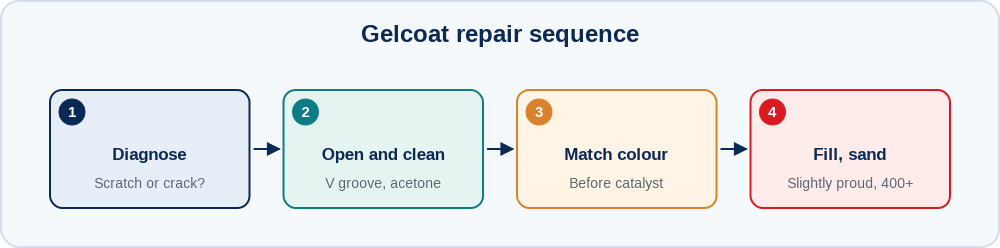
To repair small gelcoat scratches use gelcoat paste; the resin is too thin and the paste too thick to simply paint on. The steps: diagnose the damage, open the scratch or crack into a V or U groove and clean it, match the colour before adding catalyst, fill the paste slightly proud of the surroundings and sand with 400 grit and finer then polish. The hardest part is colour matching; even professionals find a perfect match difficult. Filling a structural crack without addressing its cause brings it back within a season or two. This article is general information; the product data sheet and, if needed, a repair specialist come first.
Key points
- For scratches use gelcoat paste, not resin.
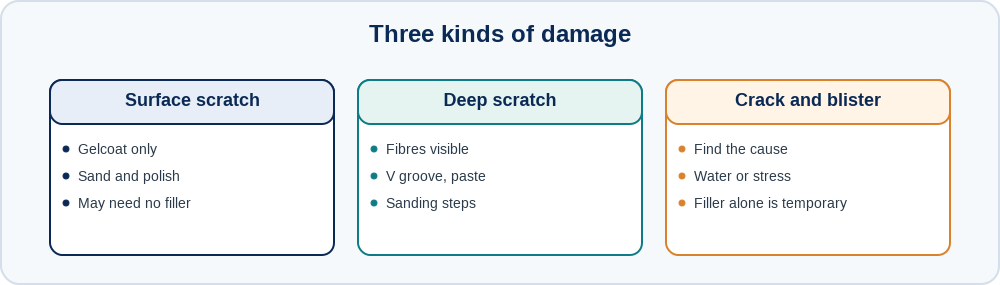
- Diagnosis comes first: a scratch is cosmetic, blisters and star cracks can indicate trapped water or stress.
- If a crack is not opened the gelcoat will not key in; open a V or U groove and clean with acetone or alcohol.
- Unlike paint, gelcoat stays the same colour wet and cured; match colour before the catalyst.
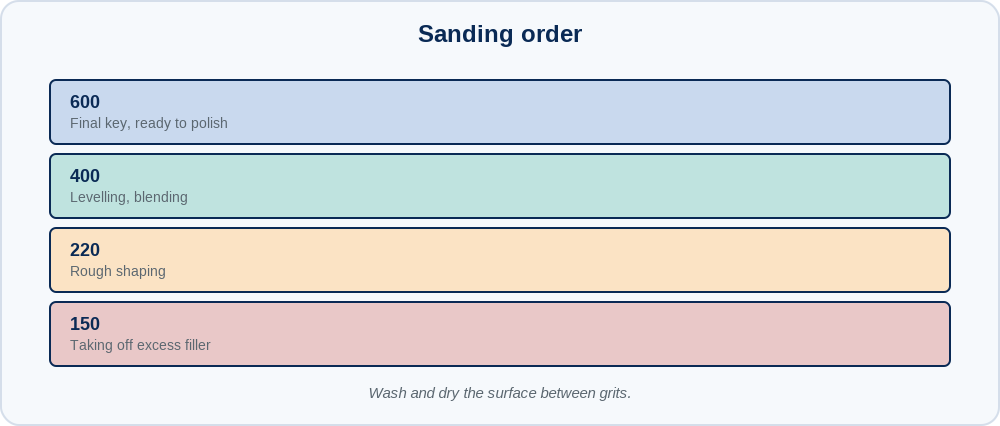
- The repair is made slightly proud, levelled with 150–220–400–600 grit and polished.
1. Diagnose first: scratch, deep scratch, crack#
Gelcoat is the visible, coloured, thin resin layer of a fibreglass boat; beneath it lies the structural fibre laminate. A marine assistance body says a scratch is cosmetic whereas a blister or star crack can hint at water trapped beneath the skin; untreated moisture blisters can balloon and undermine laminate strength. So understand the type of damage before starting repair preparation.
A repair specialist explains that if a scratch is deep enough to show fibre strands the damage has reached the core. If it is superficial and affects only the gelcoat, sanding and polishing may suffice; if it is deeper, filler is needed; if fibre shows or there is a hole, gelcoat repair is not enough and structural fibreglass repair is needed. One source says particularly deep holes could require structural fibreglass repair or a more solid filler before gelcoat repair can be done, and that in such cases it is best to consult a boat repair expert.
2. Materials: resin or paste?#
According to one source gelcoat is available both as a resin and in a thicker form called paste, and for scratch repair you want paste. The same source advises never trying to repair a scratch by simply painting over it with gelcoat: gelcoat resin is too thin to fill a scratch and gelcoat paste is too thick to brush on. On horizontal surfaces a liquid gelcoat solution may be enough; on vertical surfaces the paste consistency prevents running.
For sanding, wet-or-dry sheets of 150, 220, 400 and 600 grit are suggested; a single sheet of each is more than ample to fair all the paste in a repair kit. You will also need catalyst (hardener), colour pigments, acetone or alcohol, masking tape, a plastic spreader and PVA or wax paper to keep air off the cure. Ready repair kits include most of these for small damage.
Automotive urethanes are thin and too flexible; they crack on a hull that flexes under load. Marine gelcoat matches the chemistry of the factory skin and can be sanded flush. So gelcoat is preferred to a random car paint; but if you choose paint, marine alkyd or polyurethane topside enamels are also available.
3. Preparation: V groove, cleaning, masking#
Before repairing a scratch, shape it into a V; then wash the area with soap and water, rinse and let it dry completely. A retailer guide says that if you do not open up the crack you cannot force the gelcoat into the repair area or expose enough surface for it to adhere; a miniature grinding tool (like a Dremel) is ideal and the sharp point of a can opener will work too. Another source describes grinding the length of a crack down to the glass with a die grinder to create a V- or U-shaped groove, cleaning with alcohol and filling with polyester, vinylester or filler.
A boating magazine suggests carefully masking around the repair with two-inch-wide painter’s tape, leaving about a sixteenth of an inch of unmasked margin around the scratch. Another guide lists tidying the damage with a blade, cleaning with acetone and masking the surround. These steps make the edges of the repair clean and straight.
4. Colour matching: the hard half of the job#
One source says the hardest part of a repair to the surface of a fibreglass boat is matching the colour and that even professionals who do gelcoat repairs daily have difficulty getting a perfect match. The mechanical part is easy; colour needs trial and error. A retailer guide says that on a white boat the task stays moderate because colour matching is comparatively forgiving, while on a dark boat the added difficulty comes almost entirely from colour matching; trials can spread over a day or two of cure time between batches.
Unlike paint, gelcoat remains the same colour when wet and after curing, so you can match the colour before adding the catalyst. For a current boat the dealer or builder may be able to supply the original gelcoat colour. On older boats the gelcoat has faded; one source notes that even after only a few years gelcoat can fade and it may be necessary to tint the colour from the can for a better match. Mixing a small amount of clear gelcoat with pigments in a calibrated beaker makes the match repeatable.
- Test a small quantity first; write down counts and ratios.
- Check the colour in daylight and in a hidden spot.
- Add the catalyst after matching the colour.
- For white, ready kits are often enough; reds and blues may need custom matching.
- If the match will not hold, consult a specialist or the builder.
5. Filling, curing and sanding#
Mix the paste with catalyst and fill the scratch to stand slightly proud of the surroundings; smooth with a spreader and cover with PVA or wax paper, which keeps air from the cure. An application guide asks for the gelcoat to sit slightly higher than the surroundings. A boating magazine says the surface of the cured paste will be uneven, so sanding and polishing are required to smooth the repair and blend it with the rest of the hull.
Sand in stages: once the repair has cured slightly proud, sand with 400 grit until flush with the surroundings; if needed start at 150–220 and move to 400 and 600. Wash and dry the surface between grits. Finally, after wet 600, finish with a cutting compound and polish, then protect with wax or sealer.
6. Common mistakes#
- Filling over an unopened crack.
- Closing a structural crack without finding the cause.
- Trying to match colour after the catalyst.
- Trying to fill a scratch with resin.
- Sanding with one coarse grit and jumping to polish.
- Applying paste to a dusty or greasy surface.
7. A short case: the same scratch, two approaches#
Two boats have a scratch of the same depth. The first owner leaves the scratch dirty and oily and brushes liquid gelcoat on; a season later the repair cracks and the colour difference is obvious. The second owner opens the scratch to a V, cleans it with acetone, matches the colour with a small test, fills the paste slightly proud and sands with 220-400-600 and polishes. The second approach takes longer; but the repair is more likely to be invisible and lasting.
8. Checklist#
9. Conclusion#
The mechanical part of gelcoat repair is easy; the real difficulty is correct diagnosis, careful preparation and colour matching. Use paste for scratches, open and clean the crack, match colour before the catalyst, fill slightly proud and sand in stages then polish. For structural or moisture-related damage remove the cause first. This guide is a general framework; the product data sheet and, if needed, a repair specialist come first.
Frequently asked questions#
Can a gelcoat scratch be covered with paint?
No. Simply “painting” a scratch with gelcoat does not work; the resin is too thin to fill a scratch. Paste is used for scratches.
Why is colour matching hard?
Gelcoat ages and fades; according to one source even after a few years the colour may need tinting from the can. On dark colours trial and error can take a day or two.
Why must a crack be opened?
If the crack is not opened the gelcoat cannot go in and there is not enough surface to bond. A small grinding tool or a sharp point is used.
What happens if a structural crack is filled?
A structural crack filled without addressing its cause often returns, according to one source, worse, within one to two seasons.
When should I leave the repair to a specialist?
If the damage has gone into the laminate, if there is a hole, if delamination or water absorption is suspected or if you want a perfect match on a dark colour.
Was this guide helpful?
Thank you! Your feedback has been saved.
Guide content is for general information; in practice, the current technical data sheet of the product applies.
Keep reading
Related guides
Causes and Diagnosis of Paint Blistering
A study of the sources, types and diagnostic approach to blistering on boat paints.
2 min read Paint and CoatingsBoat Colour Selection and Solar Reflectance: Effect of Heat Absorption on Surfaces
A study of the effect of boat paint colour on solar reflectance and surface temperature.
2 min read Paint and CoatingsNumber of Coats in Epoxy Coating Systems
A study of the effect of the number of coats in epoxy coating systems on protective performance and thickness.
2 min read