
Paint and Coatings
Steel Boat Painting: System Setup and Coat Plan
On a steel boat paint is the main defence against rust. This article summarises how source accounts think of surface preparation, primer and coats as a system; it is not a product, coat-count or time recommendation.
Short answer
For a steel hull Fisheries Supply (seller) describes an anti-corrosive epoxy or specified metal primer, listing surface profile, corrosion protection and coating-system compatibility as selection priorities. A FAO document explains that steel corrodes much faster with oxygen, water and salt. A NACE account of ship coating systems describes an inorganic zinc primer followed by epoxy coats for harsh zones and regular inspection and repair of the boot-topping area. Cruising World writes that steel ship designers see rust as a reality and that there is low rust tolerance on light plate. This article is general information; product, coat count and time vary by maker.
Key points
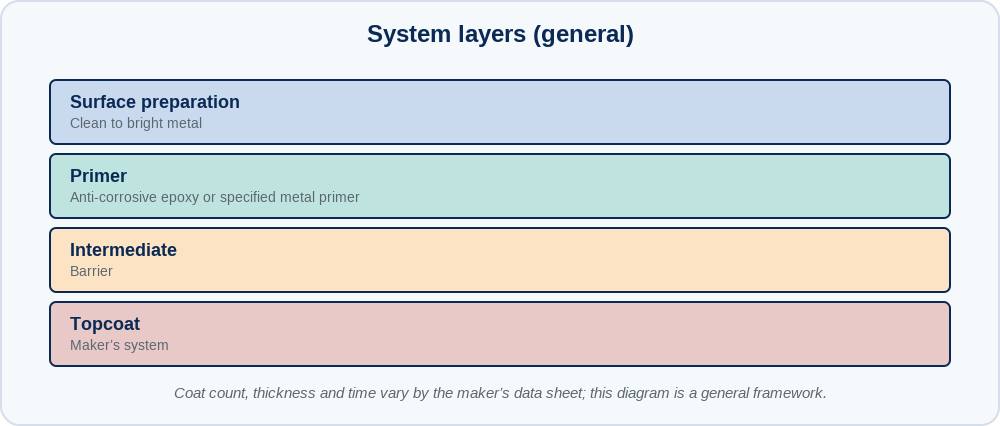
- A steel hull paint system consists of surface preparation, primer, intermediate coats and a final system; the maker’s data sheet governs (Fisheries Supply, seller).
- Steel rusts much faster with oxygen, water and salt (FAO).
- For harsh zones an inorganic zinc primer and epoxy coats are described; boot-topping upkeep matters (NACE).
- Tolerance for rust on light plate is low; touch-up matters (Cruising World).
- For product, coat count and time the maker and a qualified yard govern.
1. Why is paint on a steel boat a system?#
On a steel hull paint is the barrier separating the metal from oxygen, water and salt. A FAO document explains that steel rusts when exposed to oxygen or air and corrodes much faster when water (rain or moist air) and salt (sea spray) are also present. This article is a general summary; it gives no product, coat count, thickness or waiting time and is not application advice. Some sources are seller, maker or forum accounts and are labelled as such.
Cruising World writes that steel ship designers see rust as a reality while steel yacht designers must often assume the vessel will not rust at all, and that on steel sailboats built of light plate there is no tolerance for rust on decks and cabin houses. This shows how important the paint system and touch-up care are. The same source says a steel boat is anything but maintenance-free but with attention and touch-up work a steel cruising boat can be kept in her prime for decades.
2. Surface preparation and primer#
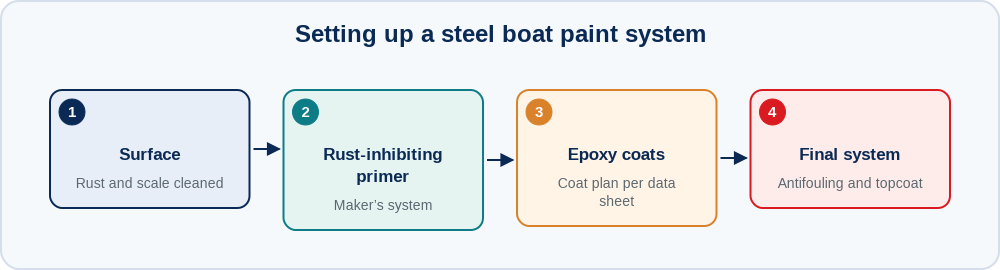
Cruising World writes that during fabrication mild steel plate and framing stock develop surface scale and rust that must be removed to protect the steel from further oxidation. Fisheries Supply (seller) describes an anti-corrosive epoxy or specified metal primer for a steel hull or component and lists surface profile, corrosion protection and coating-system compatibility as selection priorities. A safe-boating site describes steel hull maintenance as removing rust by sanding, chipping, scraping, grinding or blasting to shining metal and then moving on to painting; the same site mentions a phosphoric-acid-based rust converter. That is the source’s general account and may not hold for every system.
Pettit (maker) describes in an application guide immediately applying a rust-inhibiting steel primer to bare steel, waiting until it is dry to the touch and then applying coats of its epoxy primer; the number of coats and times are in that product’s guide and are not repeated here. A forum user relays that a Canadian builder of 65-95 foot steel motor yachts said rust prevention matters especially on the crucial first coat; that is a user account.
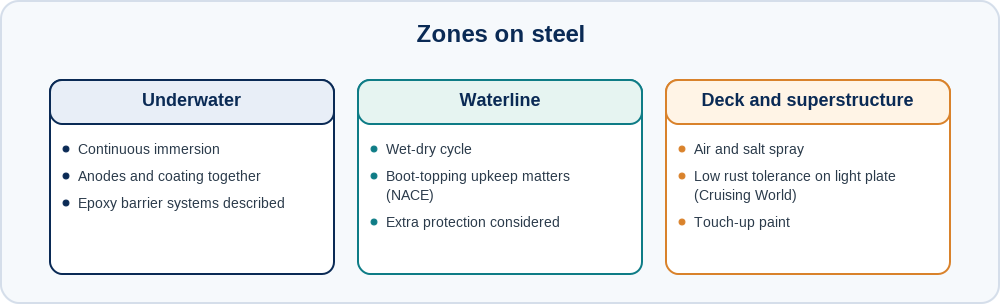
| Zone | Sources’ general account | Caution |
|---|---|---|
| Underwater | Continuous immersion; epoxy barrier systems described (seller) | Anodes and coating together |
| Waterline | Wet-dry cycle; boot-topping upkeep matters (NACE) | Extra protection considered |
| Deck and superstructure | Air and salt spray; low rust tolerance on light plate (Cruising World) | Touch-up paint |
3. Thinking by zone#
A NACE account of ship coating says different areas face different conditions and that for harsh conditions an inorganic zinc primer followed by two coats of epoxy performs well; it also stresses regular inspection and repair of the boot-topping area. That is an account in a ship context; for yachts the system is set by the maker’s recommendation and this article recommends no coat count. We have prepared a separate article on the role of zinc primer.
For the underwater area sources describe epoxy barrier systems and considering anodes and coating together; for antifouling and compatibility see the related articles. The maker’s system determines compatibility of each layer; mixing products from different makers carries a risk of incompatibility.
4. A practical frame#
- Assess the condition of the steel and the extent of rust.
- Find out the system the maker recommends for steel.
- Clear rust and scale from the surface by the maker’s method.
- Apply the primer within the window in the maker’s data sheet.
- Apply epoxy and intermediate coats per the coat plan (data sheet).
- Discuss extra protection for underwater and waterline with the maker.
- Keep records and a schedule for touch-up repair.
5. Limits#
Sources agree steel needs a system and that surface preparation matters; differences appear in system detail. A maker describes a specific rust-inhibiting primer and epoxy process, a seller says generally anti-corrosive epoxy and NACE describes an inorganic zinc primer in a ship context. So a coat plan cannot be reduced to one template; the maker’s data sheet and a qualified yard govern. This article is not application or engineering advice.
5b. Where sources differ#
Fisheries Supply (seller) says “anti-corrosive epoxy or specified metal primer”; Pettit (maker) describes a rust-inhibiting steel primer followed by epoxy primer coats; NACE (ship context) describes an inorganic zinc primer and epoxy coats. These sources speak in different contexts and with different interests: a seller describes the general frame, a maker its own process, a professional body ship practice. The difference means looking at the maker’s full system recommendation for a yacht.
This article summarises the sources’ general accounts; it may not hold for a particular boat. For product, coat count and time the maker’s data sheet and a qualified yard govern.
5c. A practical frame for reading the sources#
The sources are a magazine, sellers, a maker, a professional body and a forum; each writes in its own context. None knows your boat’s plate thickness, existing coating or berthing conditions. So taking the shared message, that paint on steel is a system and that surface preparation and touch-up care matter, and consulting the maker for detail, is reasonable.
If the type of the existing coating is unknown, applying a new system over it carries a risk of incompatibility. This article proposes no test or method for that; consult the maker and a qualified yard on compatibility. Sanding and blasting steel create dust and noise, and some coatings may need special health and safety precautions. Read the product’s safety information sheet and consult a qualified yard.
Finally, paint alone is not the solution; the anode system, drainage, ventilation and interior care should be considered together. If you see blistering or rust bleeding consult a specialist. Recording decisions and keeping the maker’s instruction helps later maintenance.
In addition, seller and maker statements are the firm’s own account of its product and have not been independently verified. A product’s compatibility with another paint should always be checked in the product’s technical document; where a document and a guide conflict, the maker’s document and a qualified yard’s assessment should be used.
6. Common mistakes#
- Cutting surface preparation short.
- Mixing products without checking the maker’s system.
- Missing the primer’s window.
- Not inspecting the waterline and boot-topping area.
- Postponing touch-up repair.
- Not considering anodes and coating together.
- Keeping no records.
7. Checklist#
8. Conclusion#
Painting a steel boat is a system job: surface preparation, primer, epoxy coats and the final system are considered together; sources emphasise surface preparation, protection by zone and touch-up care. This article is general information; it gives no product, coat count or time, and the maker’s data sheet and a qualified yard govern.
Frequently asked questions#
What makes up a steel boat paint system?
Sources describe surface preparation, an anti-corrosive epoxy or specified metal primer, intermediate coats and a final system (Fisheries Supply, NACE). Detail is in the maker’s data sheet.
How many coats?
This article gives no coat count; the count and thickness vary by product and are stated in the maker’s data sheet.
Why does steel rust fast?
A FAO document writes that steel rusts when exposed to oxygen or air and corrodes much faster when water and salt are also present.
Is extra protection needed at the waterline?
A NACE account of ship coating says additional protection may be warranted there and that an inorganic zinc primer followed by epoxy coats performs well, with boot-topping regularly inspected and repaired. That is in a ship context; ask the maker for a yacht.
What if rust appears?
Cruising World writes about the importance of touch-up repair in fighting rust; see the steel yacht rust articles for detail.
Was this guide helpful?
Thank you! Your feedback has been saved.
Guide content is for general information; in practice, the current technical data sheet of the product applies.
Keep reading
Related guides
Boat Colour Selection and Solar Reflectance: Effect of Heat Absorption on Surfaces
A study of the effect of boat paint colour on solar reflectance and surface temperature.
2 min read Paint and CoatingsCauses and Diagnosis of Paint Blistering
A study of the sources, types and diagnostic approach to blistering on boat paints.
2 min read Paint and CoatingsNumber of Coats in Epoxy Coating Systems
A study of the effect of the number of coats in epoxy coating systems on protective performance and thickness.
2 min read