
Paint and Coatings
Hull Cleaning Robots and Diver Cleaning
Cleaning a hull while the boat is afloat can save a trip to the yard, but the wrong method abrades paint and can create a cloud harmful to the environment. This article summarises methods, robots and limits using general sources.
Short answer
Done properly, in-water hull cleaning removes growth and a minimal amount of antifouling paint; done too vigorously, or on scrubbed ablative paint, it creates a plume of paint (Maryland DNR). The same source advises divers to clean gently, use the least abrasive material, avoid hull cleaning for at least 60 days after hard antifouling is applied and, on ablative-painted boats, clean only running gear and zinc anodes. According to a New Zealand biosecurity study, in-water cleaning of a biocidal system was found acceptable when growth consisted of slime and soft taxa. Robots are developing at ship scale; independent evidence at boat scale is limited and most claims come from makers. This article is general information; it recommends no method or product, so see local rules and the paint data sheet.
Key points
- Properly done in-water cleaning removes growth and little paint; done harshly it makes a plume (Maryland DNR).
- On ablative-painted boats only running gear and anodes are cleaned; wait at least 60 days after hard paint (Maryland DNR).
- On biocidal systems in-water cleaning was found acceptable for slime and soft growth (New Zealand MPI); aggressive cleaning of hard growth is problematic.
- Methods such as cavitation jets can erode ablative paint if applied too close or for too long (source summary).
- Robots are developing at ship scale; independent evidence at boat scale is limited and maker claims should be kept separate.
1. Why is in-water hull cleaning contentious?#
Having a hull cleaned while the boat stays afloat saves time and can reduce the number of haul-outs; but method, paint type and environmental rules must be considered together. Maryland DNR’s clean boating information sheet says that done properly underwater hull cleaning removes marine growth and a minimal amount of antifouling paint, while when done too vigorously or when ablative paint is scrubbed a plume of paint forms in the water. This article is a general summary; it recommends no method, product or service and is not legal advice.
In New Zealand’s biosecurity work the categories of in-water cleaning are listed as brush- or abrasive-pad-based, contactless mechanical systems, high-pressure water jet, cavitational water jet, heat and ultrasonic treatment and shrouding technologies. That broad range shows there is no single right method and each has different effects on paint and environment.
2. Diver and hand cleaning#
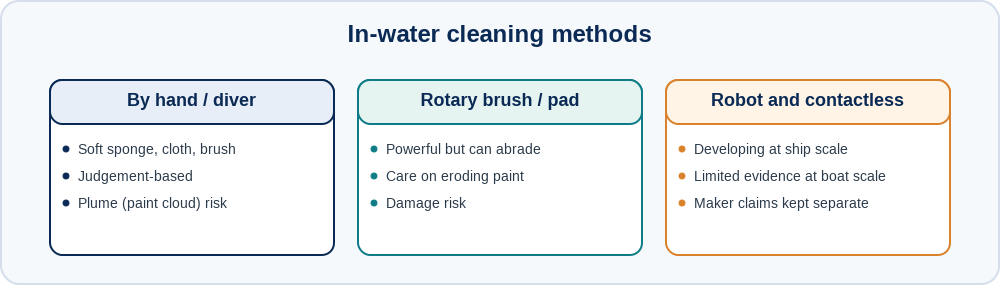
Maryland DNR lists best practices for divers: clean gently to avoid creating a plume of paint in the water; on boats with ablative paint clean only running gear and zinc anodes; refrain from hull cleaning for a minimum of 60 days after hard antifouling paint has been applied; and always use the least abrasive material that will effectively clean the painted surface, choosing tools such as soft sponges. The same source adds that questions such as whether the hull will be hauled annually affect paint choice and that if underwater hull cleaning is anticipated ablative paint should not be used. These are a state agency’s general guidance; for your own product and region the data sheet and local rules govern.
A cruising guide on The Boat Galley describes removing soft growth and slime from the hull with a soft brush, noting that it takes some paint off and leaves a little cloud in the water but is a lot better than the scrubby pads many professional divers use (a single user’s view). The same guide says to cover as much skin as possible, otherwise barnacles on uncleaned areas will cut you. In PBO the owner of a boat with Coppercoat writes that he has to get in the water every four to eight weeks to give the hull a scrub or wipe and that frequency depends on the water. These are user accounts, not method recommendations.
| Method | Sources’ general observation | Caution |
|---|---|---|
| Soft sponge / cloth | Gentle on slime and soft growth | Insufficient on hard growth |
| Rotary brush / pad | Powerful but can abrade paint | Care on eroding paint |
| Cavitation jet | Can clean without damaging sound paint | Can erode ablative paint if applied too close or too long |
| Robot | Developing at ship scale | Independent evidence at boat scale limited |
3. Paint type and type of growth#
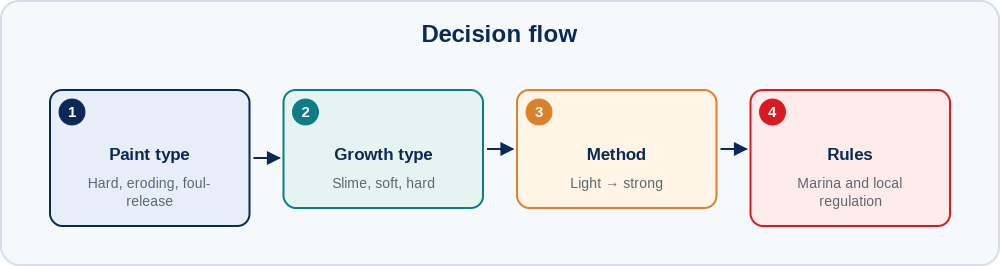
The New Zealand Ministry for Primary Industries in-water cleaning study assesses whether a system contains biocide, whether growth is slime, soft or hard, the cleaning method (soft cloth, hand removal, brush), the number of vessels cleaned per day and whether waste-capture technology is used. According to the study the significant factors leading to unacceptable copper concentrations in ports and marinas included the area of vessel being cleaned, the number of vessels cleaned per day, the technique used and the rate of flushing. For biocidal systems in-water cleaning was found acceptable when the fouling consists of slime and soft taxa, though with limits on the number of vessels cleaned. This is a regional risk assessment and not a rule for any particular marina.
On foul-release coatings a soft brush or sponge is advised and stiff brushes destroy the silicone (see the foul-release article). On ablative paint brushing wears the paint away; on hard paint early cleaning (the waiting period) is not advised. So paint type and type of growth are the first two inputs in method choice.
4. Robots: ship scale and boat scale#
At ship scale robots are developing. Jotun’s HullSkater, as described by CNN, is a 200-kilogram magnetic crawling robot that removes the early stages of fouling with a brush and is operated remotely from Norway over 4G. Hullbot, described in Cosmos magazine, says it can clean vessels up to 60 metres including yachts, ferries and light ships; the article also floats a future in which a hard gelcoat or epoxy is cleaned daily by robot without antifouling coating. These are maker and company accounts; independent comparative evidence at leisure-boat scale is limited.
A review of ship hull “grooming” (frequent light cleaning) in Frontiers notes that requirements for the cleaning method differ between biocide-based and biocide-free fouling-release coatings and that most ships spend 40-60 percent of their time pier-side, which leaves them vulnerable to fouling. That is a ship study. A WPI student report prepared for the US Coast Guard also examines the market for hull cleaning robots; it cannot be transferred directly to boat scale. That a method works on a ship does not mean it will give the same result on a boat’s paint system.
- Identify the paint type and the cleaning limits in the data sheet.
- Assess the type of growth: slime, soft or hard.
- Choose the least abrasive tool; start with a soft sponge or cloth.
- Observe the waiting period after new paint.
- On ablative-painted boats clean only running gear and anodes.
- Learn the marina’s and local regulation’s in-water cleaning rules.
- If hiring a service, ask in advance about method and waste capture.
5. Regulation, waste and records#
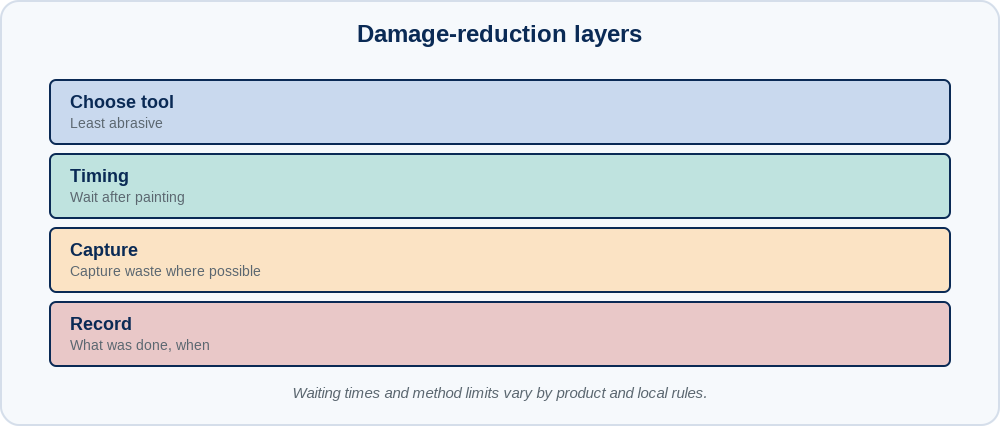
In-water cleaning is restricted or subject to special rules in many places. Green Blue writes that slime in the water can be taken off with a soft cloth or 1200-grit wet-and-dry but that more vigorous cleaning methods are banned to prevent pollution. That is a guide from a UK organisation and may not apply in Türkiye or other countries. See the rules set by your marina and local authorities; biocide regulation and marina cleaning rules are covered in related articles. This article is not legal advice.
The New Zealand study shows that whether waste-capture technology is used is a separate factor in risk assessment. If you hire a service, ask how the provider manages waste and which tool is used. Record every cleaning with date, method and observation.
5b. Cleaning frequency and paint-system fit#
Frequent light cleaning is generally less harmful to hull paint than scraping heavily built-up growth with a harsh method; that is a general engineering observation. The “grooming” concept in the Frontiers review rests on this idea: early light cleaning aims to reduce the need for harsher cleaning. But not every paint system suits frequent cleaning; ablative paint thins quickly with frequent brushing and hard paint asks for cleaning to be avoided in the first weeks. So plan the cleaning regime together with paint choice.
In PBO the owner of the Coppercoat boat writes that while he expected the hull to glisten effortlessly he still has to scrub or wipe in the water every four to eight weeks. That illustrates that even in systems said to be low maintenance the need for cleaning may continue; it is a single user’s account.
6. Common mistakes#
- Brushing the hull hard on an ablative-painted boat.
- Cleaning early after hard paint is applied.
- Not knowing the local in-water cleaning rules.
- Not allowing for paint cloud and waste.
- Treating a robot or service claim as an independent result.
- Holding high pressure or cavitation close and long.
- Keeping no cleaning record.
7. Checklist#
8. Conclusion#
In-water hull cleaning removes growth and a minimal amount of paint when done properly, and creates a paint plume when done harshly or on ablative paint. Paint type, type of growth, waiting period and local rules decide the method. Robots are developing at ship scale and independent evidence at boat scale is limited. This article is general information; it recommends no method or product and is not legal advice.
Frequently asked questions#
Does in-water hull cleaning damage paint?
Maryland DNR says done properly it removes growth and a minimal amount of paint, while overly harsh cleaning or scrubbing ablative paint creates a plume of paint. Soft tools and gentle cleaning are advised.
How should an ablative-painted boat be cleaned?
Maryland DNR advises cleaning only running gear and zinc anodes on ablative-painted boats; brushing the hull paint wears away the paint itself.
How long should I wait after new paint?
Maryland DNR advises refraining from hull cleaning for at least 60 days after hard antifouling is applied; for your own product see the data sheet.
Are robots ready for boats?
Robots are developing at ship scale (such as Jotun’s HullSkater and Hullbot); independent evidence at boat scale is limited and claims come from makers.
Can in-water cleaning be banned in a marina?
In some places yes; Green Blue says more vigorous cleaning methods are banned and only a cloth or fine paper may take slime. See your marina and local regulation.
Was this guide helpful?
Thank you! Your feedback has been saved.
Guide content is for general information; in practice, the current technical data sheet of the product applies.
Keep reading
Related guides
Boat Colour Selection and Solar Reflectance: Effect of Heat Absorption on Surfaces
A study of the effect of boat paint colour on solar reflectance and surface temperature.
2 min read Paint and CoatingsCauses and Diagnosis of Paint Blistering
A study of the sources, types and diagnostic approach to blistering on boat paints.
2 min read Paint and CoatingsNumber of Coats in Epoxy Coating Systems
A study of the effect of the number of coats in epoxy coating systems on protective performance and thickness.
2 min read