
Paint and Coatings
How to Use a Wet Film Thickness Comb
A wet film comb is a simple tool for checking thickness while the paint is still liquid. This article generally explains comb types, correct technique and how the reading is turned into a dry film estimate.
Short answer
A wet film comb is a simple gauge with notched edges. You press the clean comb square into the wet film and withdraw it lightly; the highest tooth wetted by paint indicates wet film thickness (WFT). To reach the target dry film thickness (DFT) a rough estimate is made using the volume solids in the product’s technical data sheet; but this is an estimate and definitive verification is by dry film measurement. Clean the comb after every reading, avoid disturbing the film and take readings at several points. This article is general information; see the maker’s data sheet for target values.
Key points
- A wet film comb is a simple tool that checks thickness at once during application.
- Press the clean comb square into the film, withdraw lightly and read the highest wetted tooth.
- For a dry film estimate take volume solids from the data sheet; the result is an estimate.
- Take readings at several points and clean the comb each time.
- For definitive verification measure dry film after cure.
1. What is a wet film comb?#
A wet film thickness comb is a flat gauge, usually metal or plastic, with teeth of different heights on its edges. It is used to quickly check the thickness of an applied film while the paint is still liquid. Being simple, cheap and portable is why it is widely used to catch errors during application. A comb does not replace dry film measurement; it helps estimate whether the target dry film thickness (DFT) is being reached.
This article is a general usage summary. For target values and volume solids see the product’s technical data sheet; no product or thickness recommendation is made here. For dry film gauges and general thickness measurement see the related article.
2. Comb and wheel types#
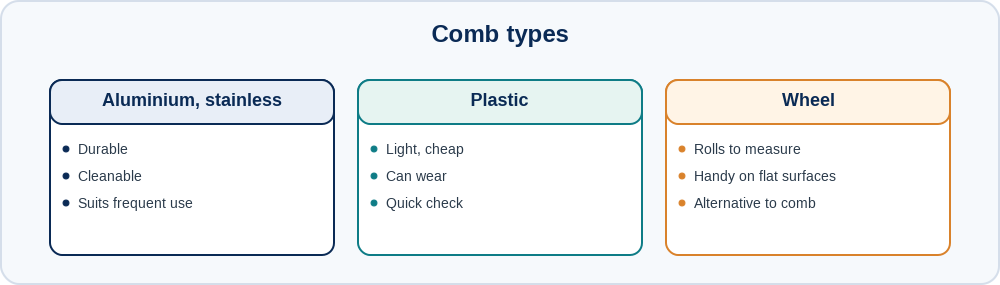
Combs can be made of aluminium, stainless steel or plastic. Metal combs are more durable, can be cleaned with solvent and suit frequent use; plastic ones are light and cheap but can wear. Some combs have different scale ranges on each edge so different thickness ranges can be measured with one tool. Wheel-type gauges measure by rolling on a flat surface and are an alternative to notched combs; depending on geometry their use may be limited on curved surfaces.
The tool’s scale range must cover the wet film thickness you want to measure. When choosing look at the wet film target in the product data sheet and the tool maker’s scale information. A worn or bent comb gives wrong readings; a damaged comb must be replaced.
| Type | Strength | Limitation |
|---|---|---|
| Aluminium, stainless comb | Durable, cleanable | May cost more |
| Plastic comb | Light, cheap | Can wear, bend |
| Wheel | Handy on flat surfaces | Limited on curved surfaces |
| Multi-edge comb | Several ranges | Need to pick the right edge |
3. Correct technique#
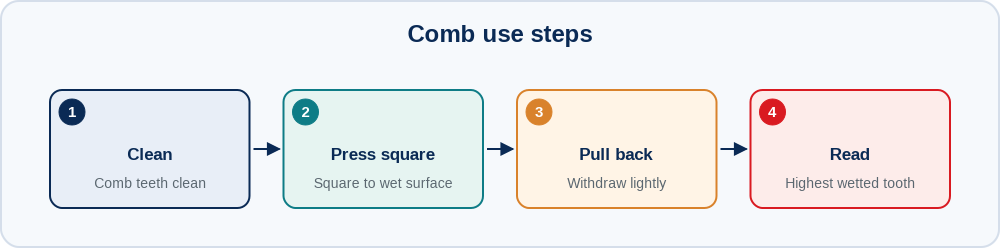
The steps are simple but need care. First make sure the comb is clean; dried paint stuck on the teeth covers them and spoils the reading. Then press the comb square (90 degrees) into the wet film; holding it at an angle makes the teeth contact the film surface differently. Press the comb steadily without sliding and withdraw it lightly. The value beside the highest tooth wetted by paint is the wet film thickness; teeth not wetted show the film did not reach that level.
Take the measurement straight after application; as solvent starts to evaporate the wet film thins and the reading falls over time. Wipe the comb clean after every reading. To avoid disturbing the film much do not crush the comb in a wide movement and, if possible, correct the comb mark afterwards or wait for it to flow out on its own, depending on the product’s flow. Consider sagging risk on sloping and vertical surfaces.
4. Estimating dry film from wet film#
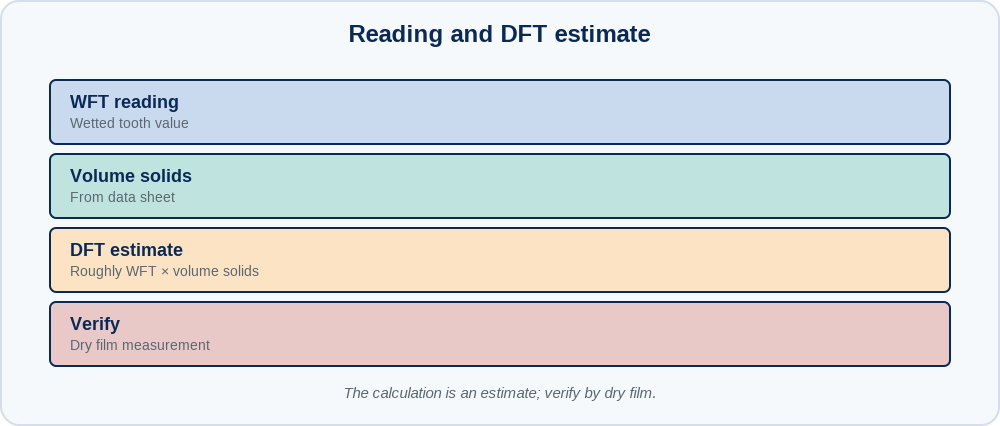
While a coating cures solvent evaporates so the dry film is thinner than the wet. For a rough estimate the volume solids ratio in the product’s technical data sheet is used: estimated dry film thickness is close to the wet film thickness multiplied by the volume solids ratio. For example if the data sheet gives a certain volume solids ratio for a product you can calculate backwards from that ratio the wet thickness needed to reach the target DFT. Always take the numbers for this calculation from the maker’s data sheet; no specific value is recommended here.
This calculation is an estimate: application loss, application method, surface roughness, thinning and shrinkage during cure can affect the result. If thinning was done the wet-to-dry relationship changes too and the maker’s instructions should govern. For definitive verification a dry film measurement after cure is needed; on non-metal substrates such as fibreglass wet film and consumption checks may in practice be more decisive.
- Take target WFT/DFT and volume solids from the data sheet.
- Make sure the comb scale covers the target and clean the comb.
- Press the comb square into the wet film straight after application.
- Withdraw lightly and read the highest wetted tooth.
- Take several readings in different areas.
- Convert the reading roughly to DFT with volume solids.
- Correct if needed; verify with dry film after cure.
5. Limitations#
A wet film comb has several limits. Readings may be harder with very fluid or very fast-drying products; with very thick or thixotropic products such as structural fillers reading with a comb may be unreliable. On curved, rough or textured surfaces the way the teeth contact changes. The applicator’s pressing angle and speed also affect the result. So a comb is a guide, not a precise measuring instrument. Before deciding take several readings and, if needed, verify with dry film measurement.
In multi-coat systems it is important to check each coat’s wet film target separately and keep to the cure times between coats. Record readings with area and coat information; these records help trace causes if problems arise later.
5b. Practical notes for boat application#
When using a comb on large surfaces such as a boat hull, planning measuring points in advance makes the job easier. Divide the surface into zones, take readings at several points in each zone and record the values. Because wind, temperature and direct sun change the solvent’s evaporation rate, the same product thins at different speeds in different conditions; so taking the reading at the same time as application, straight after it, gives more consistent results. If two people are working, one applying while the other measures can be a practical arrangement.
Also if the comb will be used constantly, keeping a spare comb and having a suitable solvent and rag ready for cleaning speeds the workflow. For solvent choice see the product’s data sheet and safety data sheet. So that comb marks do not leave defects in the coating, where the product allows, prefer taking measurements in areas that will be reworked or can be corrected, and follow the maker’s application instructions.
6. Common mistakes#
- Using the comb without cleaning it.
- Pressing the comb at an angle.
- Taking the measurement long after application.
- Deciding from a single reading.
- Assuming volume solids without checking the data sheet.
- Taking the wet estimate as exact DFT.
- Using a damaged or bent comb.
7. Checklist#
8. Conclusion#
A wet film comb is a cheap, practical way to check thickness at once during application. By pressing the clean comb square into the film and withdrawing it lightly you read the highest wetted tooth; with volume solids you can roughly estimate dry film. But the result is an estimate; several readings and a dry film measurement after cure raise reliability. The maker’s technical data sheet governs target values; this article is general information.
Frequently asked questions#
How is a wet film comb read?
Press the comb square into the wet film and withdraw it; the value beside the highest tooth wetted by paint is the wet film thickness. Teeth not wetted show the film did not reach that level.
How do I get from wet film to dry film?
Estimate roughly using the volume solids in the product’s data sheet: wet film thickness times the volume solids ratio. This is an estimate.
How many readings should I take?
Instead of one reading take several in different areas of the surface; product can behave differently on vertical and horizontal surfaces.
Can a comb be used on every paint?
It can be used on most liquid coatings; but readings may be harder with very fluid or very fast-drying products. See the maker’s advice.
Why must I clean the comb?
Paint built up on the teeth spoils the next reading and lowers the comb’s accuracy; clean after every reading.
Was this guide helpful?
Thank you! Your feedback has been saved.
Guide content is for general information; in practice, the current technical data sheet of the product applies.
Keep reading
Related guides
Boat Colour Selection and Solar Reflectance: Effect of Heat Absorption on Surfaces
A study of the effect of boat paint colour on solar reflectance and surface temperature.
2 min read Paint and CoatingsCauses and Diagnosis of Paint Blistering
A study of the sources, types and diagnostic approach to blistering on boat paints.
2 min read Paint and CoatingsNumber of Coats in Epoxy Coating Systems
A study of the effect of the number of coats in epoxy coating systems on protective performance and thickness.
2 min read