
Paint and Coatings
When Is It Necessary to Strip a Hull Down to Bare Fibreglass?
Removing all old paint from a hull is a big decision: it brings time, cost, waste and gelcoat risk. This article explains reasons to strip, situations where it is unnecessary and tests that support the decision.
Short answer
Full stripping to bare fibreglass is usually considered when old coats have grown so thick they undermine adhesion, when paint is flaking or blistering widely, when the existing and new systems are incompatible, or when there is a widespread moisture problem that you do not want left under the coating. For local damage, well-bonded coats or just a colour change full stripping is often unnecessary; local repair and sanding may be more reasonable. Before deciding run an adhesion test, a moisture reading and a thickness assessment. This article is general information; consult an expert and maker data for a decision specific to your boat.
Key points
- Full stripping is expensive and laborious; it is not needed on every boat.
- Very thick coats, widespread flaking or an incompatible system bring full stripping into play.
- Local damage and well-bonded coats are usually solved with local repair.
- Before deciding run an adhesion test, moisture reading and thickness assessment.
- After stripping you must dry the bare laminate and apply a complete system.
1. Why is stripping a big decision?#
Stripping a hull to bare fibreglass means removing all existing paint coats and, if necessary, part of the surface layer. It is among the most labour-intensive jobs in boat maintenance: days or weeks of work, significant waste, the risks of strippers or mechanical methods and the need to apply a complete new system afterwards. So finding out through diagnosis whether stripping is really needed lowers both cost and risk.
This article offers a general decision framework and does not replace an assessment specific to your boat. Every boat’s history, coats and hull material differ; maker data and expert opinion come first. For removal methods, safety and waste see the related articles.
2. Situations that bring full stripping into play#
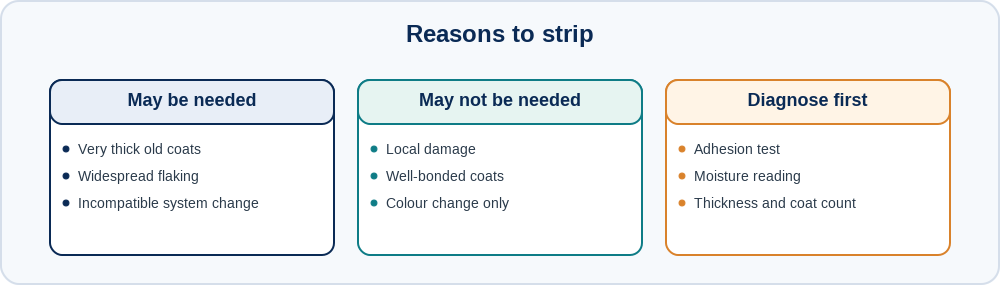
Several typical situations can make full stripping sensible. The first is very thick coats built up over the years: as thickness grows stress between coats rises, paint can crack and flake and newly added coats must bond to this weak base. The second is paint flaking or blistering across wide areas of the hull; local repair can then become an endlessly restarting chore. The third is incompatibility between the existing system and the one to be applied; for example, applying an incompatible coating over an unknown old system can cause adhesion problems, and then maker compatibility information or a test patch is needed.
The fourth is suspicion of a widespread moisture problem underneath. If the hull looks wet and blistered, applying a new system on top hides the problem; but this decision should not be made visually alone, and a moisture reading and professional assessment should be made. The fifth is where fairing and surface correction needs are widespread and extensive reshaping of the hull is wanted. None of these reasons is absolute alone; seeing several together strengthens the decision.
| Situation | Lean toward full strip | Alternative |
|---|---|---|
| Very thick accumulated coats | Strong | Partial thinning if needed |
| Widespread flaking | Strong | Local repair on small areas |
| Incompatible system | Medium–strong | Compatible primer or test patch |
| Suspected widespread moisture | Measure first | Moisture removal plan |
| Local damage | Weak | Local repair |
| Colour change only | Weak | Sanding and repainting |
3. Situations where full stripping is not needed#
On many boats full stripping is unnecessary. If the coats are well bonded, damage is local (an impact, a fracture, a small cluster of blisters) or the aim is only to refresh colour or appearance, local repair and general sanding are often enough. Keeping well-bonded old coats lowers cost, waste and the risk of exposing the bare laminate. The condition of this approach is that adhesion is really good and the new system is compatible with the old; this must be tested rather than assumed.
In some cases an intermediate solution is suitable: stripping only the bad areas and sanding and priming the rest. This keeps the reversible part of the decision; it is possible to keep the scope small in a first step, see the results and widen it in a second.
4. Which tests before deciding?#
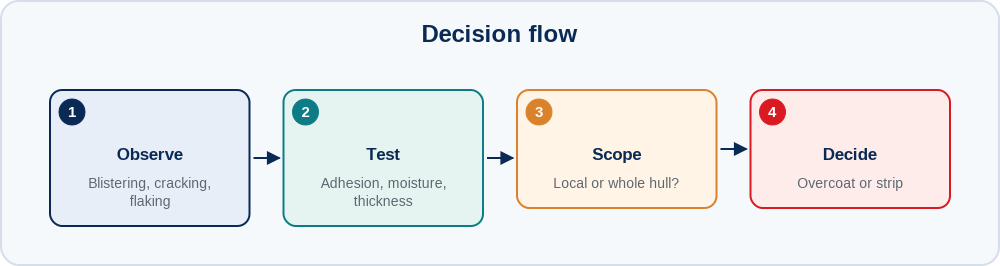
Three basic data help the decision. The first is adhesion: a cross-cut test (see the related article) shows how well coats bond to each other and the substrate; if poor results are widespread, leaning toward stripping is more reasonable. The second is moisture: taking readings with a moisture meter in different areas of the hull helps you understand whether there is a moisture-driven problem; but it must be interpreted according to meter type and surface and a single reading does not give a definitive result. The third is thickness: measuring paint thickness helps understand the total build-up and thick areas; but measuring thickness directly on laminate may not be possible with every instrument.
In addition observe the surface: clues such as blister patterns, crack directions and which layers flaking starts at show the origin of the problem. If needed take the view of an expert or surveyor; especially where osmosis is suspected the decision should not rest on appearance alone.
5. Stripping method and afterwards#
If you decide to strip, method selection becomes critical. Chemical strippers, mechanical methods and blasting carry different risk and waste profiles; on fibreglass protecting the gelcoat should be the priority. For safety and waste management see the related articles and for media choice the blasting article. Examining the hull fully during stripping is also an opportunity: hidden damage, moisture and repair needs are revealed.
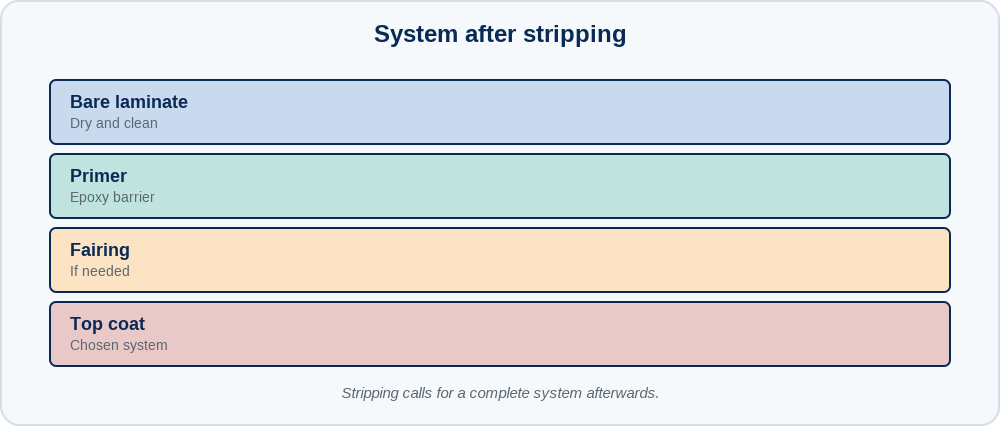
After stripping the bare laminate should be dried, cleaned and protected without delay. Leaving a bare hull exposed raises the risk of new moisture and contamination. Then, if needed, fairing, barrier primer and the chosen top-coat system are applied. For system choice, coat counts and cure times follow the maker’s technical data sheets; this article does not recommend a specific product or thickness.
- Observe: signs of blistering, cracking, flaking and thickness.
- Run a cross-cut adhesion test.
- Take moisture readings; ask an expert if needed.
- Define scope: local repair, partial or full stripping?
- If stripping is needed plan method, safety and waste.
- After stripping inspect the hull, dry it and protect it at once.
- Apply primer and top coats per the maker’s system.
6. Common mistakes#
- Saying “let’s strip everything” without testing.
- Stripping the whole hull for local damage.
- Ignoring a moisture problem and covering it.
- Leaving the bare hull exposed for long after stripping.
- Applying new coats without verifying system compatibility.
- Not choosing the stripping method for the hull material.
- Not planning for waste and safety.
7. Checklist#
8. Conclusion#
Stripping to bare fibreglass is a strong intervention and not needed on every boat. Very thick coats, widespread flaking, an incompatible system or suspected widespread moisture can support the decision; local damage and well-bonded coats are usually solved by local repair. Before deciding gather adhesion, moisture and thickness data, plan method, safety and waste if stripping, and apply a complete system afterwards. This article is general information; maker data and expert opinion come first.
Frequently asked questions#
Does every boat need full stripping?
No. In many cases well-bonded coats can be kept and only damaged areas repaired; full stripping comes into play under certain conditions.
Which signs support full stripping?
Widespread flaking, very thick accumulated coats, poor adhesion in a cross-cut test and incompatibility with the new system are typical reasons.
What should I test before stripping?
Adhesion (cross-cut), moisture reading and, where possible, a total thickness assessment give the most useful data for the decision.
Can stripping damage the hull?
If the method is poorly chosen the gelcoat can wear; media and applicator choice are critical. See the blasting and stripper articles.
What happens after stripping?
The bare laminate is dried, cleaned and, without delay, a barrier primer and the chosen system are applied.
Was this guide helpful?
Thank you! Your feedback has been saved.
Guide content is for general information; in practice, the current technical data sheet of the product applies.
Keep reading
Related guides
Boat Colour Selection and Solar Reflectance: Effect of Heat Absorption on Surfaces
A study of the effect of boat paint colour on solar reflectance and surface temperature.
2 min read Paint and CoatingsCauses and Diagnosis of Paint Blistering
A study of the sources, types and diagnostic approach to blistering on boat paints.
2 min read Paint and CoatingsNumber of Coats in Epoxy Coating Systems
A study of the effect of the number of coats in epoxy coating systems on protective performance and thickness.
2 min read