
Paint and Coatings
Paint Mix Ratio and Catalyst Errors
Two-component coatings such as epoxy and polyurethane cure by a chemical reaction and that reaction needs the right ratio. This article explains the consequences of ratio and catalyst errors and how to prevent them, based on general sources.
Short answer
In two-component coatings the base and hardener (catalyst) must be mixed at the ratio the maker specifies; ratio error spoils cure and film properties. According to a technical article on multi-component coatings, a wrong ratio changes film properties and the component in excess remains in the film; Euclid Chemical says the most apparent sign of ratio error is a coating that does not cure, staying soft and tacky, though sometimes the film looks normal. Adding extra hardener to cure epoxy faster does not work. The most common error is confusing volume and weight ratios. Take the ratio from the technical data sheet and measure with separate labelled pots. This article is general information.
Key points
- Take the ratio from the maker’s data sheet; volume and weight ratios differ.
- Too much or too little hardener spoils cure and film properties; the excess component stays in the film.
- Ratio error sometimes gives a soft tacky film and sometimes the film looks normal with problems showing later.
- In epoxy, extra hardener does not speed cure; a faulty mix usually has to be removed and redone.
- Use separate labelled pots, mix the whole kit and record the batch.
1. Why does the ratio matter so much?#
Two-component coatings, meaning most epoxy primers and polyurethane topcoats, are sold liquid in two separate cans: the base (resin) and the hardener (catalyst, activator). When the two are mixed a chemical reaction starts and the coating hardens. This reaction is stoichiometric; that is, the components must be present in a particular ratio. According to KTA’s technical article on multi-component coatings, the optimum chemical balance does not always translate to a convenient ratio such as 1:1 or 2:1; the maker sets the required ratio by formulation. The same article says that if mixed at a ratio different from the one specified, the final film properties can change.
This article gives a general summary and recommends no ratio for any product. The correct ratio is always in the product’s technical data sheet; take care whether it is by volume or weight. For pot life and induction see the related articles.
2. How does ratio error spoil cure?#
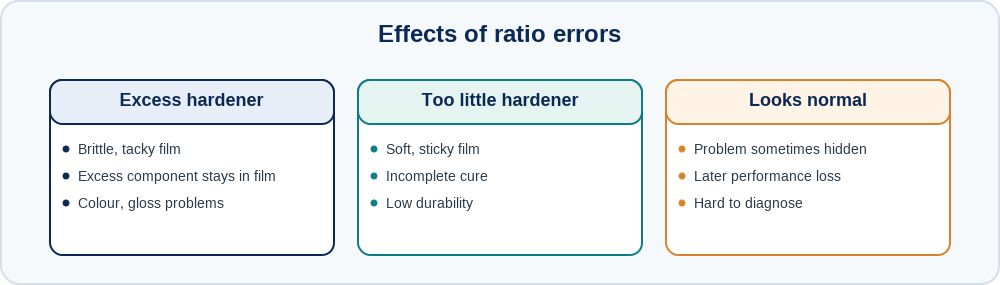
According to Euclid Chemical’s tips on epoxy floor coatings, resin and hardener must be used at the proper ratio; mixing Part A and Part B off ratio can seriously compromise the epoxy’s ability to cure properly and achieve ultimate strength. The same source says the most apparent evidence of off-ratio mixing is an epoxy coating that does not cure and stays soft and tacky, but that in other cases an off-ratio coating may appear to have cured properly and not be visually different from one mixed at the proper ratio. Knowing both cases matters: a film looking hard does not mean the mix was right.
The KTA article notes that there is no single, direct physical property affected by off-ratio mixing that can be used as a marker for all two-component materials, so identifying an off-ratio mix as the sole reason for an observed defect is difficult. In an examination in the same article the off-ratio mix was found to be much softer and it is noted that the component in excess remains in the film. It also writes that in some cases a film from an off-ratio mix may perform for a certain time; that is, the problem may appear later, not at once. So an “it worked” look is no guarantee.
| Error | Possible effect | Note |
|---|---|---|
| Too much hardener | Excess component stays in film; properties change | Does not speed cure (epoxy) |
| Too little hardener | Incomplete cure, soft tacky film | Sometimes hardens late but properties may stay low |
| Volume/weight confusion | Wrong ratio, cure problem | One of the most common errors |
| Incomplete mixing | Streaky, local non-cure | Watch pot base and sides |
| Looks normal | Later performance loss | Hard to diagnose |
3. Volume versus weight ratio confusion#
Machine Design’s article on two-part adhesives says confusing volume and weight mix ratios is a common mistake and that these ratios differ for a given product. Entropy Resins also says epoxy mix ratios are typically different if measured by volume or by weight. This is a warning that also holds for coatings: a product’s data sheet may give both a volume and a weight ratio and the measuring method must be chosen accordingly. For example a 4:1 volume ratio is not 4:1 by weight; the numbers change because of density differences.
Practical advice: mark the unit of the ratio in the data sheet and choose your measuring tool to match. If measuring by volume use clear graduated pots; if by weight use an accurate scale. Data sheets for the same product in different markets or versions may give different ratios; use the information on your can’s label and in the current data sheet.
4. The “more hardener cures faster” fallacy#
In cold weather or when rushed the thought of speeding cure with “a bit more hardener” sometimes comes up. Entropy Resins says that, unlike polyester and vinylester resins, epoxy does not cure faster when more hardener is added, that it may simply not cure, that the only fix is to remove all the uncured epoxy and start over and that nothing should be coated over it. This is an epoxy resin maker’s statement and coating makers’ instructions vary by product; but the general principle is not to speed things up by changing the ratio. For speed consider the maker’s fast hardener or temperature management.
Permabond writes that manufacturers set ratios to tune pot life, cure speed, hardness and adhesion, so unless the manufacturer or instructions direct otherwise you should stick to the ratio in the data sheet. The same source says 1:1 ratio systems are less sensitive to exact ratio than 10:1 systems; but this was said of adhesives and cannot be applied to paint systems with certainty. The result is again the same: follow the maker’s ratio.
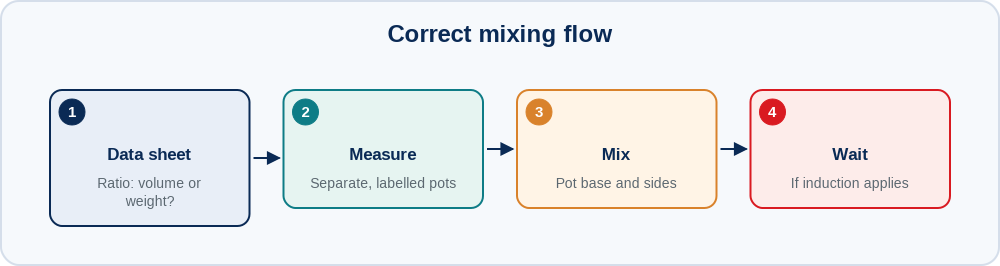
- Note the ratio and its unit (volume or weight) from the data sheet.
- Mix the whole kit at once if possible; if splitting, measure the ratio precisely.
- Use a separate labelled pot and measuring tool for each component.
- Stir the base well first, then add hardener, scraping pot base and sides while mixing.
- If thinning is needed follow the maker’s recommended solvent and order.
- Wait the induction time if any and start the pot-life clock.
- Record batch number and ratio.
5. Mixing discipline and cross-contamination#
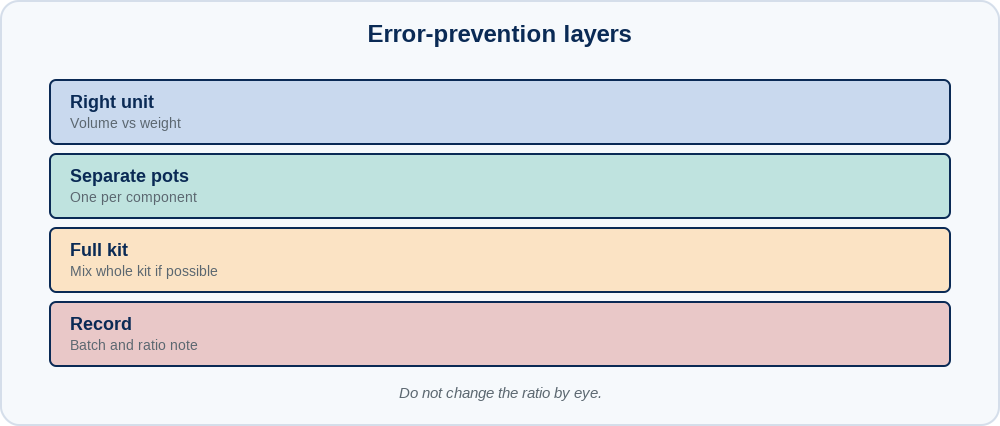
Incure’s article on ratio errors in two-part systems recommends labelling pots and measuring scoops for Part A and Part B clearly and never sharing one pot or scoop between the two components, because cross-contamination skews the ratio unnoticed. The same source recommends discarding the last 5 to 10 percent of a cartridge in critical applications. These suggestions come from an adhesive maker and do not apply directly to coatings, but the cross-contamination logic holds for paint too: leaving the hardener can open, closing the base lid with a hardener-contaminated hand or using the same stirrer between the two cans can affect ratio and cure.
Mixing the whole kit lowers ratio error risk because the cans are already filled to the right ratio by the maker. Even for a job too small, choosing a smaller pack is often safer than mixing part of a can. If you must split, use the tools the maker suggests, such as a “measuring cup” or “mixing stick”. In tinted (colour-added) products the same ratio holds; adding colour paste can change the ratio so follow the tinting instruction.
On a forum (Fine Woodworking) one user describes an epoxy mixed slightly light on hardener that hardened the next day, only curing later; this is one person’s experience and cannot be generalised. A slightly off-ratio mix “recovering” does not mean there is no later loss of strength. In uncertain cases consult the maker’s technical service.
6. Common mistakes#
- Adjusting the ratio by eye.
- Confusing volume and weight ratios.
- Adding extra hardener to speed cure.
- Not mixing base and hardener fully, neglecting the pot base.
- Using the same pot or stirrer for both components.
- Mixing components of different batches together.
- Not being willing to remove a faulty mix instead of coating over it.
7. Checklist#
8. Conclusion#
In two-component coatings the ratio is the basis of hardening and durability. Too much or too little hardener spoils cure and film properties; the error sometimes gives a soft, tacky film and sometimes looks normal and shows up later. Raising hardener to speed up epoxy does not work. Take the ratio from the data sheet, mind the unit, measure with separate pots and mix the whole kit. This article is general information; the maker’s instructions for your product come first.
Frequently asked questions#
Are volume ratio and weight ratio the same?
No. In epoxy systems volume and weight ratios differ; confusing one with the other is a common mistake. Check which unit the data sheet gives.
Can I add extra hardener to cure faster?
No. Entropy Resins says epoxy, unlike polyester and vinylester, does not cure faster with more hardener; the excess only causes it not to cure.
How do I recognise a ratio error?
A coating that does not cure, soft and tacky, is the typical sign; but sometimes the film looks normal. KTA says no single physical property marks off-ratio mixing, which makes diagnosis hard.
How is uncured epoxy fixed?
Per Entropy Resins the only fix is to remove all the uncured epoxy and start again; do not coat over it. For your product ask the maker.
Can I split a kit and mix half?
Mix the whole kit if possible. If you must split, measure the data-sheet ratio precisely and use separate labelled pots.
Was this guide helpful?
Thank you! Your feedback has been saved.
Guide content is for general information; in practice, the current technical data sheet of the product applies.
Keep reading
Related guides
Boat Colour Selection and Solar Reflectance: Effect of Heat Absorption on Surfaces
A study of the effect of boat paint colour on solar reflectance and surface temperature.
2 min read Paint and CoatingsCauses and Diagnosis of Paint Blistering
A study of the sources, types and diagnostic approach to blistering on boat paints.
2 min read Paint and CoatingsNumber of Coats in Epoxy Coating Systems
A study of the effect of the number of coats in epoxy coating systems on protective performance and thickness.
2 min read