
Underwater
IMO 2023 Biofouling Guidelines and What They Mean for Recreational Boat Owners
Marine growth on a hull is not just a matter of fuel and speed; boats also carry organisms to new seas. That is why the IMO has biofouling guidelines. This guide summarises the 2023 revision and the recreational craft guidance in an owner’s language.
Short answer
The IMO revised its guidelines for the control and management of ships’ biofouling in July 2023 (MEPC.378(80)), and a separate guidance for recreational craft under 24 m exists (MEPC.1/Circ.792). These documents aim to reduce the transfer of invasive aquatic species and are guidance, not binding treaty text. In practice, owners should inspect the hull and niche areas regularly, use a suitable antifouling system, clean in a controlled way and keep records.
Key points
- The IMO biofouling guidelines were revised in July 2023 as MEPC.378(80).
- A separate guidance exists for recreational craft under 24 m (MEPC.1/Circ.792).
- The aim is to reduce the transfer of invasive aquatic species on hulls.
- Niche areas such as the rudder, propeller, shaft and water intakes carry higher risk.
- Inspection, a suitable coating, controlled cleaning and records are the practical answer.
1. What is biofouling and why does it matter?#
Biofouling is the accumulation of microorganisms, plants and animals on underwater surfaces. On a boat’s hull it can range from a thin biofilm to hard organisms such as mussels and barnacles. The first effect is hydrodynamic: a rough surface increases friction, speed drops, or more fuel is needed for the same speed.
The second effect is biological. Organisms attached to the hull can be carried with the boat to a new region and become invasive there. This is the basic reason behind the IMO guidelines: hulls, together with ballast water, are an important pathway for the transfer of invasive aquatic species.
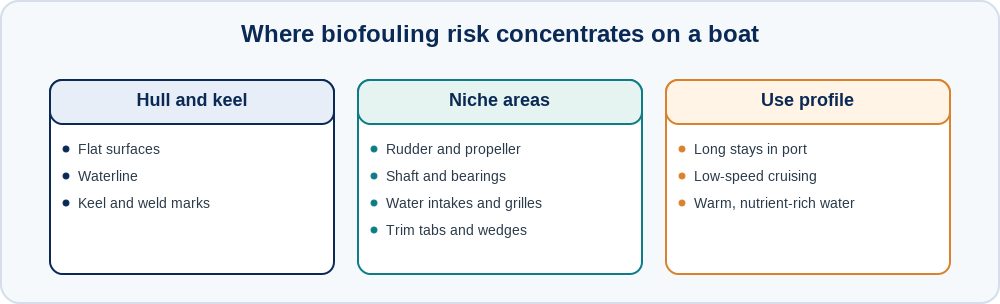
Recreational boats cruise more slowly than commercial ships and spend long periods in port. That use profile makes attachment easier, which is why the IMO published a separate guidance for recreational craft.
2. The IMO framework: which document says what#
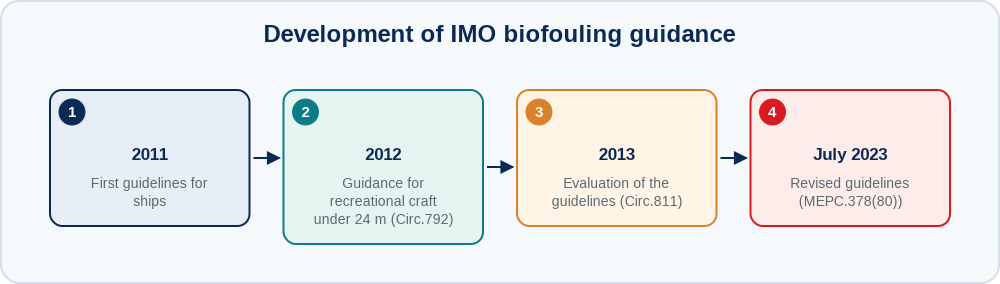
The IMO adopted its first guidelines for the control and management of ships’ biofouling in 2011. In 2012 a separate guidance for recreational craft under 24 m was issued (MEPC.1/Circ.792). In 2013 a circular on evaluating the guidelines appeared (MEPC.1/Circ.811). After a review that took three years, the revised guidelines were adopted at MEPC 80 in July 2023 (MEPC.378(80)).
Later, the IMO also produced additional documents on biofouling and in-water cleaning. In April 2025 the guidance on in-water cleaning (MEPC.1/Circ.918) was published. At the 2023 session of the PPR sub-committee, general agreement was expressed that recreational vessels should be exempted from mandatory reporting requirements.
3. What does the recreational craft guidance recommend?#
The guidance asks the owner to focus on three points: reduce the build-up of biofouling on the hull and niche areas, inspect it regularly and clean it when needed. The tools it lists include suitable antifouling coatings, cleaning practices and marine growth prevention for water intakes.
- Regular visual inspection of the hull and niche areas.
- Choosing an antifouling system suited to the use profile.
- Controlled cleaning of the hull and niche areas when needed.
- Suitable prevention methods for internal systems such as water intakes.
- Recording maintenance and cleaning.
The guidance is valuable because it explains these steps at recreational scale without a heavy administrative burden. For the owner the real gain is moving from random maintenance to a planned, recorded routine.
4. Niche areas: where the risk really concentrates#
Biofouling accumulates not only on flat hull surfaces but also where coating is hard to apply and wears quickly. The rudder, propeller, shaft and bearings, water intakes and grilles, trim tabs and wedges are among the main ones. The IMO guidance draws particular attention to these areas.
| Area | Why is it risky? | Practical note |
|---|---|---|
| Rudder and propeller | Moving parts; coating wears easily | Consider a special system suited to propellers and metals |
| Shaft and bearings | Narrow and hard to reach | Record the inspection |
| Water intakes and grilles | Risk of carrying organisms into internal systems | Regular inspection and cleaning |
| Trim tabs and wedges | Corners and edges; coating stays thin | Check thickness at edges |
| Waterline | Light and nutrients, rapid growth | Regular cleaning plan |
5. A practical routine for the owner#
The routine below turns the essence of the guidance into a simple calendar. Details differ for each boat, but the order is the same: inspect, clean, review the coating, record.
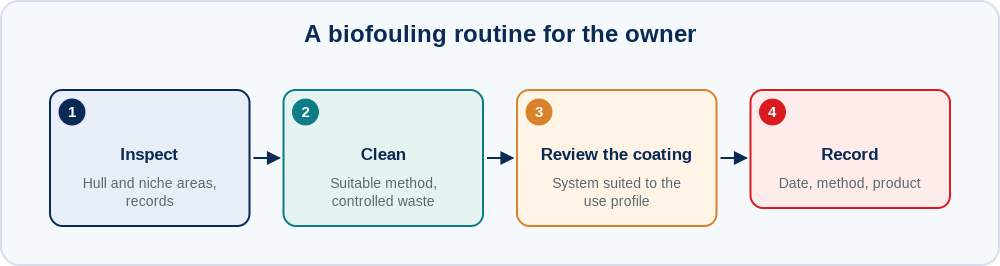
- Inspect: photograph the hull and niche areas at haul-out or during a diving check.
- Clean: choose a method suited to the coating; judge stiff brushes or abrasive methods according to the coating type.
- Coating: choose a system suited to the use profile and follow the manufacturer’s data sheet.
- Record: write the date, method and product in the maintenance log.
- Before a long passage: check the current rules of the destination and keep the hull clean.
6. Pre-passage checklist#
7. The value of record keeping#
Records are the cheapest and most neglected step of the guidelines. The date and method of cleaning, the product applied and the condition of the hull are useful for the maintenance plan and for answering questions at an arrival inspection. The same records also support a boat’s value at resale.
8. Common mistakes#
- Looking only at the flat hull surfaces and neglecting niche areas.
- Cleaning with a method that damages the coating.
- Cleaning without collecting the waste.
- Keeping the same antifouling system after the use profile has changed.
- Keeping no records.
Another common misunderstanding is “it is only guidance, so it does not apply to me”. Even though guidance is not directly binding, it offers the owner a useful maintenance framework and often reflects the spirit of national rules. If a regional rule exists, this framework lowers the cost of compliance.
9. Example scenario: one season in the Mediterranean#
Consider a 14-metre sailing yacht wintering in Bodrum. It is launched in April, used for short trips in June, and spends much of July and August at anchor or in the marina. That profile means low speed and long idle periods, while warm water and light accelerate growth. On such a boat the waterline, rudder and propeller area may show clear build-up even by early September.
An approach in line with the guidance works like this: at launch in April the hull and niche areas are photographed; in mid-July an interim dive inspection is made; where needed, areas are cleaned with a method gentle enough for the coating and with waste capture arranged; at haul-out in October the condition is documented again. At the end of the season it is clear which part of the hull collected how much growth, and the coating decision for the next season rests on data.
If the same boat plans to cruise abroad, the current rules of the destination are checked beforehand and the hull is inspected just before departure. This simple discipline reduces both the risk of an unnecessary refusal and the deviation in fuel consumption during the trip. In the end, the guidance is not a heavy procedure but a record-based maintenance habit.
10. Conclusion#
The 2023 revision and the recreational craft guidance remind us that biofouling management is not only a performance matter but also an environmental responsibility. The best approach for the owner is regular inspection that includes niche areas, a coating suited to the use profile, controlled cleaning and records. Do not forget to check the current rules of your destination in advance.
Frequently asked questions#
Are the biofouling guidelines mandatory for yacht owners?
The IMO guidelines are recommendatory rather than binding treaty provisions. However, some countries apply their own biofouling requirements to arriving boats, so check the current rules of your destination.
Which document applies to a recreational boat under 24 m?
The IMO published a separate guidance for recreational craft under 24 m: MEPC.1/Circ.792 (2012). It is a simplified adaptation of the guidelines.
What are niche areas and why do they matter?
They are places such as the rudder, propeller, shaft, water intakes, trim tabs and areas where coating is hard to apply or wears quickly. Organisms attach easily there and the spots are often overlooked.
How often should I inspect the hull?
There is no fixed interval; it depends on the use profile. Boats that stay long in port, cruise slowly or operate in warm waters should be inspected more often.
What should I watch for when cleaning?
Choose a method that does not damage the coating, collect the waste and check local rules. The IMO also published a separate guidance on in-water cleaning in 2025.
Was this guide helpful?
Thank you! Your feedback has been saved.
Guide content is for general information; in practice, the current technical data sheet of the product applies.
Keep reading
Related guides
Formation of Algae and Biofilm on the Hull
A study of how algae and biofilm form on the hull, the methods of protection and their effect on the surface.
2 min read UnderwaterChoosing Antifouling: A Decision Based on Usage Profile
A decision-focused study explaining how the type of antifouling should be chosen according to the frequency of use and water conditions.
2 min read UnderwaterManaging the Waterline Zone with a Paint System
A study of the special conditions around the waterline of a boat and how this zone is managed with a paint system.
2 min read