
Underwater
Cybutryne ban and the second-hand yacht: strip the old antifouling or apply a sealer?
The colour of a second-hand yacht’s underwater paint tells you very little about its history. One of the layers beneath may contain a biocide that is now banned. This guide explains what the ban says, how to identify the old layer, and how to choose between removal and a sealer coat with a simple decision flow.
Short answer
Cybutryne (Irgarol, CAS 28159-98-0) may not be applied or re-applied in antifouling systems under the IMO AFS Convention from 1 January 2023. For ships bearing an external layer that contains it, the options are to remove the system or to apply a sealer coat that prevents leaching. On a used yacht, first document the paint history; if no records exist, have a sample analysed, then choose removal or a sealer with confirmed compatibility according to the surface, budget and the rules where you sail.
Key points
- Antifouling systems containing cybutryne cannot be applied or re-applied under the IMO AFS Convention since 1 January 2023.
- For an existing layer there are two routes: removal, or a sealer coat that blocks leaching.
- On a used yacht the first step is to ask for records; without them, have a sample analysed.
- A sealer does not remove the source; it only blocks leaching and needs manufacturer-confirmed compatibility.
- Removal waste must be captured and disposed of under local waste rules.
1. Why it matters on a used yacht#
A yacht’s underwater coating builds up over the years as layer upon layer. At each haul-out the top antifouling is renewed, but the older layers underneath often stay in place. Anyone buying a second-hand boat therefore inherits not only today’s colour but also the chemical history that has been sitting below it for years.
Since 1 January 2023, cybutryne has been a controlled substance at IMO level. That means a product that was once legal may be present in the layer beneath you, and when you apply new paint you reach a decision point: will you remove that layer or seal over it?
The issue is not only environmental. The type of the old layer also determines how well new antifouling adheres, which intermediate coats you can use, what the work costs and how you plan maintenance in the following years. A pre-purchase survey should therefore cover the paint history as well.
2. What exactly does the ban say?#
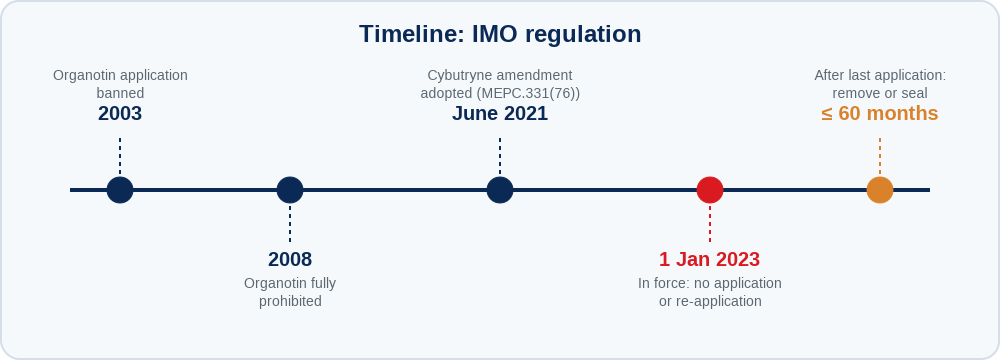
At its 76th session in June 2021, the IMO’s Marine Environment Protection Committee adopted amendments to the AFS Convention that bring cybutryne under control. The amendments entered into force on 1 January 2023. According to the convention text, ships shall not apply or re-apply antifouling systems containing this substance. The substance is identified by CAS number 28159-98-0.
For ships that already carry an external layer containing cybutryne, two options are provided: remove the system, or apply a sealer coat that prevents leaching from the underlying system. This must be done at the next scheduled renewal of the antifouling after 1 January 2023, and no later than 60 months after the last application of an antifouling containing cybutryne.
3. How do you find out what is on the hull?#
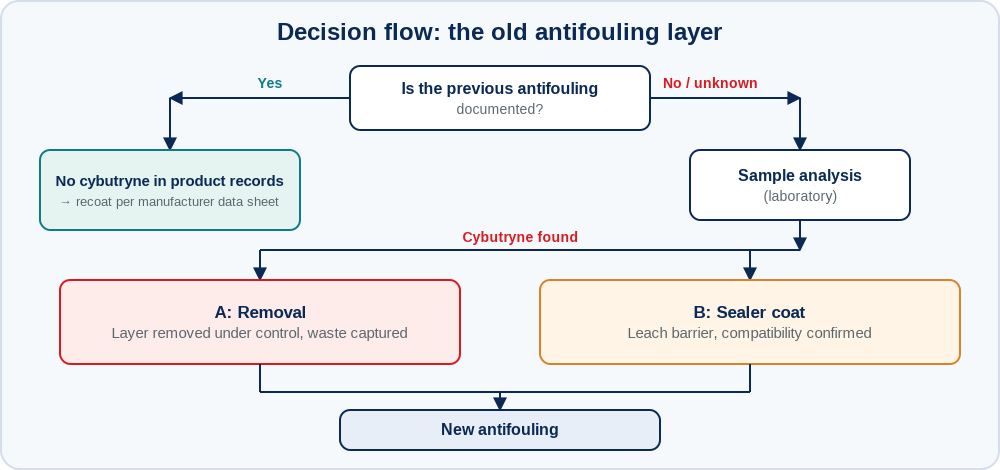
Colour or surface appearance does not reveal which biocide was used. A sound assessment starts with paperwork and, where needed, is completed by analysis.
- Ask for earlier haul-out invoices, work orders and paint purchase records.
- Match product names and batch numbers with the manufacturer’s technical data sheet and safety data sheet, and look for the active substance in the composition section.
- If there is no maintenance log or “paint passport”, ask the seller for a written statement, but do not treat the statement alone as sufficient.
- If records are missing or contradictory, take a cross-section sample through all layers and have a laboratory analyse the active substance.
- Attach the result to the survey report and use it in price negotiations.
When sampling, a small area is cut through all layers and then repaired. The analysis may also show which layer holds what. That information is a cheap investment because it can narrow the scope of any removal.
4. Option A: removing the old layer#
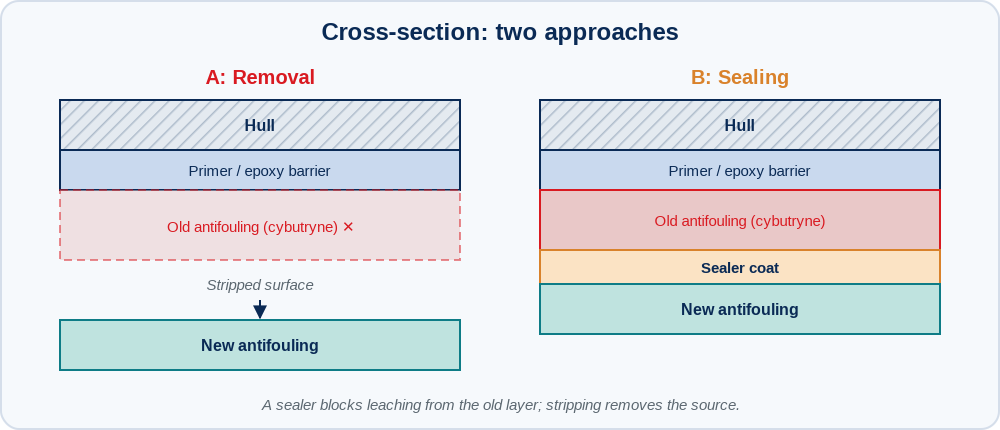
Removal eliminates the source. The hull becomes a clean surface again, and you can build the new antifouling system exactly as the manufacturer describes. Where old layers are thick, cracked or incompatible, it is usually the soundest solution. It also gives you a rare chance to see the hull for osmosis checks and moisture readings.
On the other hand, removal is labour-intensive, dusty and generates waste. In 2024 the IMO published guidance on best management practices for the removal of antifouling coatings from ships (AFS.3-Circ.6). In practice this means working in a covered or enclosed area, capturing the dust and handling the waste separately.
- Pros: removes the source, exposes the surface, lowers the compatibility risk of the new system.
- Cons: high time and labour cost; waste management required; careful method needed so the hull is not damaged.
5. Option B: applying a sealer coat#
A sealer is a barrier applied over the old layer that blocks leaching from it. It is faster than removal and usually generates less waste. On the other hand, the old layer stays on the hull; if it ever has to be removed, the problem has only been postponed.
The deciding point when choosing a sealer is compatibility. The product must be compatible with both the old system beneath and the antifouling that will go on top. This must be confirmed with the manufacturer’s compatibility chart or a written approval, not with general rules of thumb. The sealer’s thickness and number of coats are also set by the manufacturer.
| Criterion | Removal | Sealer coat |
|---|---|---|
| Status of the source | Eliminated | Stays on the hull, sealed in |
| Time and labour | High | Lower |
| Waste | Significant; controlled handling needed | Less |
| Compatibility risk | Low, clean surface | Manufacturer approval essential |
| Chance to inspect the hull | Yes | Limited |
| Long-term effect | Solved once | Removal risk remains for the future |
6. How to decide#
The decision cannot be reduced to one rule. The condition of the surface, the thickness of the old layer, the remaining service life of the yacht and the budget are weighed together. The general approach can be summarised as follows.
7. Waste and the environment#
Particles of old antifouling must not reach the water or the soil. In the yard, use an impermeable surface, dust-collecting sanding or extraction, covers and a waste container. How the collected waste is classified and where it is delivered depends on local legislation; ask the yard or the competent authority.
The US state of Washington has banned Irgarol paints on recreational vessels since 1 January 2023, which shows that the subject is not limited to maritime conventions but also appears in national and local rules.
8. Pre-purchase checklist#
A good purchase is made knowing not just how the yacht looks today but also the future of the system beneath it. Reflecting the removal-or-sealer decision in the price before purchase, rather than leaving it until afterwards, prevents surprises.
9. Common mistakes#
Mistakes about paint history on second-hand yachts fall into a few typical patterns. Knowing them in advance reduces both cost and lost time.
- Assuming colour is a reliable clue: different biocides can look the same and colour is not chemical evidence.
- Treating the seller’s verbal statement as enough: spoken information is not binding unless it is written into the survey report and the sales contract.
- Seeing a sealer as a product that can be applied over anything: compatibility must be confirmed with the manufacturer’s written data.
- Ignoring the waste and time items of removal: the days spent in the yard cost as much as the labour.
- Not recording the decision: which method was chosen and why becomes evidence at the next haul-out or at sale.
Another common mistake is to judge the antifouling decision only by the biocide underneath. The hull’s own condition, such as osmosis, moisture, gelcoat cracks or old repairs, comes up in the same process. A surface exposed by removal is a rare chance to see these problems; choosing a sealer means that chance is not used. The decision should therefore rest not only on “which is cheaper?” but also on “do I need to see the hull?”.
10. Conclusion#
The cybutryne ban added a new check for buyers of second-hand yachts. The right approach is to collect the records first, have a sample analysed if necessary, and then choose between removal and a sealer with confirmed compatibility according to the surface and the budget. On either route the work should follow the manufacturer’s data sheet, the waste should be handled in a controlled way, and every step should be recorded.
Frequently asked questions#
Are cybutryne and Irgarol the same substance?
Yes. Irgarol is the common trade name for cybutryne, CAS number 28159-98-0.
How can I tell whether my older yacht has cybutryne under the paint?
The most reliable evidence is past paint invoices, product names and the technical data sheets or safety data sheets. If no records exist, a laboratory sample analysis is needed; colour or appearance cannot answer the question.
Is a sealer coat enough as an alternative to removal?
The convention text recognises applying a sealer that prevents leaching as an option. A sealer is only a barrier, though: the product must be compatible with the existing system and applied according to the manufacturer’s data sheet.
Is this rule mandatory for my yacht?
The convention’s removal-or-seal requirement has listed exceptions, and the obligation depends on the yacht’s flag, size and the rules where it is kept. Ask the flag administration or the competent authority for a definitive answer.
Why does removing the old layer create a waste problem?
Removal dust and particles may contain old biocides. Use containment, covers and filtered extraction; local rules decide how the waste is classified and disposed of.
Was this guide helpful?
Thank you! Your feedback has been saved.
Guide content is for general information; in practice, the current technical data sheet of the product applies.
Keep reading
Related guides
Antifouling Coatings: Function, Layer Structure and Application Principles
A study of the function, layer structure and application steps of the antifouling system used on underwater hull surfaces.
2 min read UnderwaterChoosing Antifouling: A Decision Based on Usage Profile
A decision-focused study explaining how the type of antifouling should be chosen according to the frequency of use and water conditions.
2 min read UnderwaterChemical Principles of Antifouling Systems
A study of the mechanisms of action and chemical foundations of antifouling systems that prevent marine organisms from attaching to the hull.
2 min read