
Underwater
Biofouling Management Plan and Record Book for a Yacht: A Step-by-Step Template
IMO guidelines recommend a biofouling management plan and record book for ships. On a recreational boat the structure can be much simpler, but the logic is the same: what was done and when must be written down. This guide describes a template you can adapt to your yacht.
Short answer
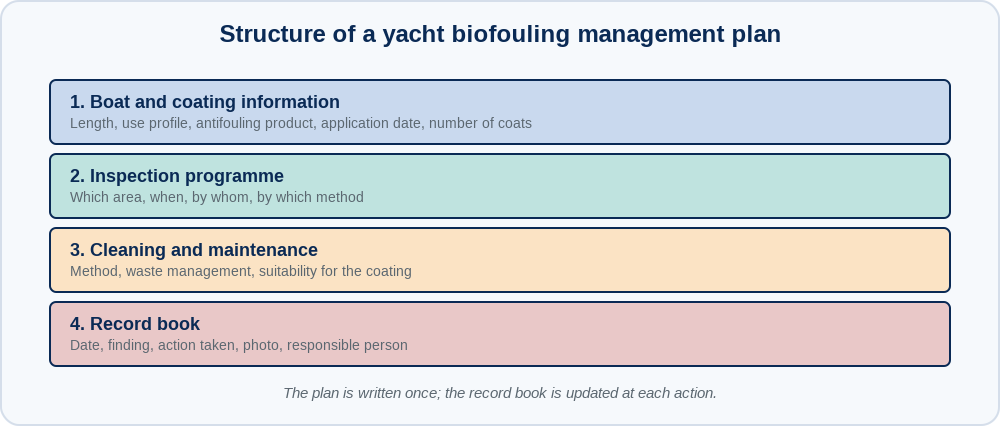
A yacht biofouling management plan has four parts: boat and coating information, an inspection programme, cleaning and maintenance rules, and a record book. The plan is written once and the record book is updated at every inspection and cleaning. Records of date, area, finding, method, product and photo support maintenance decisions and form documentation for arrival inspections and resale.
Key points
- The plan has four parts: boat and coating information, inspection programme, cleaning rules and a record book.
- The plan is written once; the record book is updated at every action.
- Photos taken from the same point make the speed of build-up visible.
- Records carry value at arrival inspections and in resale.
- This template is not an official IMO form but an example adapted from the logic of the guidelines.
1. Why a plan and a record book?#
Most yacht owners treat antifouling maintenance as a seasonal job: the boat is hauled out, the hull is washed, paint is applied and the boat goes back in the water. The date, the product and the conditions of that job are often lost. The next season the question “what did we apply last year?” goes unanswered and the decision rests on guesswork.
A biofouling management plan and record book fill that gap. A well-written plan defines who does what, when and how. The record book documents what was done. Together they make maintenance independent of any one person: even when someone else takes over the boat, the process continues without a break.
2. What does the IMO recommend?#
The IMO guidelines for ships recommend keeping a biofouling management plan and a biofouling record book. The plan covers the antifouling system and measures to protect the hull; the record book covers inspections and maintenance carried out. The separate guidance published for recreational craft explains the same logic at a simpler scale.
3. Structure of the plan: four parts#
A simple yacht plan should not exceed a page or two. It has four parts, each kept short.
3.1 Boat and coating information#
This part holds the boat’s length, type, typical use profile (season length, average cruising speed, time spent in port) and information on the antifouling system: product name, manufacturer, application date, number of coats and any intermediate coat or sealer. It is the basis for understanding the system correctly at the next maintenance.
3.2 Inspection programme#
It states which areas are inspected, how often and by which method. The hull, waterline, rudder, propeller, shaft, water intakes, trim tabs and wedges are listed. Inspection can be done by eye at haul-out and by diving when afloat.
3.3 Cleaning and maintenance rules#
It defines under what conditions cleaning is done, which method is used and how waste is collected. Methods that may damage the coating (stiff brushes, abrasive pads) are removed from the list or allowed only on suitable coatings. The manufacturer’s cleaning instructions are attached to the plan.
3.4 Record book#
The record book is the trace of every action in the plan. A simple table is enough: date, area, finding, action taken, product or method used, a photo link and the person who did the work.
4. What should the record book contain?#
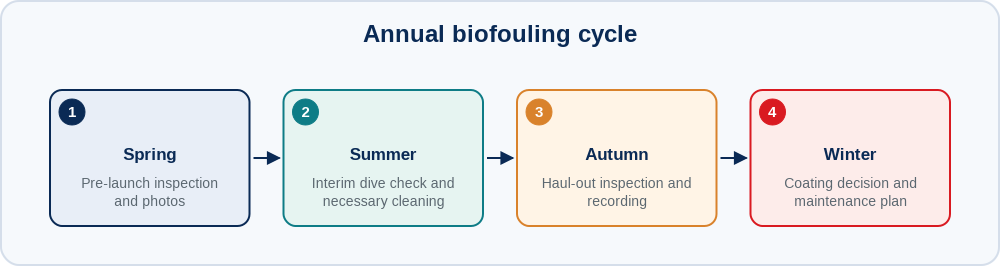
| Field | Sample entry | Why is it needed? |
|---|---|---|
| Date | 14 April | To measure the speed of build-up |
| Area | Propeller and shaft | Niche-area tracking |
| Finding | Thin biofilm, no hard growth | Data for decisions |
| Action | Cleaned with a soft sponge | Record of coating suitability |
| Waste | Collection sheet used | Environmental compliance |
| Photo | propeller-2026-04-14.jpg | Comparison |
| Responsible | Skipper | Traceability |
5. The annual cycle#
The plan divides the year into four periods. The task of each period is small; carried out regularly through the year, they prevent large surprises.
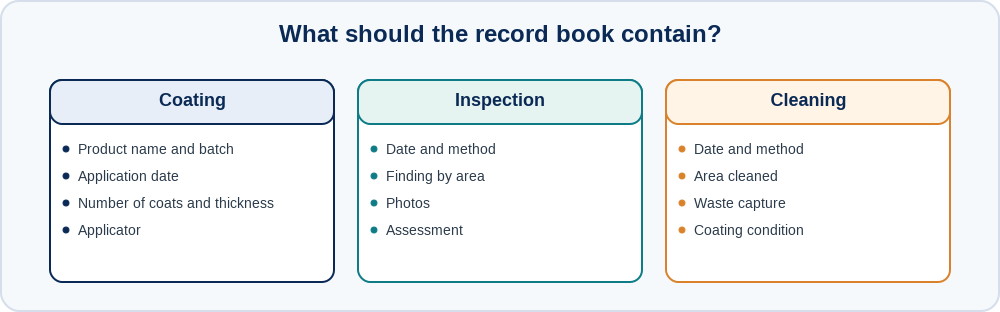
- Spring: before launch, the hull and niche areas are inspected and photographed.
- Summer: an interim dive check is made; if needed, cleaning and recording with a suitable method.
- Autumn: at haul-out the condition is documented again and wear is assessed.
- Winter: the coating decision is made, product and budget are planned and the plan is updated.
6. Photo discipline#
Recorded photos are the strongest tool of the plan. It is enough to shoot the same area from the same angle, in similar light and from the same distance, and to write the date and area name in the file. The speed of build-up over time can then be read by eye. Putting a small ruler or an object of fixed size in the frame makes comparison easier.
Photos can appear in the record book as file names and can be stored in the cloud or a local folder. What matters is that you can find the same photo a year later.
7. Paper or digital?#
Both formats have advantages. A paper log is always at hand on the boat and does not depend on electricity. A digital sheet offers search and sharing and ties the photo directly to the entry. A practical approach is to keep paper as the main log and digital as the backup, or the other way round. Whichever is chosen, regular dated entries are essential.
8. The value of records#
- They base maintenance decisions on data rather than guesses.
- They make it easier to answer questions at arrival inspections and in ports.
- They support the boat’s value and buyer confidence in resale.
- They provide evidence in coating warranty matters and correspondence with the manufacturer.
- They give continuity when the boat changes hands.
In warranty claims, manufacturers often ask for the application date, conditions and maintenance history. Regular records shorten the discussion in such a case.
9. Common mistakes#
- Writing a long and complicated plan; nobody reads or updates it.
- Keeping records only at haul-out and missing mid-season changes.
- Taking photos but not writing the date and area name.
- Writing the product name but not the batch and application conditions.
- Skipping the note on cleaning waste.
The most frequent mistake is postponing the job with “I will write it later”. A record is most accurate and cheapest when made a few lines at a time, right after the action.
10. Example: a filled-in plan for a 12-metre motor yacht#
A plan only becomes clear when applied to a concrete boat. Take a 12-metre motor yacht used in Marmaris that spends about four months a year in the water. Its profile: one or two short outings a week, the rest of the time idle in the marina. That means the hull stays still most of the time.
In part 1 the boat’s length, type and profile are written; the antifouling product, application date, number of coats and applicator are added. In part 2 the inspection programme is defined: a visual check ashore before launch, a dive check of the waterline and niche areas in early July, and a second inspection at haul-out. In part 3 the cleaning rule is: only a soft sponge or a method approved by the coating manufacturer; no stiff brushes; a sheet is used for waste.
In part 4 the record book is a simple table filled with five lines after each inspection. At the end of the season it says: the waterline and propeller area showed first growth in July, the coating wore slightly in August, a short cleaning was needed in September. For the next season that information goes straight into the coating decision: continue with the same system, move to a more durable one, or find a special solution for niche areas.
Writing such a plan takes an afternoon. Yet in front of the next season, the next maintenance or the next buyer, reaching the right information saves hours and sometimes weeks. A good plan is not long; it is usable.
11. Conclusion#
A biofouling management plan turns a yacht’s underwater maintenance from a person-dependent habit into a traceable process. A simple four-part plan and a disciplined record book improve both today’s decision quality and tomorrow’s resale value. Adapt the template to your own boat, keep it short and update it after every action.
Frequently asked questions#
Is a management plan mandatory for a recreational boat?
IMO guidelines recommend a plan and record book for ships; a separate and simpler guidance exists for recreational craft. Obligations vary by country and region, but writing a plan is useful in any case.
Is this template an official IMO form?
No. The template is a practical example adapted from the logic of the guidelines. If an administration requires a specific format, follow its current requirement.
Should the record book be paper or digital?
Either works. What matters is that dates, findings and photos are entered regularly and can be found when needed.
What should I watch for in photos?
Shoot the same area from the same angle in similar light, and put the date and area name in the file name. The difference between two records is then easy to see.
How long should I keep the records?
There is no fixed period; keeping them for the whole life of the coating system and as long as you own the boat is recommended, because they help during a sale.
Was this guide helpful?
Thank you! Your feedback has been saved.
Guide content is for general information; in practice, the current technical data sheet of the product applies.
Keep reading
Related guides
Seasonal Maintenance Calendar and Paint Life
A study of seasonal maintenance planning and the effect of maintenance intervals on boat paint life.
2 min read Refit and MaintenanceAnnual Paint Inspection and Reporting Approach
A study of the scope of annual inspection of boat paint, evaluation criteria and the reporting approach.
2 min read UnderwaterFormation of Algae and Biofilm on the Hull
A study of how algae and biofilm form on the hull, the methods of protection and their effect on the surface.
2 min read