
Underwater
In-Water Hull Cleaning (IMO Circ.918) and the Damage It Can Do to Antifouling Coatings
Cleaning the hull afloat, without hauling out, looks quick and economical. But the wrong method can thin the antifouling coating, release particles and, in some regions, break the rules. This article gives yacht owners a simple framework based on the IMO’s 2025 guidance.
Short answer
In-water hull cleaning is addressed in the IMO’s April 2025 guidance (MEPC.1/Circ.918) under planning, testing, evaluation, reporting and coating compatibility. The core rule for yacht owners: first learn the coating type and the manufacturer’s instructions, check marina and regional rules, choose a gentle method that does not damage the coating, collect waste where possible and record every operation.
Key points
- The IMO published MEPC.1/Circ.918 on in-water cleaning in April 2025.
- Coating type decides the method: biocidal and foul-release coatings need different cleaning.
- Stiff brushes and abrasive methods can thin or damage the coating.
- Some marinas and regions restrict in-water cleaning; check the rule first.
- Method, date and waste management should be recorded.
1. Why is in-water cleaning so controversial?#
Cleaning the hull afloat, without hauling out, is an attractive option: there is no crane, slipway or dry-dock cost and the boat returns to service quickly. For that reason owners and diving contractors often use it, especially in mid-season. At the same time the method carries three risks together: damage to the coating, release of particles and biocide into the water, and the spread of organisms to other places.
The IMO guidance published in April 2025 (MEPC.1/Circ.918) aims to balance these risks. It addresses planning, testing, evaluation, reporting, approval and coating compatibility so that in-water cleaning can be done safely and in an environmentally responsible way. Recreational craft operate at a different scale, but the logic of these headings still guides the yacht owner.
2. The basic idea of the guidance#
The idea behind the guidance is simple: in-water cleaning is neither to be banned outright nor left free; the suitability of the method, the coating and the local conditions decide. The method must not damage the coating, the waste released must be controlled and the operation must be recorded.
3. Know the coating first#
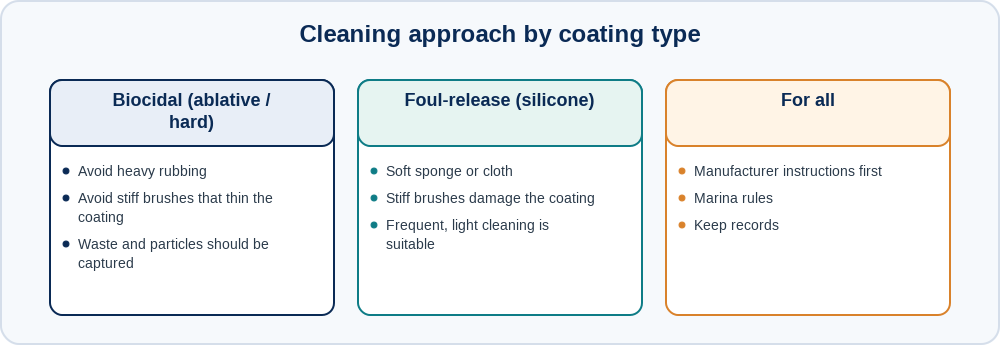
The cleaning decision depends on the coating type. Biocidal coatings (ablative or hard) work through the active substance released from the surface; excessive rubbing thins this layer or disturbs the release. Foul-release (silicone) coatings contain no biocide; their slippery surface makes attachment weak, but the surface is soft and is easily damaged by stiff brushes.
| Coating | Point to watch | Suitable approach |
|---|---|---|
| Biocidal, ablative | Excessive rubbing thins the coating | Light, timely cleaning with waste control |
| Biocidal, hard | Hard surface can be burnished but sheds particles | Suitable pads, manufacturer instruction |
| Foul-release (silicone) | Soft surface; stiff brush causes damage | Soft sponge or cloth, frequent light cleaning |
| Unknown coating | Risk of the wrong method | Document first; if unsure, the gentlest method |
4. Three layers of risk#
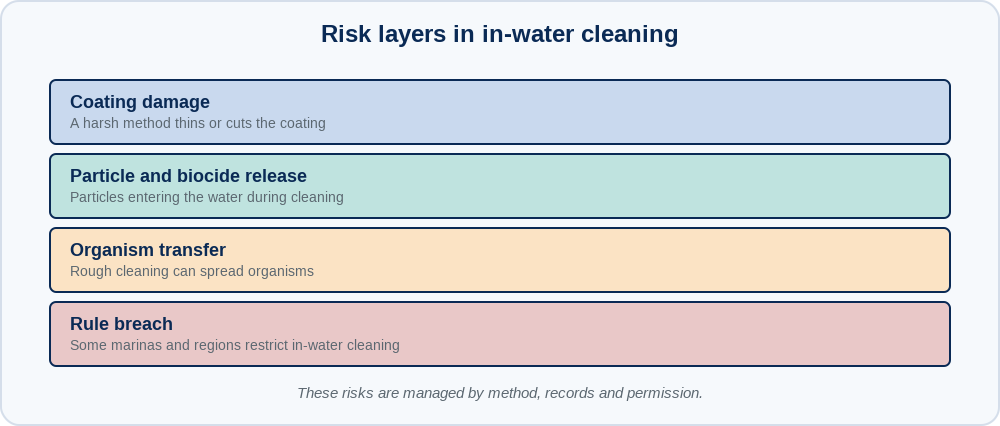
The risks of in-water cleaning are not separate from each other. The diagram below shows four layers of risk that can appear together in the same operation.
- Coating damage: a harsh method thins, cuts or roughens the coating.
- Particle and biocide release: particles enter the water during cleaning.
- Organism transfer: larger organisms can be spread to the surroundings during cleaning.
- Rule breach: some marinas and regions restrict or ban in-water cleaning.
5. Early and light cleaning beats late and harsh cleaning#
Many product makers and industry sources recommend regular cleaning with light methods while the biofilm is still thin. Cleaning after a thick, hard layer has formed needs harsher methods, which puts more load on both the coating and the environment. On slow boats the movement cannot be expected to clean the surface by itself, so a gentle manual intervention may be needed.
For foul-release coatings some manufacturers state that the coating can be cleaned as often as desired. This is an example of how light, regular cleaning keeps performance while protecting the coating. In every case the method stated in the product data sheet is decisive.
6. Marina and regional rules#
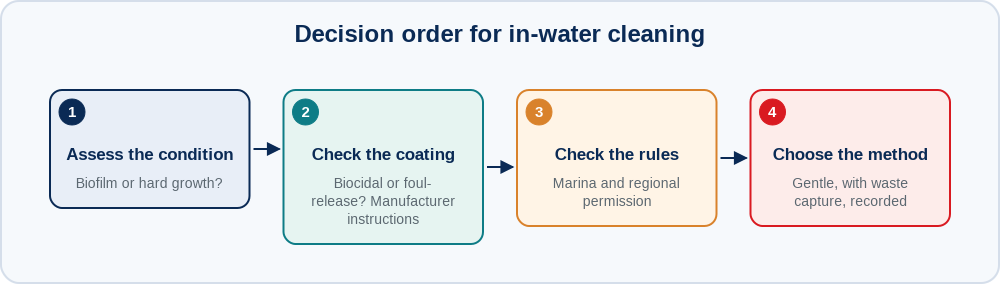
In-water cleaning rules are not uniform around the world. Some marinas and ports ban in-water cleaning, some tie it to a specific method or waste capture, and some allow only authorised contractors. Asking the marina management before planning the cleaning should therefore be the first step.
7. Choosing the method#
The method must match the durability of the coating. The gentlest method is the least risky: a soft sponge, a cloth or equipment with soft brushes. Stiff brushes, scrapers or high-pressure water should be considered only where the manufacturer approves them. For cleaning by diving, which tool the diver will use should be clarified in advance.
- Document the starting condition by photographing the hull and coating.
- Read the coating manufacturer’s cleaning instruction.
- Choose the gentlest sufficient method and tell the diver in writing.
- Use a waste-capture arrangement where possible.
- After cleaning, photograph the coating again and record it.
8. Records and traceability#
Another subject the IMO guidance points to is reporting and traceability. At yacht scale this means a simple record: the date, which areas were cleaned, the method used, the name of the diver or firm, and the condition of the coating before and after cleaning. This record is also valuable at the next haul-out for understanding why the coating has worn.
9. Common mistakes#
- Using a stiff brush without knowing the coating type.
- Arranging cleaning without checking the marina rule.
- Cleaning the hull too late, after a thick hard layer has formed.
- Not giving the diver written instructions on the method.
- Not checking the coating condition after cleaning.
The assumption that “the diver already knows” is an especially common mistake. The diver uses a tool to clean the hull, but only you know the type and limits of your coating. Giving the instruction in writing protects both sides.
10. A short case: two identical boats, two different results#
Take two 11-metre sailing yachts in the same marina. The first is lightly cleaned every six weeks by a diver using a soft sponge and photographed each time. The second is not cleaned at all during the season; in September, when the hull is covered with a thick hard layer, a firm is called and carries out a long clean with stiff-brush equipment.
On the first boat the coating at the end of the season is evenly and thinly worn; the records show which area was cleaned and when. On the second, the harsh cleaning has thinned the coating down to the primer in places and shortened its life. Although the cost of the two approaches may look similar at first, the second boat may have to renew its coating early in the next season.
This example is a plain summary of the “early and light” principle. When cleaning is done before growth builds up, with a method suited to the coating and with a record, it wears both the coating and the environment less.
11. Conclusion#
In-water hull cleaning is a practical and economical tool when done right; when done wrongly it carries risk to the coating, the environment and the rules. The IMO’s 2025 guidance stresses the planning, testing, evaluation and recording sides of the work. The summary for yacht owners: know the coating, check the rule, choose the gentlest sufficient method, manage the waste and record it.
Frequently asked questions#
Is in-water hull cleaning harmful?
Light cleaning can be acceptable if the method suits the coating type. Stiff brushes and abrasive methods can thin the coating, and in some regions the practice may breach local rules.
What is the IMO’s in-water cleaning guidance?
MEPC.1/Circ.918, published on 29 April 2025, is the “Guidance on in-water cleaning of ships’ biofouling”. It covers planning, testing, evaluation, reporting, approval and coating compatibility.
How is a foul-release coating cleaned?
Silicone-based coatings are cleaned with a soft sponge or cloth. Stiff brushes damage the coating; the manufacturer’s instruction is decisive.
Does the marina allow in-water cleaning?
Rules vary by marina and region; some places restrict or ban it. Ask the marina management before cleaning.
How often should I clean?
There is no fixed calendar; use profile, water temperature and coating type decide. Early, light cleaning generally does less harm than late, harsh cleaning.
Was this guide helpful?
Thank you! Your feedback has been saved.
Guide content is for general information; in practice, the current technical data sheet of the product applies.
Keep reading
Related guides
Formation of Algae and Biofilm on the Hull
A study of how algae and biofilm form on the hull, the methods of protection and their effect on the surface.
2 min read Paint and CoatingsPreventing Mould and Algae Growth: A Surface Protection Approach
A study of the causes of mould and algae growth on boat surfaces and their prevention with a paint system.
2 min read UnderwaterChemical Principles of Antifouling Systems
A study of the mechanisms of action and chemical foundations of antifouling systems that prevent marine organisms from attaching to the hull.
2 min read