
Paint and Coatings
Induction Time in Paint: Why Wait?
Induction time is a short pause between mixing and application. This article explains what it does, in which products it is required and why the data sheet should be followed, using general sources.
Short answer
Induction time (sweat-in) is the period a two-component coating must stand after base and hardener are mixed and before application; this wait lets the chemical reaction begin and the components become compatible. According to Corrosionpedia insufficient induction time causes coating failures; many epoxies need a fixed interval for the resin and hardener to become fully compatible, otherwise film appearance and performance are poor. Not every coating requires induction; follow the product’s technical data sheet. Carboline advises not skipping this time if the data sheet calls for it. This article is general information.
Key points
- Induction time is the wait after mixing before application; it is not needed for every product.
- In some epoxies it is needed for resin-hardener compatibility; skipping weakens film appearance and performance.
- Carboline advises not skipping induction if the data sheet requires it and thinking about amine blush risk.
- Induction is said to be more critical in cold and humid weather; time depends on temperature.
- Take the time from the data sheet, start the clock at mixing and plan it together with pot life.
1. What is induction time?#
Induction time, known in the trade as “sweat-in time”, is the time a two-component coating’s mix must stand after base and hardener are mixed and before application. The Corrosionpedia definition says in paint it is the duration that must elapse after mixing fresh paint material before starting a satisfactory application. According to an industry note this wait allows the necessary chemical reaction to begin and ensures the product reaches the right consistency and chemical readiness. Not every coating requires induction; the manufacturer’s product data sheet must always be followed.
This article gives a general summary and recommends no time for any product. Induction and pot-life values vary by product; the technical data sheet governs. For pot life and mix ratio see the related articles.
2. Why wait?#
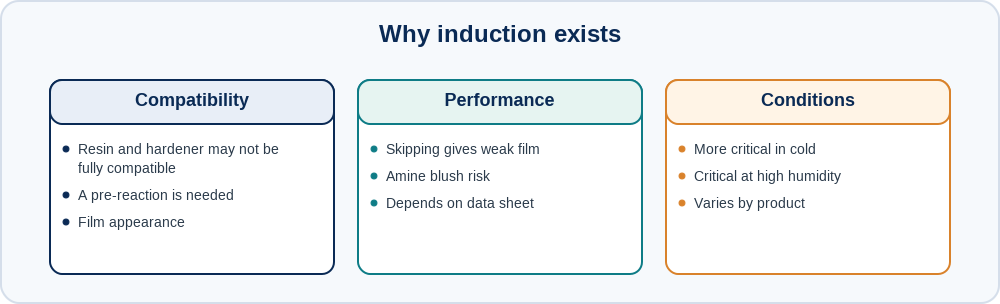
According to Corrosionpedia many epoxy coatings require a fixed time interval to make the epoxy resin and hardener fully compatible; when this pre-reaction time is not met film appearance and coating performance are poor. PCI Magazine’s article on epoxy curing agents also says epoxy resins tend to have limited compatibility with some curing agents, so an induction time is needed. In other words the two components may not be fully homogeneous and compatible the moment they are mixed; a short wait allows the first steps of the reaction to progress and the mix to behave more consistently.
Carboline’s guide on amine blush says some epoxy coatings require a period of induction or “sweat-in” time for the polymer chains to cross-link fully and that this time should not be skipped if the coating’s product data sheet calls for one. The same guide says that during epoxy cure carbon dioxide and moisture can react with the epoxy’s available amine and draw it to the surface, forming an amine blush (also “amine sweat” or “bloom”), and that atmospheric conditions should be controlled as much as possible. Induction is listed as one method for reducing this risk; that is, waiting is part of a strategy to prevent surface defects, not only for compatibility.
| Topic | Information | Note |
|---|---|---|
| Definition | Wait after mixing before application | Also known as sweat-in |
| Why | Resin-hardener compatibility, pre-reaction | Common in epoxies |
| If skipped | Poor film appearance and performance | Corrosionpedia |
| Amine blush | Effect of carbon dioxide and moisture | Carboline: control conditions |
| Every product? | No | See the data sheet |
3. Does every paint need induction?#
No. An industry note stresses that not every coating requires induction and that the manufacturer’s technical data sheet should be followed. Data sheets of some polyurethane finishes also carry an “induction time and pot life” heading with a temperature table; this shows some products define a temperature-dependent wait. On the other hand an epoxy seller quoted on a forum says modern epoxies do not need an induction or sweat-in time and that one should be wary if the epoxy requires it. This is a seller’s view and not a general rule; the data sheets of some paint epoxies explicitly call for induction. In conflicting views the thing to do is follow the data sheet of the product in your hand.
For products that need induction some makers give the time in a table with temperature; the time lengthens as temperature falls. An epoxy coatings guide says induction time is critical especially in cold weather and high humidity. So if you apply on a cold morning read the data sheet time more carefully and, if needed, let the material stand in a warm place before application.
4. Planning induction and pot life together#
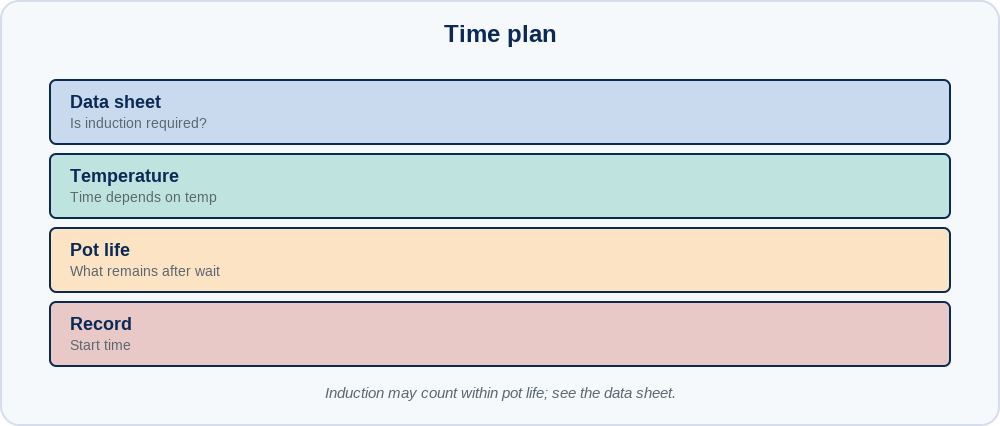
By the time induction ends your pot-life clock has long been running. In most data sheets pot life is given from the moment of mixing; that is, induction time is spent out of pot life. So read both induction and pot life together: for example if induction is half an hour and pot life four hours you have about three and a half hours to apply. These numbers are only a calculation example; use the data sheet for your own product.
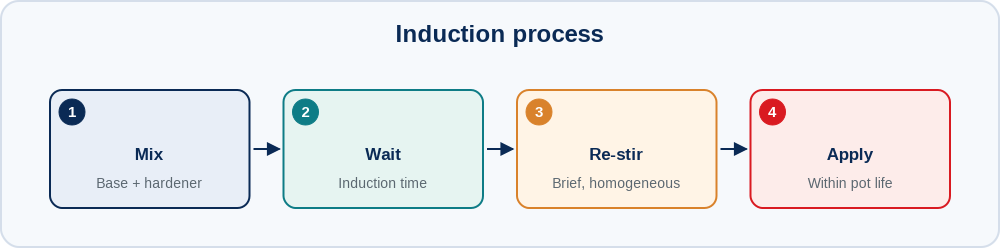
During the wait leave the mix closed and undisturbed; some makers recommend a short re-stir after the wait. Leaving the mix in the can can speed up in heat; so use a timer and keep the can in the shade in hot weather. Follow the data sheet instruction rather than splitting the mix into small pots to wait.
- Check in the data sheet whether induction time is required.
- Read the time for your temperature.
- Mix base and hardener at the right ratio.
- Start the clock and let the mix stand.
- If needed re-stir briefly after the wait.
- Apply within pot life.
- Record time, temperature and batch.
5. Possible consequences of skipping#
Corrosionpedia says skipping induction time can cause coating failures. In practice this is thought to show as uneven film appearance, gloss and flow problems, residue or tackiness on the surface and poor performance. But linking a specific defect to induction alone is difficult; moisture, temperature, ratio and surface preparation can also play a part. So for diagnosis all conditions must be assessed together.
Amine blush is a defect often met in working with epoxy and is more likely in a cold, humid environment. Skipping induction cannot be said to be the only cause; but makers such as Carboline list not skipping the wait among the first items in the prevention list. No specific time or fix is recommended in this article; if amine blush is suspected on the surface see the maker’s cleaning and recoating instruction.
5b. Practical notes for boat application#
In boat painting induction is mostly managed outdoors at changing temperatures. Early in the morning when hull and air are cool the material is cool too; then the longer time in the data sheet may apply. In the afternoon in the sun the material in the can warms up and both induction and pot life shorten. So prepare the mix near the work area and in the shade, keep the timer visible and split the job clearly in the team: while one person mixes and waits another can do a last check of the surface.
Also scraping the pot base and sides thoroughly while mixing helps secure the homogeneity expected from induction; unmixed parts are not fixed by the wait. Keeping the can closed during the wait also keeps dust and moisture out of the mix. To remember which product needs induction, writing the time and duration on the can is a practical habit.
6. Common mistakes#
- Applying without checking whether induction is required.
- Not adjusting the time for temperature.
- Not starting the clock during the wait.
- Thinking of induction apart from pot life and overrunning the time.
- Shortening the time in cold and humidity.
- Skipping the re-stir after the wait (if the maker calls for it).
- Relying on a forum view and ignoring the data sheet.
7. Checklist#
8. Conclusion#
Induction time is a short pause after mixing and before application in some two-component coatings and it helps resin-hardener compatibility and proper film formation. Not every product needs it; the data sheet governs. Skipping can lead to poor film appearance and performance; it is more critical in cold and humidity. Start the clock at mixing, plan induction together with pot life and follow the data sheet. This article is general information.
Frequently asked questions#
What is induction time?
The wait in a two-component coating after base and hardener are mixed and before application; it lets the reaction begin and the components become compatible.
Does every paint need induction?
No. Not every coating requires it; see the product’s technical data sheet. Some claims say modern epoxies do not need it, but this varies by product and the data sheet governs.
What happens if I skip induction?
According to Corrosionpedia insufficient induction leads to poor film appearance and performance problems; Carboline advises not skipping it and thinking about amine blush risk.
Is induction included in pot life?
It varies by product; in some data sheets induction and pot life are given together. Note the mixing time and plan per the data sheet.
Does the time lengthen in the cold?
Time depends on temperature and because reaction slows in the cold induction is said to be more critical; for exact time see the data sheet.
Was this guide helpful?
Thank you! Your feedback has been saved.
Guide content is for general information; in practice, the current technical data sheet of the product applies.
Keep reading
Related guides
Boat Colour Selection and Solar Reflectance: Effect of Heat Absorption on Surfaces
A study of the effect of boat paint colour on solar reflectance and surface temperature.
2 min read Paint and CoatingsCauses and Diagnosis of Paint Blistering
A study of the sources, types and diagnostic approach to blistering on boat paints.
2 min read Paint and CoatingsNumber of Coats in Epoxy Coating Systems
A study of the effect of the number of coats in epoxy coating systems on protective performance and thickness.
2 min read