
Paint and Coatings
Paint Temperature and Humidity: Ideal Application Conditions
Even the right paint and good surface preparation may not deliver in unsuitable weather. This article explains the effect of temperature, humidity and dew point on paint application using maker documents and general sources.
Short answer
In paint application air temperature, surface temperature and relative humidity must be assessed together. Makers ask for the surface to be at least 3 °C above the dew point; International in one product document says not to apply paint to surfaces less than 3 °C above dew point or warmer than 41 °C and in an expert tip says relative humidity should not exceed about 85 percent. According to Yacht magazine for one-component products makers generally specify a 5 °C substrate temperature and for two-component often 12 °C or more. Condensation can lead to poor adhesion, loss of gloss and a milky look. Read ranges from the product data sheet; this article is general information.
Key points
- Air temperature, surface temperature and relative humidity are assessed together; ranges come from the product data sheet.
- Surface temperature must be at least 3 °C above dew point; use a surface thermometer.
- Two-component products generally need a higher minimum temperature than one-component ones.
- Condensation can create poor adhesion, loss of gloss and a milky look.
- When conditions are borderline postponing is usually cheaper than correcting defects later.
1. Why do conditions matter so much?#
Paint drying and cure are chemical and physical processes that depend on temperature and humidity. According to International Yacht Paint’s expert advice air and surface temperature affect the drying properties of any paint; products are tested across a range of temperatures to determine drying times and application characteristics and extreme conditions should be avoided. The same source says residual heat (for example from a surface warmed by the sun) can result in poor flow and levelling, rapid drying, cracking and loss of gloss and recommends measuring the surface temperature with a surface thermometer.
This article is a general summary and recommends no temperature or humidity range for any product. Always read ranges from the product’s technical data sheet. For pot life, induction and thinning see the related articles.
2. Temperature: air and surface measured separately#
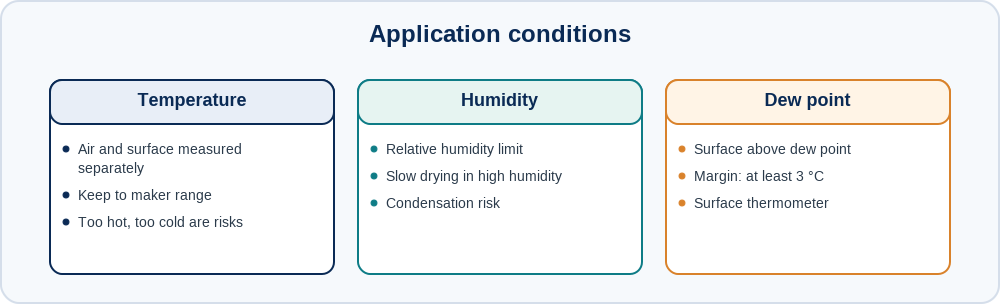
Makers give separate ranges for air, surface and paint temperature. For example one International polyurethane finish document says not to apply paint to surfaces less than 3 °C above dew point or warmer than 41 °C, with product temperature 15 to 35 °C and ambient temperature at least 5 °C. In another product of the same maker ambient and substrate temperature are given as 10 to 40 °C. These examples show ranges change with the product. Yacht magazine writes that for one-component products makers generally specify a substrate temperature of five degrees and for two-component paints or primers often 12 degrees or more.
Besides temperature, the state of surface and air relative to each other matters. Yacht magazine says the hull should be as warm as the ambient air or preferably three degrees or more warmer; if the hull is colder than the air, moisture in the air will condense on it. If paint is applied onto condensation adhesion weakens and it can peel later; if condensation begins after application gloss worsens or the paint turns milky. So care is needed in the early morning and late evening after sunny but cold nights.
| Source (example) | Range | Note |
|---|---|---|
| International polyurethane (document 1) | Surface at least dew point +3 °C, at most 41 °C; product 15–35 °C; ambient at least 5 °C | Varies by product |
| International polyurethane (document 2) | Ambient and surface 10–40 °C | Another product |
| Yacht magazine (general) | One-component 5 °C; two-component often 12 °C and above | Makers generally |
| Intercryl 588 (document) | Cure above 10 °C and 3 °C above dew point | Deck system |
3. Humidity and dew point#
Relative humidity (RH) is the ratio of water vapour in the air to the maximum it can hold at that temperature. International explains that air can only hold so much water or solvent vapour at one time, that as relative humidity increases the level of solvent vapour the air can hold reduces and so the paint dries more slowly. In another tip from the same source it says paint should not be applied above a maximum relative humidity of around 85 percent, at which level you reach the dew point regardless of surrounding temperature. This is a maker’s tip; read the exact limit from your product’s data sheet.
Dew point is the temperature at which water vapour in the air begins to condense. Teknos recommends the surface temperature be at least 3 °C above dew point and advises using a dewpoint dial or surface thermometer. International also says dew point matters when applying paint because evaporation of the solvent from the paint draws heat from the surface, cooling it; that is, surface temperature can fall during application. So dew point needs attention not only before application but throughout application and drying.
4. Risks in hot, cold and windy weather#
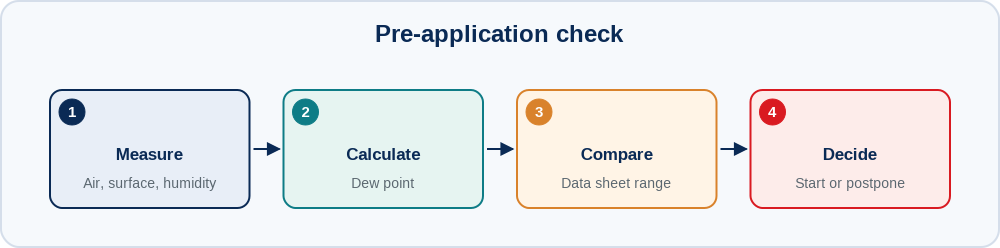
Hempel’s hot-climate application guide says shorter pot life, orange peel, tendency to run and sag, a shorter overcoating interval and cosmetic problems increase in heat. The guide also says additional thinning increases the tendency to sag. So moving application to the cool hours of early morning or late afternoon, storing material cool and working in the shade are useful measures in heat. In the cold cure slows, condensation risk rises and some products may not cure at all; avoid application below the minimum temperature.
Wind matters too: wind flashes solvent off quickly, creates drying differences on the surface and carries dust. Air movement is good but too much can give orange peel and a dry-spray effect. If painting in an enclosed space provide ventilation; but because solvent vapours can be flammable keep away from fire and spark sources. For safety detail see the product’s safety data sheet.
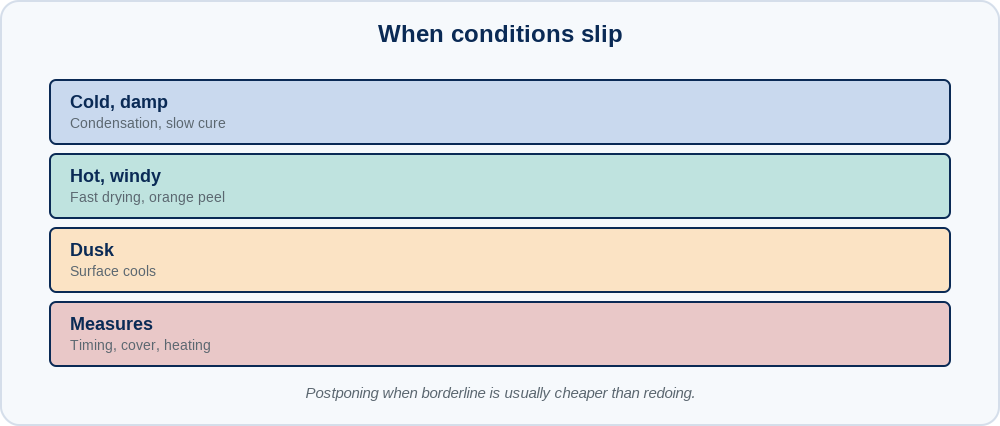
- Measure air temperature, surface temperature and relative humidity.
- Calculate the dew point or find it with a dial.
- Verify the surface is at least 3 °C above dew point.
- Compare with the data-sheet air, surface and product temperature ranges.
- Forecast the daytime change and the night-time fall.
- If conditions are borderline consider postponing.
- Record the conditions (temperature, humidity, time).
5. Planning and records#
Plan painting around the weather: International advises checking the forecast across preparation, application and drying phases when painting outside and deciding whether to start by considering air and surface temperatures, humidity and dew point. Sunny days at the end of winter and start of spring are tempting but nights can be cold; near sunset the surface cools and condensation risk rises. Plan to finish painting early enough in the day to spend the drying period outdoors.
Record temperature, humidity, dew point and time for each application; these records help find the cause if defects appear later. If condensation or moisture is suspected, postponing is often far cheaper than stripping and redoing the defect. If the boat is painted in a closed shed, temperature swings inside the shed can also create condensation; surfaces that look freshly washed are a warning sign.
6. Common mistakes#
- Looking only at air temperature without measuring the surface.
- Ignoring the dew point margin.
- Applying paint late in the evening.
- Rushing in high humidity.
- Thinning more in heat.
- Painting a sun-warmed surface.
- Not recording conditions.
7. Checklist#
8. Conclusion#
In paint application temperature, humidity and dew point must be assessed together: measure air and surface temperature separately, make sure the surface is at least 3 °C above dew point and keep to the ranges in the product data sheet. Condensation spoils adhesion and appearance; in heat pot life shortens and sagging and orange peel increase. When conditions are borderline postponing is generally the cheapest solution. This article is general information; your product’s data sheet governs.
Frequently asked questions#
What is the lowest temperature for paint?
It varies by product. According to Yacht magazine for one-component products a 5 °C substrate temperature is generally specified and for two-component often 12 °C or more. See your own product’s data sheet.
Why a 3 °C dew point margin?
Makers such as Teknos and International recommend the surface be at least 3 °C above dew point; this margin helps prevent condensation on the surface.
What should relative humidity be?
In an expert tip International advises not applying paint above about 85 percent; the exact limit varies by product and the data-sheet range governs.
Can air and surface temperature differ?
Yes. If the hull is colder than the air, moisture in the air can condense on it; Yacht magazine advises the hull be as warm as the air or preferably three degrees warmer.
What happens in hot weather?
Hempel says problems such as short pot life, orange peel, sagging and short overcoating interval increase in heat.
Was this guide helpful?
Thank you! Your feedback has been saved.
Guide content is for general information; in practice, the current technical data sheet of the product applies.
Keep reading
Related guides
Boat Colour Selection and Solar Reflectance: Effect of Heat Absorption on Surfaces
A study of the effect of boat paint colour on solar reflectance and surface temperature.
2 min read Paint and CoatingsCauses and Diagnosis of Paint Blistering
A study of the sources, types and diagnostic approach to blistering on boat paints.
2 min read Paint and CoatingsNumber of Coats in Epoxy Coating Systems
A study of the effect of the number of coats in epoxy coating systems on protective performance and thickness.
2 min read