
Refit and Maintenance
Launch, Sea Trials and the Handover File
A refit meets its real test when the boat goes back into the water and runs at sea for the first time. Launch, sea trials and the handover file are the three stages of that test, and all three are tied to records.
Short answer
After launch the waterline, sealing and systems are checked; sea trials test navigation and systems under real load; the handover file brings together all measurement, record and test results. A refit is not considered closed until all three steps are complete.
Key points
- At launch the waterline and sealing are checked first.
- Sea trials test the systems under real load.
- The handover file gathers all the refit evidence in one place.
- The maintenance plan is handed to the owner with the boat.
Checks before launch#
Before the boat goes into the water, all sealing points and sea cocks are checked again. The sea cocks below the hull are closed and drain plugs are fitted. The paint and sealant along the waterline are inspected. The load the hull will take during lifting is assessed together with the support points. This preparation reduces the stress that entering the water places on the hull.
Launch#
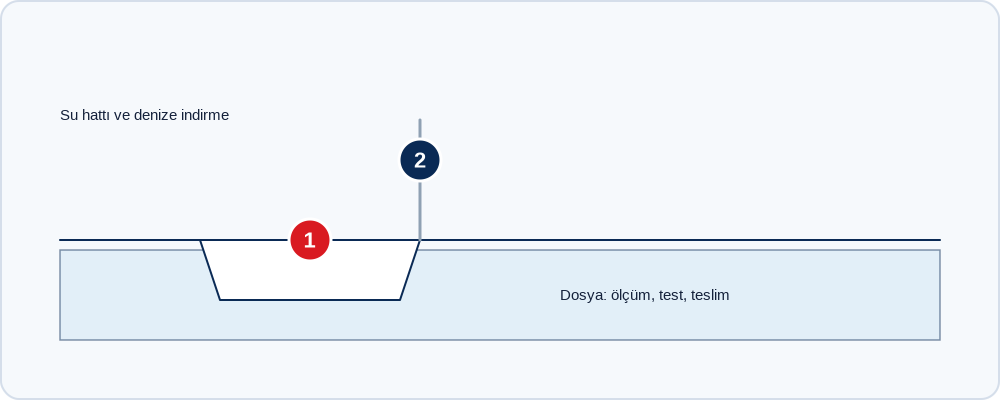
The boat is lowered into the water with lifting equipment and brought to balance at the waterline. In the first moments it is watched for water entering the hull, for leaks and for correct trim. If there is a leak, the boat is lifted out at once and the cause is found. If the waterline does not match the marked height, the weight distribution is corrected.
| Check | Method | Acceptance |
|---|---|---|
| Hull leak | Observation and pump operation | No significant water ingress |
| Waterline | Measurement against marked height | Matches the manufacturer and design value |
| Stern tube | Observation without engine running | No dripping |
| Sea cocks | Opening and closing trial | Operates without trouble |
Sea trials#
Sea trials test the systems by running the boat in real conditions to see whether they work correctly together. The test covers the engine, steering, electrics, plumbing and navigation equipment. The trial run is planned from low speed up to high speed. Each system is run separately and the results are recorded. At the end of the test, unfinished work and corrections are tied to a list.
The handover file#
The handover file is the document that brings together all the evidence of the refit. It should contain: scope of work and contract, budget and time plan, measurement and quality records, plumbing and electrical diagrams, the material list, pressure and sealing test results, the sea trial report and the maintenance plan. The file is handed to the owner and to the future maintenance team.
Maintenance plan and handover#
At the end of the handover file sits the maintenance plan. The plan covers replacement of cathodic protection anodes, checks on sealing glands, inspection of hardware on sailing yachts and engine service intervals. This plan is the most concrete way to keep the value of the refit.
Lifting and launching safely#
Launching is a planned operation, just like haul-out. The slings go at the points marked at haul-out, positioned to avoid the propeller shaft, transducers and other underwater equipment. Wind and weather are checked first; in strong wind a boat hanging in slings can swing and damage itself and nearby boats. Everyone's role is agreed in advance and one person gives the commands.
The boat is not released from the slings the moment it touches the water. While it is held, someone goes aboard and checks every through-hull, the shaft seal and the rudder tube for water. If there is a problem, the boat can be lifted straight back out.
Starting the engine afloat#
When the engine is first started afloat, raw water flow is checked at once. If no water comes out with the exhaust, the engine is stopped immediately; the seacock may be closed, the impeller damaged or the strainer blocked. Mechanical shaft seals are bled of air as the maker advises. With the engine idling, oil pressure, coolant temperature and charging voltage are watched.
Commissioning navigation equipment#
Navigation equipment removed or newly fitted during the refit is recommissioned afloat. The speed log is calibrated over a known distance. The compass may have acquired deviation from the engine, cables or new metal hardware; this is checked and corrected if needed. The autopilot is set up through the maker's commissioning steps, and radio and emergency beacon registrations and operation are checked.
The sea trial programme#
Sea trials follow a written programme stating which tests are run, in what order, under what conditions and what is measured. A typical programme covers idle, cruising and full-load running, astern, steering from lock to lock, the anchor windlass, and pumps and electrical systems under load. Every reading is recorded with date and time. A suitable weather window is chosen, an adequate, experienced crew is aboard, and lifejackets, communications and emergency equipment are ready.
The punch list#
Every defect found during and after the trials goes on a punch list with its description, owner, target date and sign-off. The list separates items to close before handover from minor ones that can follow, and it is reviewed with the owner.
First check after handover#
A first check is recommended after a set running time or date. The engine and shaft line are reviewed, rig tensions checked, and seals and hose clamps retightened. New parts can settle in first use and need small adjustments; this check is also part of the warranty process.
How long do sea trials take?
It depends on the scope of the refit. A few hours may be enough for simple work, while a major refit can need several days in different conditions.
Should the owner join the sea trials?
It is recommended. Testing the systems together lets questions be answered on the spot.
Conclusion#
Launch, sea trials and the handover file are the last three links of a refit. When the boat sits balanced in the water, its systems have been tested at sea and all the evidence is gathered in the file, the refit is truly complete. This article closes the DR. YACHT refit series; you can return to the earlier thirty articles to find the topic you need.
Was this guide helpful?
Thank you! Your feedback has been saved.
Guide content is for general information; in practice, the current technical data sheet of the product applies.
Keep reading
Related guides
Quality Control in Refit: Measurement, Records and Inspection
How is the quality of refit work measured? Principles of measurement points, record keeping and staged inspection, with a check list before handover.
6 min read Refit and MaintenanceTank Inspection, Maintenance and Repair: Holiday Testing, Thickness Measurement and Records
Inspection, thickness measurement, holiday testing, repair approaches and records for steel boat tanks, summarised from source accounts with their limits.
10 min read Refit and MaintenanceGrey Water, Black Water and Shower Tanks: Corrosion, Lining and Design
Why grey, black and shower tanks on steel boats corrode, what an internal lining does and design details, summarised from source accounts.
11 min read