
Paint and Coatings
Paint Problems Around Leaking Windows and Ports
Paint problems around windows and ports are mostly linked to leaks in sources; first find where water enters, think about paint only after. This article summarises the accounts with their limits; it is not a product, method or time recommendation.
Short answer
A yachting magazine writer says every boat he has owned has had at least one leaking window or hatch, temporary bodges never lasting more than a few days and the only way being to do it properly; he writes that the most common leak areas on hatches are the rubber gasket or the seal around the glass in the frame. A sealing guide says butyl-based sealant has a working life of around twenty years at most, the top strip usually going first. A maintenance article says on a hatch frame paint and powder coating blister and peel and that where paint ends at the gelcoat is the first place new paint will peel. Forum users describe cases of water coming through the core and out at the frame. This article recommends no product; the maker and a qualified yard govern.
Key points
- Paint blistering and peeling around windows and ports are mostly linked to leaks.
- An opening hatch is described with three seals: glass-to-frame, frame-to-boat and the rubber opening gasket (magazine).
- Butyl-based sealant working life can be about twenty years, failing first at the top strip (guide).
- Water can pass through the core and appear at the frame; there are warnings against quick fixes (forum).
- Painting before the source is found can hide the problem; for product and time the maker and a qualified yard govern.
1. A paint problem is often a leak symptom#
When you see blistering, peeling or water marks around windows and ports, sources mostly describe it as a symptom of a problem, the real question being where the water enters. This article is a general summary; it gives no product, sealant type, number of coats or time and is not application advice. Sources are magazine, guide, maker and forum accounts and may differ; maker and user accounts are labelled.
2. Where do leaks come from?#
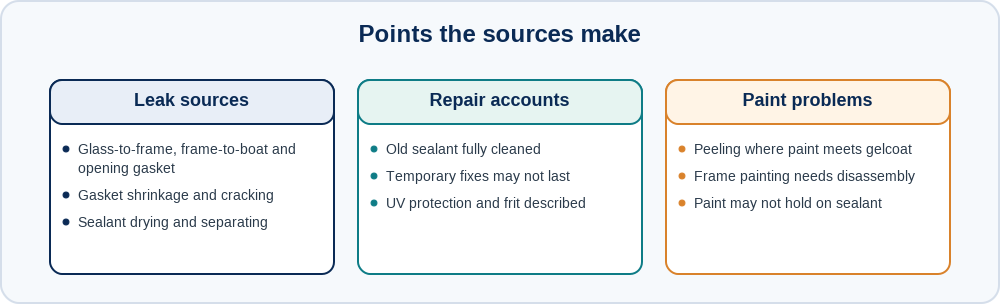
A yachting magazine writer says every boat he has owned has at some point had at least one leaking window or hatch, temporary bodges never lasting more than a few days and the only way being to do it properly. He writes that on hatches the most common leak areas are the rubber gasket or the seal around the glass where it fits into the frame, advising leaving the base plate undisturbed unless it is known to leak. The same article describes three seals for an opening hatch: glass to frame, frame to boat and the rubber opening seal; it says glass is usually bedded in butyl non-adhesive sealant as the frame holds it in place.
| Source | General account | Caution |
|---|---|---|
| Rubber opening gasket | Shrinkage and cracking | Even seating |
| Glass-to-frame sealant | Butyl or sealant | Limited working life |
| Frame-to-boat seam | Seam drying and separating | Core moisture risk |
3. Paint, sealant and core#
A sealing guide writes that butyl-based sealant has a working life of around twenty years at most, the first part to go usually being the top strip exposed to strong rays. A sailing magazine article says windows should have a UV-protective frit coating, like the black dot-matrix on car windscreens, that stops light attacking the sealant, and that if absent a film can be applied; that is an expert account and may not apply to every boat.
A maintenance article describes on an aluminium hatch frame the anodised finish fading, paint and powder coating beginning to blister and peel and the lens scratched or cracked; it writes that where paint ends at the gelcoat is where new paint will start to peel first and that to paint the frame the hatch needs disassembly, even if painting while still on the deck may work. A maker and a forum user also describe removal, full cleaning of the old sealant and resealing; one user writes of taping around the window, marking its outline and applying sealant. That is a user method, not a recommendation.
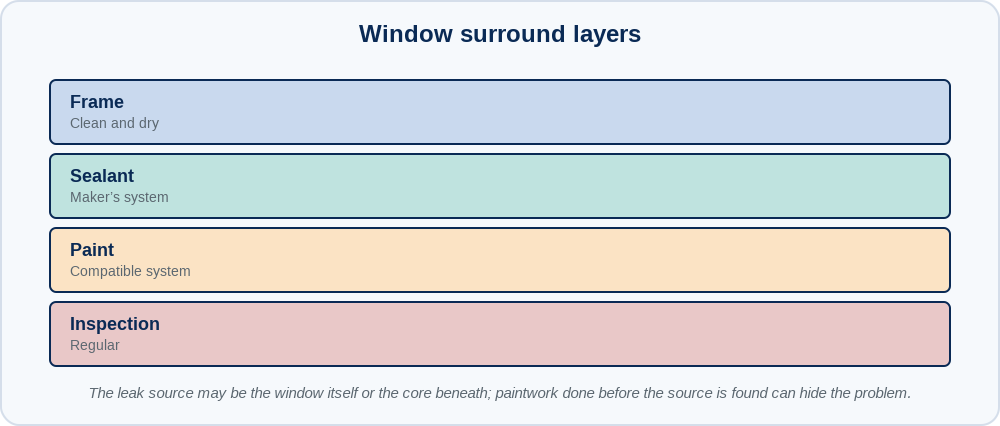
In a sailboat owners’ forum one user writes that the window is held by the bedding compound and not only the screws, so butyl tape may not be appropriate; another post describes a case where water had been seeping through the core and finding its way out at the window frame, given as a cautionary tale against quick fixes. That is a user account and your own boat may not be the same; but it shows that renewing paint without finding the source can hide the problem.
A retailer’s inspection guide lists as signs to check flattened, cracked or shrunken gaskets, gaps where gasket compression looks uneven around the perimeter, dried, separated or missing sealant at frame edges, cracks in the frame or deck around hinge mounting points and latches that do not engage cleanly. That is a seller guide; this inspection is not a diagnosis and if in doubt a qualified yard should be consulted.
On the paint side, sources describe that paint may not hold over sealant and that incompatible products can cause trouble; compatibility can only be confirmed from the maker’s document. Renewing paint without finding the source and doing the necessary repair can lead to the same signs returning.
4. A practical frame#
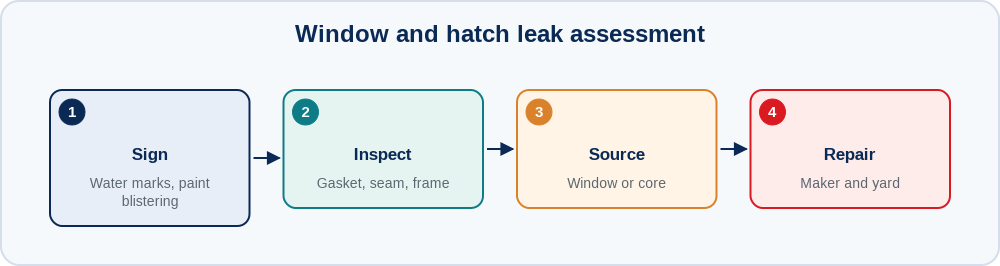
- Inspect: look at the gasket, seam, frame, water marks and paint blistering.
- Tell the source apart: the window, the frame seam or the core beneath.
- Bearing in mind temporary fixes may not last, decide the repair method with a craftsman.
- If old sealant must be cleaned and resealed follow the maker’s instruction.
- Renew paint only after the source is dealt with, with a compatible system.
- Plan regular inspection.
- Keep records; read the safety data sheet.
5. Limits#
Sources overlap that paint problems around windows and ports are mostly linked to leaks and that the source must be found; they differ on method, sealant type and lifespan. A guide describes butyl life as twenty years while users relay their own experience. So there is no single right answer; the boat, window type and the maker’s instruction govern. This article is not application advice.
5b. Where sources differ#
A magazine says temporary fixes do not work; a guide says butyl can work twenty years; a retailer lists inspection signs; a forum user describes water coming through the core. These are sources speaking in different contexts and with different interests. The difference means consulting the maker and a qualified yard to understand the cause on your own boat.
This article is general information; it recommends no product, method, ratio, number of coats or time. The maker’s data sheet and a qualified yard govern.
5c. A practical frame for reading the sources#
The sources are magazines, makers, sellers and forums; each writes in its own context. None knows the window type, the sealant or the condition of the core of your boat. So taking the shared message and consulting the maker and a qualified yard for detail is reasonable.
Sealants, solvents and removal work can carry health and injury risks; sanding dust and paint vapours are risks too. This article describes no personal protection, ventilation or waste method; read the product’s safety data sheet, consult a qualified yard and follow the relevant safety rules. If there is rot or a structural problem around windows and ports apply to a qualified specialist; electrical wiring around a leaking window can also be a hazard.
Seller and maker statements are the firm’s own account of its product and have not been independently verified. A product’s compatibility with another coating should always be checked in the product’s technical document; where a document and a guide conflict, the maker’s document and a qualified yard’s assessment should be used. Recording decisions and product details helps later maintenance.
6. Common mistakes#
- Renewing paint without finding the leak source.
- Taking a temporary fix as permanent.
- Painting incompatible paint over sealant.
- Ignoring core moisture.
- Treating a forum account as a firm rule.
- Not reading the safety data sheet.
- Keeping no records.
7. Checklist#
8. Conclusion#
Paint problems around windows and ports are mostly linked to leaks in sources; the source should be found first and paint renewed after. This article is general information; it gives no product or time and the maker and a qualified yard govern.
Frequently asked questions#
Why does paint around a window blister?
Sources mostly describe leaks; water can get under the paint and cause blistering and peeling. Inspection is needed for the real cause.
Which seals does a hatch have?
A yachting magazine describes three on an opening hatch: glass to frame, frame to boat and the rubber opening gasket.
Does a temporary fix work?
A magazine writer says temporary bodges never lasted more than a few days; that is a user observation.
How long does butyl sealant last?
A guide says butyl-based sealant can have a working life of around twenty years; that is a generalisation and varies by boat.
Can water come through the core?
A forum user describes a case of water seeping through the core and appearing at the window frame; that is a user account.
Was this guide helpful?
Thank you! Your feedback has been saved.
Guide content is for general information; in practice, the current technical data sheet of the product applies.
Keep reading
Related guides
Boat Colour Selection and Solar Reflectance: Effect of Heat Absorption on Surfaces
A study of the effect of boat paint colour on solar reflectance and surface temperature.
2 min read Paint and CoatingsCauses and Diagnosis of Paint Blistering
A study of the sources, types and diagnostic approach to blistering on boat paints.
2 min read Paint and CoatingsNumber of Coats in Epoxy Coating Systems
A study of the effect of the number of coats in epoxy coating systems on protective performance and thickness.
2 min read