
Paint and Coatings
Ceramic and Nano Coatings for Yacht Gelcoat and Paint: Promise and Reality
Ceramic and nano coatings are among the most talked-about protection products on boats in recent years. The promises are big; the reality depends on preparation, application and use. This article separates promise from realistic expectation.
Short answer
Nano ceramic coatings promise a mirror-like, water- and dirt-repelling surface on gelcoat; when water stops beading or sheeting off, it is time to reapply. They do not hide imperfections, however: on an older boat gelcoat correction to remove oxidation and scratches is needed first. Five-year claims appear on packaging and in ads but should be questioned; real life depends on application quality, use and care. A coating does not replace paint or gelcoat.
Key points
- Ceramic coating promises a longer-lasting, water-repellent and glossy surface than wax.
- It does not hide defects; gelcoat correction and cleaning come first.
- Life claims such as five years should be questioned; ask for a written warranty.
- Removing a wrongly applied coating is harder than starting with bare gelcoat.
- Ceramic is a protection applied over paint or gelcoat, not instead of it.
1. Why is ceramic coating so talked about?#
On boats, classic protection was wax and sealant. In recent years ceramic and nano coatings have entered the field and are marketed with big promises. A boating magazine reports saying that traditional waxes melt away quickly in the sun while advanced marine ceramic coatings offer long-lasting shell protection and incredible gloss, but it asks whether this is really a game-changer or just another overhyped trend. The question is fair.
This article separates ceramic and nano coatings into promise and reality. The text is not product or brand advice; before deciding on a product, the manufacturer’s instruction and written warranty are decisive.
2. What is a ceramic coating?#
Ceramic (or nano ceramic) coatings are liquid coatings applied to a gelcoat or paint surface that cure to a clear, hard film. Manufacturers state that the coating bonds chemically to the surface, forms a water-repellent (hydrophobic) surface and makes dirt easy to clean. One maker says the coating forms a permanent clear layer that can be removed only by abrasion; a marine magazine says such coatings give a mirror-like shine and repel water and dirt but do not hide imperfections.
That last point is critical. Ceramic is not a repair material but a protection and gloss layer. Whatever condition the surface is in, ceramic “seals” that condition.
3. Promise and realistic expectation#
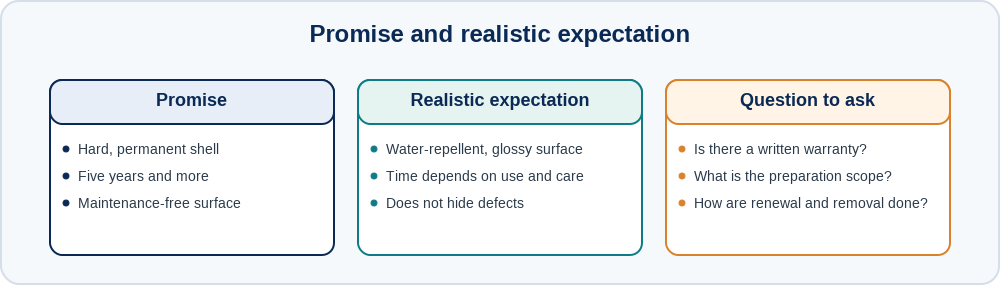
| Subject | Common promise | Realistic expectation |
|---|---|---|
| Life | Five years and more | Depends on product and application; ask for a written warranty |
| Maintenance | A “maintenance-free” surface | Cleaning becomes easier; care is still needed |
| Appearance | Glossy as new | Gloss rises; defects are not hidden |
| Defects | Covers small damage | Scratches and oxidation must be corrected first |
| Removal | Permanent | Removable only by abrasion; hard if wrongly applied |
A field source says claims that ceramic lasts five years without rework can be seen on bottles or in ads but should be treated as a myth; the real life depends on application and conditions. The editor of a boat-insurance site also writes that he investigated the marketing claims of consumer-grade ceramic coatings. These two examples show that questioning claims should be a reader’s reflex in this field.
4. Preparation: the heavy work#
The least discussed but most important part of ceramic coating is preparation. One applicator says he treats the coating like a multi-day detailing project, that a wrongly applied coating can look patchy with high spots and that embedded oxidation makes the hull look cloudy under the new shell; removing a wrongly applied coating is therefore harder than starting with bare gelcoat. Another source says that on an older boat the gelcoat correction that removes oxidation must be done before coating.
In a marine magazine test, a panel wipe is mentioned as the last step before applying the ceramic coating. This shows that degreasing the surface is an indispensable part of the process. There are also multi-stage systems that use a primer to fill micro-pores and a topcoat to seal.
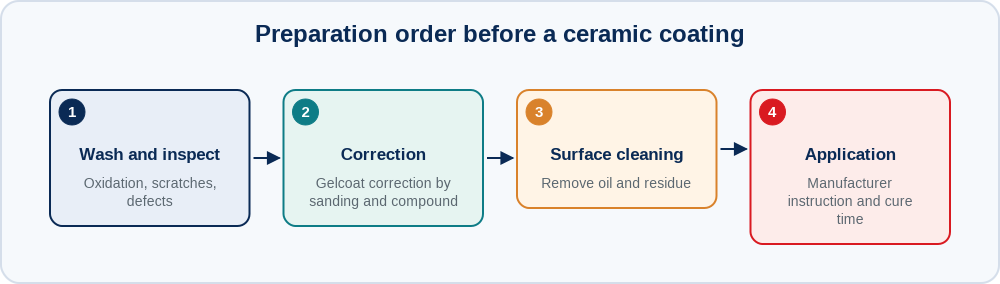
- Wash and inspect: oxidation, scratches, blisters and residue of an old coating.
- Correction: gelcoat correction by sanding and compound; repair damaged surfaces.
- Surface cleaning: remove oil and residue (panel wipe).
- Application: per the manufacturer’s instruction, in suitable temperature and humidity; observe the cure time.
- Care: the manufacturer’s recommended shampoo and washing interval; watch for the renewal moment.
5. Wax, sealant and ceramic#
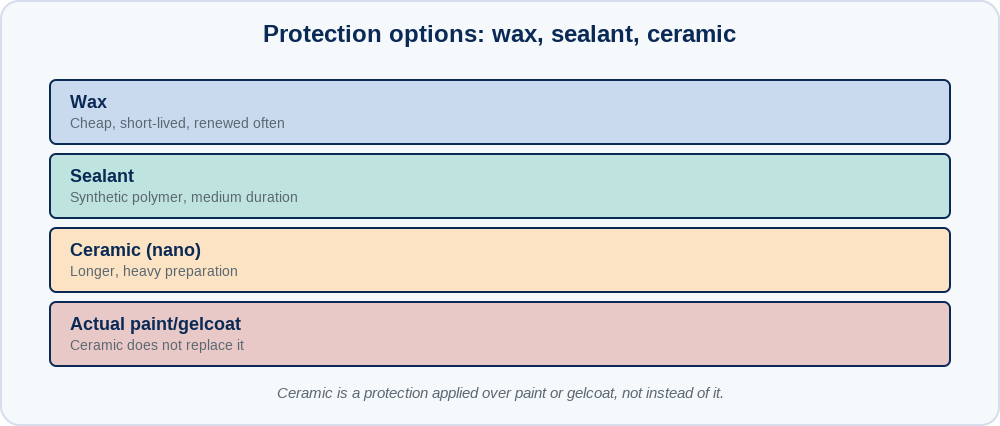
A marine magazine says many coatings are available to protect the hull, such as wax, sealant and ceramic, each with its own variations. Wax adds shine and helps protect the hull from harsh elements; the same is true of synthetic polymer sealants and of ceramic. The “wax on, wax off” ritual is satisfying for some owners and is the least expensive way to protect the hull.
In short, the choice is not a matter of “good or bad” but of preparation, cost and expectation. Wax is renewed often and is cheap; ceramic promises longer but is heavy on preparation and costly if it goes wrong.
6. Independent experience#
A boating magazine reports that its test boat’s gelcoat stayed glossy and free of oxidation 18 months after treatment and that even the manufacturer was surprised. Another publication notes that a three-year-old test boat benefited greatly from the treatment. These observations are promising; but they are the result of a single boat in a single climate and should not be generalised.
7. Underwater and working surfaces#
Ceramic and nano coatings are mostly described for above-water surfaces. Some applicators also offer them for interiors and underwater surfaces; but it is clear that underwater they do not replace antifouling and should not be treated as an independent solution against biofouling. Separate written evidence should be requested from the manufacturer for such claims.
8. A short case: the same claim, two results#
On the first boat the owner has ceramic applied directly to an old, oxidised gelcoat. The coating looks cloudy and patchy; the oxidation is trapped under the new shell and abrasion is needed to remove it. On the second boat the owner first has a professional gelcoat correction done, has the surface cleaned and then has ceramic applied; the surface is glossy and water-repellent and care is easier.
The same product can be used on both boats; the difference is preparation. Ceramic is the reward for a good surface, not the remedy for a bad one.
9. Pre-decision checklist#
10. Common mistakes#
- Thinking ceramic is a repair or defect-hider.
- Keeping preparation short or skipping it.
- Accepting claims such as five years without questioning.
- Looking only at price and not asking about the applicator’s experience.
- Treating the coating as a solution to replace antifouling underwater.
11. Conclusion#
On the right surface with the right preparation, ceramic and nano coatings can give long-lasting gloss and easy care. But the promises are big and the evidence is mostly manufacturer and applicator claims. Plan preparation from the start, tie the life claim to a written warranty and treat the coating as a protection applied over paint or gelcoat, not instead of it.
Frequently asked questions#
Does ceramic coating repair gelcoat damage?
No. Nano ceramics give a glossy surface but do not hide imperfections. Gelcoat correction is needed first for oxidation and scratches.
When is it renewed?
A marine magazine says the moment the water stops beading or sheeting off is the time to reapply.
Does it last five years?
Five-year claims appear on packaging and in ads; they should be questioned. Real life depends on preparation, application, climate and care.
How does it differ from wax?
Wax is cheap and melts quickly in the sun; ceramic promises longer protection and gloss but is heavy on preparation.
What happens if it is applied badly?
A detailing source says a wrongly applied coating can look patchy and that removing it is harder than starting with bare gelcoat.
Was this guide helpful?
Thank you! Your feedback has been saved.
Guide content is for general information; in practice, the current technical data sheet of the product applies.
Keep reading
Related guides
Colour Stability and UV Resistance in Yacht Paints
A study of the fading caused by sunlight on paint colours, UV resistance and the components that preserve this property.
2 min read Paint and CoatingsAwlgrip in Hot Weather: Fast Drying, Dry Spray and Choosing a Reducer
As temperature rises, solvent leaves quickly, paint pulls fast and the wet edge shortens. This article explains the logic of hot-weather problems, the reducer families the maker separates by temperature band, and their limits.
11 min read Paint and CoatingsHow to Read the Awlgrip Topcoat Technical Data Sheet: Solids, Dry Film, Cure Time
A data sheet is not a recipe card; it is a reference written for specific conditions. This article explains how to read the solids, dry film, wet film, coverage and cure lines, and where their limits lie.
13 min read