
Paint and Coatings
Pitting Corrosion on Stainless Steel Parts
Despite its name, stainless steel can suffer pitting and crevice corrosion in a marine environment. This article summarises the logic, signs and care hints from sources; it is not engineering or safety advice.
Short answer
In Cruising World Steve D’Antonio writes that thanks to chromium stainless steel forms an oxide film as long as it is exposed to oxygen, that type 316 contains roughly 16-18 percent chromium, 8-12 nickel and 2-3 molybdenum, with molybdenum helping against crevice corrosion, and that crevice corrosion occurs where it cannot be seen. Practical Sailor writes that crevice corrosion is among the most virulent forms in stainless, that rust stains are typical indicators but some failures are noticed too late. Offshore magazine explains that the higher the chloride and temperature the likelier the passive film breaks down. This article is general information; for critical parts consult a qualified specialist and the maker.
Key points
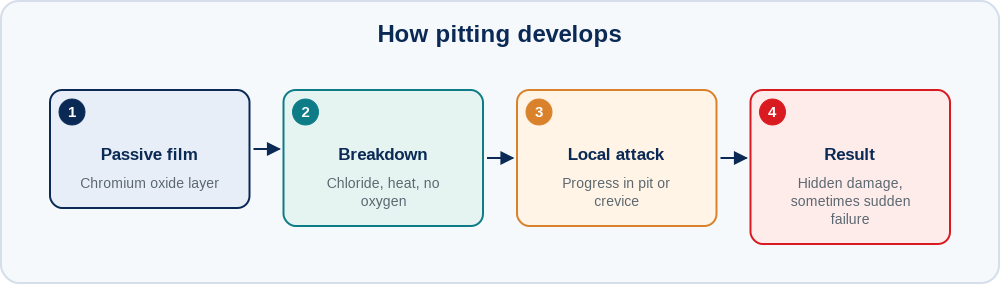
- Stainless steel forms a chromium oxide film while exposed to oxygen; if it breaks down, pitting and crevice corrosion can begin (Cruising World).
- Type 316 contains molybdenum, which helps against crevice corrosion (Cruising World).
- Crevice corrosion often occurs out of sight; rust stains are typical indicators but not always visible (Practical Sailor).
- The higher the chloride and temperature, the likelier the passive film breaks down (Offshore).
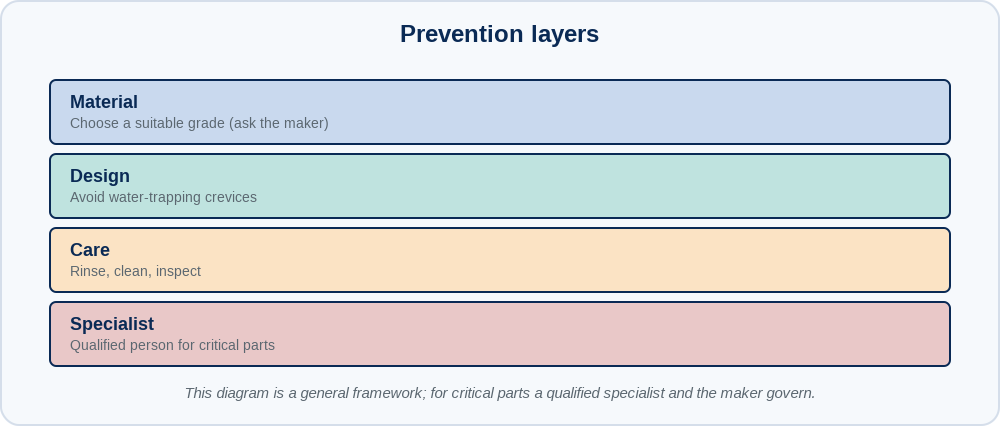
- Fresh-water rinsing and regular inspection are suggested; critical parts need a specialist.
1. Why is stainless steel called “stainless”?#
In Cruising World D’Antonio writes that thanks to the chromium in it stainless steel forms a tough oxide film as long as it is exposed to oxygen. That film protects the metal; but the same need for oxygen is the metal’s weak point. This article is a general summary; it is not engineering, safety or diagnostic advice, some sources are magazine accounts and for critical parts (rigging, rudder, connections) a qualified specialist and the maker are needed.
Offshore magazine explains that the higher the chloride and temperature the likelier the passive film breaks down, compared via values such as PREN; the same article suggests that 316 produced today may be less generously alloyed than before. That is a magazine view and may not hold for every product.
2. Pitting and crevice corrosion#
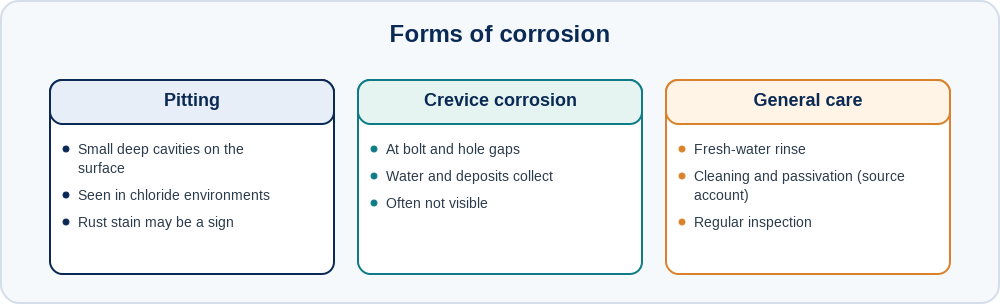
Practical Sailor describes crevice corrosion as among the most virulent forms in stainless and writes that rust stains are typical indicators but can sometimes be hidden. In the Nickel Institute’s account crevice corrosion can also occur under deposits. Cruising World says places where water gets between a fastener and its hole on deck hardware are susceptible and that damage often occurs out of sight.
So looking at the surface may not be enough; under bolts, under covers and in narrow gaps are especially suspect. Practical Sailor writes that some failures are noticed too late. For a suspect part consult a specialist.
| Form | Sources’ general observation | Caution |
|---|---|---|
| Pitting | Passive film breaks with chloride and heat (Offshore) | Small deep cavities |
| Crevice corrosion | In fastener-hole gaps and under deposits (Cruising World, Nickel Institute) | Often not visible |
| Rust stain | Typical indicator but not always visible (Practical Sailor) | Inspection needed |
3. Type 316 and its limits#
Cruising World writes that 316 contains roughly 16-18 percent chromium, 8-12 nickel and 2-3 molybdenum, that molybdenum helps against crevice corrosion, and adds that 316 fasteners often have to be special-ordered. But 316 is not immune to crevice corrosion; the magazine’s own account makes that plain. This article recommends no particular grade or product.
4. Care hints#
Practical Sailor describes fresh-water rinsing, micro-polishing and citric-acid passivation as helpful; that is a magazine account and may not suit every part. This article recommends no method or product; see the maker’s instruction.
- Inspect stainless parts by eye regularly.
- Note places where you see rust stains.
- Rinse with fresh water where possible.
- Treat areas under bolts and gaps as suspect.
- Consult a specialist for critical parts.
- Have rigging and hardware inspected carefully on a used boat.
- Keep records.
5. Limits#
Sources broadly agree on stainless corrosion; differences appear in product quality and the effect of measures. One magazine says today’s 316 may be less alloyed than before while others treat 316 as the standard choice. That shows a particular part’s condition must be assessed without generalising.
5b. Where sources differ#
Offshore magazine suggests alloy levels may have changed; Cruising World describes 316 as a grade helped against crevice corrosion by molybdenum. The two do not contradict but emphasise differently: one material quality, the other grade choice. Practical Sailor emphasises care and inspection. The right answer may differ for each part; a qualified specialist and the maker govern.
This article is not diagnostic, engineering or safety advice. On critical parts such as rigging failure can have serious consequences; if in doubt consult a qualified surveyor.
5c. A practical frame for reading the sources#
The sources here are of different kinds: a cruising magazine (Cruising World), a boat-gear testing publication (Practical Sailor), a marine industry magazine (Offshore) and a nickel-industry body (Nickel Institute). Each writes from a different angle, so none should be taken alone as a final verdict. Magazine accounts describe general tendencies and do not determine the condition of a particular part. When a rust stain appears on a part it is hard to tell from a picture whether it is a superficial mark or a sign of crevice corrosion deeper in; the shared message of the sources is therefore the importance of inspection and, where needed, specialist opinion.
A practical approach for a boat owner is: first decide which parts are critical, for example rigging, rudder and chainplate connections; then discuss with the maker or a qualified yard how hidden areas such as under bolts and narrow gaps are to be inspected; then record inspection dates and observations. This article gives no frequency, method or product, because the right approach varies with the part, the use and the environment. Some sources rest on a magazine’s experience and may not give the same result on every boat, so general principles should be weighed with local conditions.
Finally, the absence of a visible problem does not mean there is no corrosion; Practical Sailor writes that some failures are noticed too late. A look-fine impression, especially on older fasteners and used boats, should therefore not be taken as sufficient assurance by itself. If in doubt, having it inspected is not a wasted cost but a precaution before a possible failure; decide together with a qualified specialist.
6. Common mistakes#
- Thinking stainless steel is fully corrosion-free.
- Looking only at the surface and missing the area under bolts.
- Ignoring a rust stain.
- Neglecting fresh-water rinsing.
- Skipping inspection because it is 316.
- Not having hardware inspected on a used boat.
- Keeping no records.
7. Checklist#
8. Conclusion#
Stainless steel forms a protective film while exposed to oxygen; chloride, heat and oxygen starvation can break it down and lead to pitting and crevice corrosion. Damage often occurs out of sight. This article is general information; it is not engineering or safety advice, and for critical parts a qualified specialist and the maker govern.
Frequently asked questions#
Why does stainless steel pit?
According to Cruising World stainless steel forms a tough oxide film thanks to chromium as long as it is exposed to oxygen; if oxygen access is cut off or factors such as chloride break the film, local corrosion can start.
Why is type 316 preferred?
Cruising World writes that 316 contains roughly 16-18 percent chromium, 8-12 nickel and 2-3 molybdenum, with molybdenum helping against crevice corrosion. 316 fasteners often have to be special-ordered.
Where does crevice corrosion occur?
Cruising World writes that deck hardware is susceptible where water gets between a fastener and its hole and that damage can occur out of sight. Practical Sailor also notes stains can be hidden.
What should I do if I see rust stains?
Practical Sailor treats rust stains as a typical indicator; it also describes fresh-water rinses, micro-polishing and citric-acid passivation as helpful. For critical parts consult a specialist and the maker.
What should I check on a used boat?
Practical Sailor writes that some failures are noticed too late and that used-boat owners should inspect rigging and hardware carefully. Consult a qualified surveyor for decisions.
Was this guide helpful?
Thank you! Your feedback has been saved.
Guide content is for general information; in practice, the current technical data sheet of the product applies.
Keep reading
Related guides
Boat Colour Selection and Solar Reflectance: Effect of Heat Absorption on Surfaces
A study of the effect of boat paint colour on solar reflectance and surface temperature.
2 min read Paint and CoatingsCauses and Diagnosis of Paint Blistering
A study of the sources, types and diagnostic approach to blistering on boat paints.
2 min read Paint and CoatingsNumber of Coats in Epoxy Coating Systems
A study of the effect of the number of coats in epoxy coating systems on protective performance and thickness.
2 min read