
Paint and Coatings
Non-Skid Deck Paint and Anti-Slip Applications
Non-skid deck paint and anti-slip applications are described for renewing a worn moulded pattern or giving grip to wood and painted decks. This article summarises the accounts with their limits; it is not a product, ratio, number-of-coats or time recommendation.
Short answer
A paint maker’s guide writes that no deck surface has been proven to prevent slipping entirely, a low-cost slip-resistant finish adding protection; the same guide says that for a tough coating against foot traffic, anchors and dropped gear a two-part polyurethane with a non-skid additive is possibly the best option. A boating magazine article describes sanding before application but not between coats, non-slip compounds clumping and settling and needing frequent stirring. Insurer and test publications write that sand or walnut shell can be hard on skin and that commercial products give better results. This article recommends no product; the maker governs.
Key points
- No deck surface is proven to prevent slipping entirely; a non-skid finish adds protection (maker’s guide).
- Approaches are described in three groups: grit paint, textured paint and stick-on sheets.
- Non-skid compound can clump and settle; frequent stirring and a per-session batch are described (magazine).
- Sand and walnut shell can irritate skin; commercial products give better results (test publication).
- For product, ratio and time the maker and a qualified yard govern.
1. Why does a non-skid surface come up?#
On fibreglass boats the moulded non-skid pattern can wear over time; wooden and painted decks too can become slippery when wet. A boat-supplies retailer writes that non-skid paints and compounds are offered in this situation and that traditional teak decks give a natural non-skid surface. This article is a general summary; it gives no product, ratio, number of coats, grit or time and is not application advice. Sources are maker, magazine, test publication and seller accounts and may differ; seller and maker statements are labelled.

2. Three approaches#
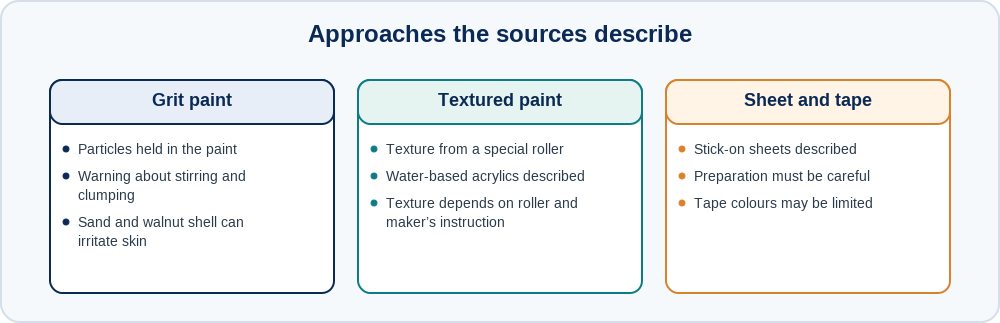
A boat-test website divides common options into three categories: deck paints with a grit-type traction material added, deck paints with a textured surface and non-skid mats, and coverings that rely on adhesive to mount them. An insurer and boating organisation’s guide writes that grit can come premixed in paint or be sold as an additive mixed in before application, and that grit such as sand or walnut shell can be sprinkled onto wet paint, the excess being swept or vacuumed off once dry.
| Approach | Sources’ general account | Caution |
|---|---|---|
| Grit paint | Particles held in the paint; premixed or additive | Clumping, stirring |
| Textured paint | Raised pattern from a special roller sleeve; water-based acrylics described | Texture depends on roller and instruction |
| Stick-on sheet | High grip described | Careful preparation, tape colour limits |
3. Paint choice and application accounts#
A paint maker’s advice page writes that a deck wants a tough coating against damage from foot traffic, anchors and dropped gear, so a two-part polyurethane with a non-skid additive is possibly the best option; the same page adds that no single deck surface has been proven to prevent slipping entirely. This is a maker’s account, may favour its own product range and is not an independent test.
A boating magazine’s tips article describes the original deck as possibly moulded non-skid, painted fibreglass over wood or painted wood, and the paint as oil-based, acrylic latex or linear polyurethane. The same article says that for non-slip painting sanding is needed only before application and not between coats, that the ratio of non-slip compound to paint should follow the maker’s suggestion and only a batch big enough for the intended session mixed, adding that non-slip compounds clump and settle, so should be stirred in well at the start and frequently while painting.
A sailing magazine writes that on a deck losing its non-slip the options are stick-on Treadmaster-type coverings, deck paints with non-skid granules suspended and a water-based acrylic textured with a special roller; it says stick-on options give a highly non-slip surface but need careful preparation to stick. A test publication says it left sand and crushed walnut shell out of its tests because fewer owners use them, commercial products give better results and they can be very rough on human flesh.
Seller pages give similar accounts: a retailer writes that the most common system is a non-skid paint with sand, silica or rubber particles premixed; another seller listing claims a product is less abrasive than silica-additive paints. These are seller accounts and have not been independently verified.
A fishing-boat magazine describes applying non-skid only where slippery, for example gunwales or cockpit sole areas lacking a moulded pattern, marking the area’s perimeter in pencil, taping the edge and using a short-nap roller; that is one writer’s account and gives no brand or ratio. A test publication also reminds that non-skid choices may not be as reliable on a wet deck as on a dry one.
4. A practical frame#
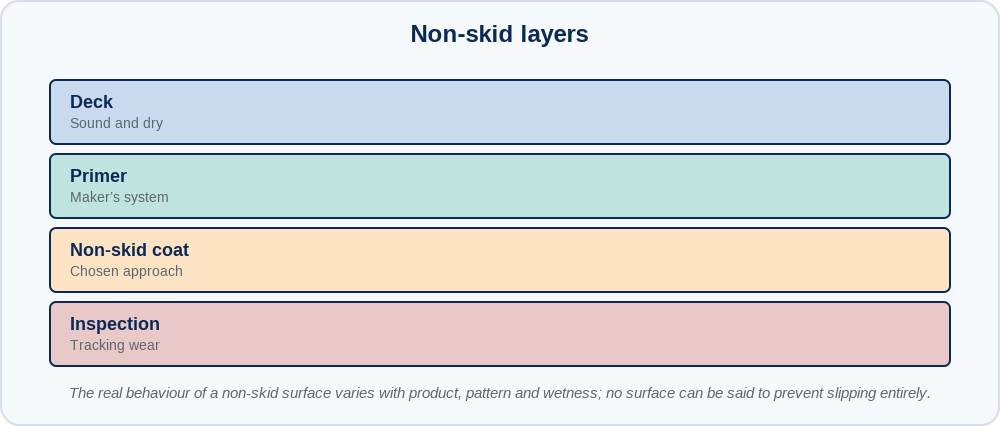
- Inspect: establish worn areas, the type of the old coating and the soundness of the surface beneath.
- Think about the non-skid need: whole deck or only critical areas; allow for wet and dry conditions.
- Choose the approach: grit paint, textured paint or stick-on sheet; each has a different preparation and upkeep load.
- Prepare and apply per the maker’s data sheet; mixing ratio and time belong to the maker.
- Keep the warning about stirring non-skid compound in mind.
- Inspect regularly; if wear or slipperiness appears investigate the cause.
- Keep records; read the safety data sheet.
5. Limits#
Sources overlap that non-skid paint and grit can improve grip on a worn deck and that preparation and mixing matter; they differ on which approach is better and on durability. A maker favours two-part polyurethane while magazines also describe water-based textured acrylics and stick-on sheets. So there is no single right answer; deck, use, climate and the maker’s instruction govern. This article is not application advice.
5b. Where sources differ#
The maker’s page describes two-part polyurethane as possibly the best option; magazines also list textured water-based acrylics and stick-on sheets; a test publication finds sand and walnut shell hard on skin; sellers say their own products are less abrasive. These are sources speaking in different contexts and with different interests. The difference means consulting the maker and a qualified yard for your own deck.
This article is general information; it recommends no product, method, ratio, number of coats or time. The maker’s data sheet and a qualified yard govern.
5c. A practical frame for reading the sources#
The sources are magazines, makers, sellers and forums; each writes in its own context. None knows the deck surface, its use or its climate of your boat. So taking the shared message and consulting the maker and a qualified yard for detail is reasonable.
Sanding dust, solvent and paint vapours can carry health and fire risks; two-part systems may need extra precautions. This article describes no personal protection, ventilation or waste method; read the product’s safety data sheet, consult a qualified yard and follow the relevant safety rules. The risk of falling on a slippery deck is serious; no covering can be said to remove slip risk entirely.
Seller and maker statements are the firm’s own account of its product and have not been independently verified. A product’s compatibility with another coating should always be checked in the product’s technical document; where a document and a guide conflict, the maker’s document and a qualified yard’s assessment should be used. Recording decisions and product details helps later maintenance.
6. Common mistakes#
- Not stirring the non-skid compound enough.
- Sanding needlessly or too little between coats.
- Skipping surface preparation.
- Treating a seller claim as independent verification.
- Ignoring wet-condition behaviour.
- Not reading the safety data sheet.
- Keeping no records.
7. Checklist#
8. Conclusion#
For non-skid deck paint and anti-slip applications sources describe grit paint, textured paint and stick-on sheets, with care needed in preparation, mixing and wet-condition behaviour. This article is general information; it gives no product, ratio or time and the maker and a qualified yard govern.
Frequently asked questions#
Does non-skid paint stop slipping entirely?
A paint maker’s guide writes that no deck surface has been proven to prevent slipping entirely, a low-cost non-skid finish adding protection.
How is the non-skid additive added to paint?
Sources describe additive coming premixed, sold separately to mix into paint, or sprinkled onto wet paint with the excess swept off once dry; ratio and method depend on the maker.
Is sanding needed between coats?
A magazine article writes that for non-skid the sanding is done before application and not between coats; see the product instruction.
Are sand or walnut shells used?
A test publication writes they are used less, commercial products give better results and they can be hard on skin.
How does textured paint work?
Textured paints get their traction from raised patterns made with a special roller sleeve; texture depends on the roller and maker’s instruction.
Was this guide helpful?
Thank you! Your feedback has been saved.
Guide content is for general information; in practice, the current technical data sheet of the product applies.
Keep reading
Related guides
Boat Colour Selection and Solar Reflectance: Effect of Heat Absorption on Surfaces
A study of the effect of boat paint colour on solar reflectance and surface temperature.
2 min read Paint and CoatingsCauses and Diagnosis of Paint Blistering
A study of the sources, types and diagnostic approach to blistering on boat paints.
2 min read Paint and CoatingsNumber of Coats in Epoxy Coating Systems
A study of the effect of the number of coats in epoxy coating systems on protective performance and thickness.
2 min read