
Paint and Coatings
One-Part and Two-Part Varnish: What Is the Difference?
The difference between one-part and two-part varnish is generally described in sources as a balance between durability and ease of use; but compatibility and maintenance also matter. This article summarises magazine, maker and test accounts with their limits; it is not a product recommendation or application advice.
Short answer
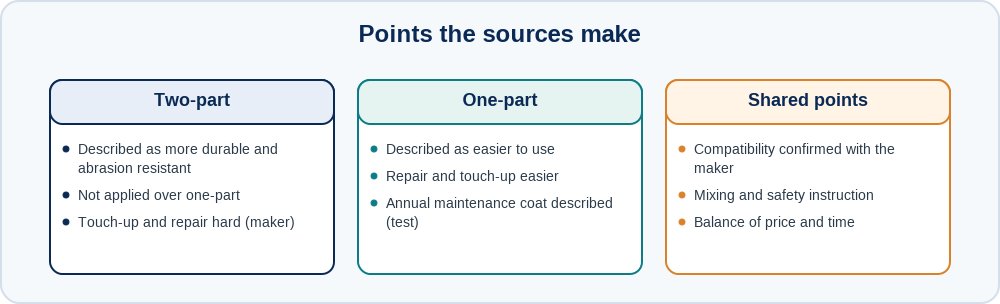
An insurer’s guide writes that two-part polyurethane varnishes last longer and are far more abrasion resistant, but that because of the very hard nature of the coating a two-part varnish cannot be applied over a one-part varnish as they are incompatible. A sailing magazine says polyurethane varnishes come as one- or two-part systems, both can work well, but one-part systems tend to be more user-friendly; a maker’s marketing executive says repairs are much easier with one-part and touch-ups are hard with two-part. A test publication recommends an annual maintenance coat for one-part varnishes. These are accounts with different interests; the product instruction governs.
Key points
- Two-part polyurethane varnishes are described as more durable and abrasion resistant (insurer guide).
- Two-part varnish is not applied over one-part; they are incompatible.
- One-part varnishes are described as more user-friendly; repair and touch-up are easier (magazine and maker account).
- A test publication recommends an annual maintenance coat for one-part varnishes.
- For compatibility, mixing and safety the maker and a qualified yard govern; maker claims are unverified.
1. What are one-part and two-part varnish?#
One-part varnishes are applied as they come from the can; two-part varnishes are mixed with a hardener before application and cure chemically. Sources generally describe the difference through durability, ease of use, compatibility and maintenance. This article is a general summary; it gives no product, mix ratio, number of coats or time and is not application or safety advice. Sources are magazine, test, maker, retailer and forum accounts and may differ; maker statements are labelled.

2. Durability and ease of use#
An insurer’s guide writes that the advantage of two-part polyurethane varnishes is that they last longer and are far more abrasion resistant. A boating magazine, comparing two types of resin, describes polyurethane, one or two part, as much more durable and resistant to UV, abrasion, fuel and solvent spills and impacts; part of the same article presents one two-part product as the most durable and best in UV resistance but also as probably the least DIY-friendly. Since that article is a roundup with affiliate links, these judgements are editorial opinions and not independent testing.
A sailing magazine writes that polyurethane varnishes come as one- or two-part systems, that both product types can work well but one-part systems tend to be more user-friendly. In the same piece a maker’s executive says repairs are much easier with a one-part varnish and touch-ups are hard with two-part. That is a maker statement; it may reflect the positioning of its own products and has not been independently verified. A powerboat magazine describes most major makers producing a two-part varnish, some people loving the two-part stuff and even a three-part product designed to overcoat existing varnish.
| Topic | General account | Caution |
|---|---|---|
| Durability | Two-part more durable and abrasion resistant | Varies with products and test conditions |
| Ease of use | One-part more user-friendly; repair easy | May be a maker claim |
| Compatibility | Two-part is not applied over one-part | Confirm with the maker |
3. Compatibility and maintenance#
An insurer’s guide writes that because of the very hard nature of the coating a two-part varnish cannot be applied over a one-part varnish as they are incompatible. A boating magazine describes one-part polyurethane being applied over two-part varnish but not the reverse. The two accounts agree in direction: two-part over one-part is described as a problem. A boat-supplies retailer’s paint guide also describes two-part coatings as containing aggressive solvents liable to soften or lift old coatings; that guide concerns paint not varnish but is the same general caution. Compatibility should always be confirmed in the product’s technical document.
A test publication reports testing, over two years on bare teak panels under the Florida sun, many one-part varnishes, a few two-part ones and synthetic or satin-like alternatives, saying UV sucked the life out of most coatings, especially the clear ones, though some performed much better than others. The same publication writes that in the real world at the one-year mark all one-part varnish test panels would be due for a maintenance coat and recommends an annual maintenance coat for one-part varnish whether it looks like it needs it or not. That is a test result; it varies with conditions and products.
A sailing magazine relays that some two-part products offer sandless recoating between coats while other magazine accounts say most one-part products need sanding; these details depend on the product and the maker’s instruction governs. Mix ratio, pot life and ventilation requirements of two-part products may differ from one-part ones; so the maker’s data sheet and safety data sheet should be read.
4. A practical frame#
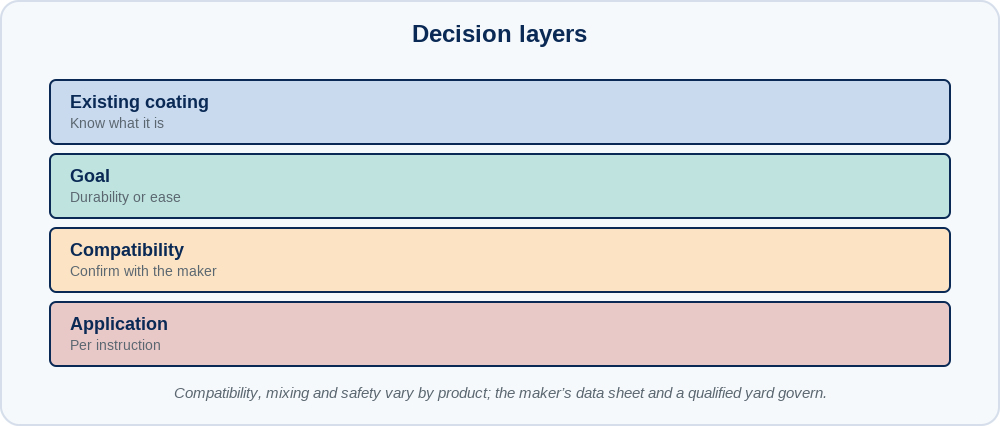
- Establish what the existing coating is; if unknown consult the maker.
- Clarify the goal: maximum durability or easy application and maintenance.
- Confirm compatibility in the product’s technical document and with the maker; do not put two-part varnish over one-part.
- Read the mixing, pot life and ventilation requirements in the maker’s instruction.
- Think ahead about touch-up and repair needs.
- Plan maintenance coats by product and conditions.
- Keep records; read the safety data sheet.
5. Limits#
Sources overlap that two-part varnishes are described as more durable and that two-part should not go over one-part; they differ on ease of use, difficulty of touch-up and maintenance frequency. A magazine presents a two-part product as most durable yet in the same piece as among the least DIY-friendly; a maker executive favours one-part for ease of repair. So there is no single right answer; the product, the existing coating, the applicator’s experience and the maker’s instruction govern. This article is not application advice.
5b. Where sources differ#
The insurer guide describes the durability advantage of two-part; a sailing magazine says both work well but one-part is more user-friendly; a maker executive says repair is easy with one-part, a maker statement; a test publication recommends an annual maintenance coat for one-part; a magazine presents a two-part product as best but least DIY-friendly in a roundup with affiliate links. These are sources speaking in different contexts and with different interests. The difference means consulting your own product’s instruction and the maker.
This article is general information; it recommends no product, method, ratio, number of coats or time. The maker’s data sheet and a qualified yard govern.
5c. A practical frame for reading the sources#
The sources are magazines, makers, sellers and forums; each writes in its own context. None knows the type of existing coating, the conditions of use or your application experience of your boat. So taking the shared message and consulting the maker and a qualified yard for detail is reasonable.
Two-part varnishes can contain components risky to health such as isocyanates; mixing can carry breathing and skin risks and ventilation requirements; varnish vapours and sanding dust can carry health and fire risks; varnish-soaked rags can self-heat. This article describes no personal protection, ventilation or mixing method; read the product’s safety data sheet, consult a qualified yard and follow the relevant safety rules.
Seller and maker statements are the firm’s own account of its product and have not been independently verified. A product’s compatibility with another coating should always be checked in the product’s technical document; where a document and a guide conflict, the maker’s document and a qualified yard’s assessment should be used. Recording decisions and product details helps later maintenance.
6. Common mistakes#
- Applying two-part varnish over one-part.
- Applying without knowing the existing coating.
- Not reading the mixing and pot life instruction.
- Treating maker marketing language as independent verification.
- Treating an affiliate-link roundup as independent testing.
- Not reading the safety data sheet.
- Keeping no records.
7. Checklist#
8. Conclusion#
The choice between one-part and two-part varnish is described in sources as a balance between durability and ease of use, and compatibility; two-part is described as more durable, one-part as easier, and two-part is not applied over one-part. This article is general information; it recommends no product or value and the maker and a qualified yard govern.
Frequently asked questions#
Is two-part varnish more durable?
An insurer guide writes that two-part polyurethane varnishes last longer and are far more abrasion resistant; a magazine describes polyurethanes generally as resistant to UV, abrasion and solvents. Products vary.
Can two-part go over one-part varnish?
An insurer guide writes that a two-part varnish cannot be applied over a one-part; a boating magazine describes one-part going over two-part but not the reverse.
Which is easier to apply?
A sailing magazine says one-part systems tend to be more user-friendly; a maker executive says repair is easy with one-part. That is a maker claim.
How often is one-part varnish renewed?
A test publication says the one-part varnishes tested needed a maintenance coat at one year and recommends an annual maintenance coat; that is a test result and varies with conditions.
Can I apply two-part varnish myself?
A magazine describes one two-part product as among the least DIY-friendly; for mixing and safety consult the maker’s instruction and a qualified yard.
Was this guide helpful?
Thank you! Your feedback has been saved.
Guide content is for general information; in practice, the current technical data sheet of the product applies.
Keep reading
Related guides
Boat Colour Selection and Solar Reflectance: Effect of Heat Absorption on Surfaces
A study of the effect of boat paint colour on solar reflectance and surface temperature.
2 min read Paint and CoatingsCauses and Diagnosis of Paint Blistering
A study of the sources, types and diagnostic approach to blistering on boat paints.
2 min read Paint and CoatingsNumber of Coats in Epoxy Coating Systems
A study of the effect of the number of coats in epoxy coating systems on protective performance and thickness.
2 min read