
Paint and Coatings
One-Part and Two-Part Polyurethane Paint Compared
When choosing polyurethane for a boat’s topsides the key decision is between one- and two-part systems. This article compares curing, durability, application, compatibility and safety of the two systems based on sources and offers a framework for choosing.
Short answer
One-part polyurethane cures through solvent evaporation and mild oxidation in air; two-part polyurethane cures through a chemical reaction between a polyol base and an isocyanate hardener. An independent magazine test reports one-part products stand out in ease of application and two-part in gloss, hardness and durability. Two-part needs more prep, precise mixing and safety measures; applied over an old one-part or alkyd film its solvents can lift the film. The choice depends on skill, budget and expectations; the data sheet comes first.
Key points
- 1K cures by solvent evaporation and air, 2K by chemical reaction.
- Per a magazine test 1K stands out in ease of application, 2K in gloss, hardness and durability.
- 1K is cheaper, more forgiving and easier to touch up; 2K is more demanding and generally more toxic.
- If the old film type is unknown do not apply 2K; its solvents can lift an old 1K or alkyd film.
- The choice depends on skill, equipment, budget, climate and expectations.
1. Curing: the basic difference#
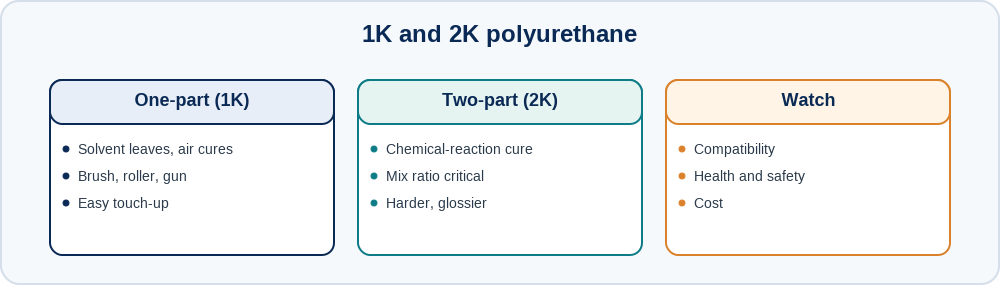
A retailer guide explains that one-part polyurethane topside paint cures through solvent evaporation combined with mild oxidation: as the carrier solvents leave the film the remaining binder oxidises slowly in contact with air. Two-part polyurethane cures through a chemical reaction between a polyol base coat and an isocyanate hardener mixed immediately before application. A magazine test writes that two-part linear polyurethanes (LPU) sit at the high end in cost, durability and gloss and use an isocyanate catalyst to cure the paint.
In practice this difference means: with a two-part product the mix ratio, pot life, temperature and humidity become critical; with one-part those constraints are much looser. A paint maker says two-part products dry quicker and have better properties in gloss, colour retention, hardness, longevity, chemical and abrasion resistance and overall film integrity; that is a maker claim.
2. Durability and gloss: what do tests say?#
An independent boating magazine’s three-year durability test reports that one-part products stole the show on ease of application but the highest marks for gloss, hardness and durability went to two-part polyurethane coatings. The same publication in another review says two-part LPUs rate highest for durability and gloss retention. A retailer guide says that under ideal conditions a two-part system can be noticeably harder, glossier and longer-lasting than the best one-part.
That does not mean one-part is inadequate. A boat-paint support page accepts that two-part polyurethanes are more UV stable and last longer but writes that unless you are in a tropical climate a one-part polyurethane’s UV resistance will be more than adequate; that is a seller view. Another round-up says a DIY topside job can last one to five years depending on the paint and where the boat lives. Real life varies with climate, upkeep and application.
| Feature | One-part (1K) | Two-part (2K) |
|---|---|---|
| Cure | Solvent loss, air oxidation | Polyol + isocyanate reaction |
| Application | Brush, roller or gun; forgiving | Precise mixing; often spray |
| Durability, gloss | Good; second in magazine test | Highest marks (in test) |
| Touch-up | Easy | Harder |
| Cost | Lower | Two to four times (per a seller) |
| Safety | Safer | Generally more toxic |
3. Application and touch-up#
A retailer guide says 1K polyurethane is easier and more forgiving for DIY, can be applied by brush, roller or gun, gives good gloss and weather resistance, suits routine maintenance repainting and is preferred by many professionals. A maker notes one-part polyurethane is easy to touch up if scratched or dinged. Two-part products, per a retailer guide, are for spray only in some cases, demand more surface preparation and priming and are generally more toxic.
A round-up site notes one-part applied thick runs on vertical surfaces and sags at corners; so 1K too must be applied in careful thin coats. For roller and brush technique see our separate articles.
4. Compatibility: the most common mistake#
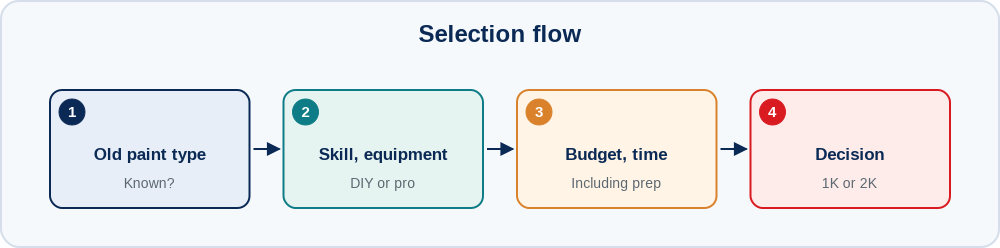
A retailer guide warns plainly: do not paint two-part polyurethane over old alkyd enamel or one-part polyurethane, because two-part paints contain aggressive solvents that can soften and lift old coatings. In a boating magazine a maker’s manager also says if you do not know the type of the previous topcoat, one-part polyurethane is best because one-part can go over both one- and two-part, while two-part applied over one-part can damage the film beneath. The same retailer guide says that if it is unknown whether the existing finish is one- or two-part, stability can be checked.
So if the existing system is uncertain: do a small test in a hidden area, consult your painter and check the compatibility table in the maker’s data sheet. Repainting over a two-part system is more flexible: a guide says one-component paints can generally only be recoated with compatible one-component systems while two-component paints offer greater flexibility.
5. Health and safety#
In two-part polyurethanes the hardener contains isocyanate, which carries respiratory and skin risk, especially when sprayed. A retailer guide says two-part paints are generally more toxic, especially when sprayed; a round-up writes that one-part is much safer to mix and apply. Personal protective equipment, ventilation and the safety data sheet are essential. See our isocyanate safety article for detail.
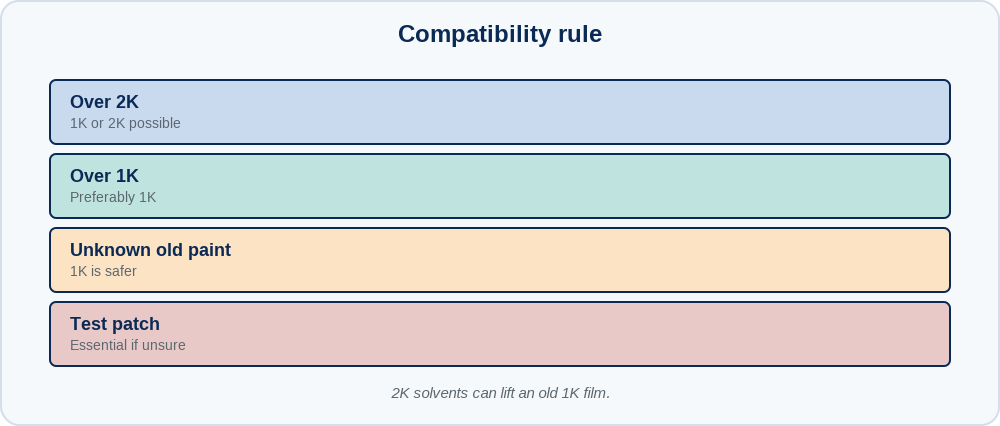
- Establish the existing paint type (1K, 2K or alkyd).
- Honestly assess your skill, equipment and workplace.
- Count the budget with prep and equipment.
- Choose the paint: 1K for ease and touch-up, 2K for hardness and gloss.
- Choose compatible primers and barriers; test on a hidden area.
- Provide safety equipment and ventilation.
6. Common mistakes#
- Applying 2K without knowing the old film type.
- Applying 2K without safety equipment.
- Applying 1K in a thick coat and causing runs.
- Neglecting mix ratio and pot life.
- Looking at price and not counting prep.
- Changing system without a test patch.
7. Checklist#
8. Conclusion#
1K polyurethane is easy, cheaper and easy to touch up; 2K polyurethane generally gives the highest gloss, hardness and durability in independent tests but demands precise application, prep and safety. If the old film type is unknown 1K can be safer. This article is general information; the data sheet and expert opinion come first.
Frequently asked questions#
What is the basic difference between 1K and 2K?
1K hardens by solvent evaporation and slow oxidation in air; 2K cures chemically when a polyol is mixed with an isocyanate hardener.
Which is more durable?
In an independent magazine test two-part polyurethanes got the highest gloss, hardness and durability marks; this depends on product and conditions.
Is 1K enough for UV?
A maker’s support page says outside tropical climates a one-part polyurethane’s UV resistance can be more than adequate; that is a seller view.
What if I do not know the old paint type?
One source says one-part polyurethane is the safer choice because it can go over both one- and two-part; still test on a hidden area.
Why is 2K more hazardous?
A retailer guide says two-part paints are generally more toxic, especially when sprayed; see our isocyanate safety article.
Was this guide helpful?
Thank you! Your feedback has been saved.
Guide content is for general information; in practice, the current technical data sheet of the product applies.
Keep reading
Related guides
Boat Colour Selection and Solar Reflectance: Effect of Heat Absorption on Surfaces
A study of the effect of boat paint colour on solar reflectance and surface temperature.
2 min read Paint and CoatingsCauses and Diagnosis of Paint Blistering
A study of the sources, types and diagnostic approach to blistering on boat paints.
2 min read Paint and CoatingsNumber of Coats in Epoxy Coating Systems
A study of the effect of the number of coats in epoxy coating systems on protective performance and thickness.
2 min read