
Paint and Coatings
Varnish Peeling and Renewal Methods
When varnish peels or shows widespread cracking and loss of gloss, sources describe several stripping methods for renewal; which suits depends on the thickness and state of the coating. This article summarises the accounts with their limits; it is not a product, method or time recommendation or safety advice.
Short answer
A boating magazine writes that for varnish suffering from old age or widespread peeling, cracking, streaking or loss of lustre a total overhaul is the only cure, and that takedown methods include sanding for thinner coatings, dry scraping or heating and scraping for thicker finishes, and chemical stripping. Another magazine says the hardest part of refinishing wood on a boat is often getting the old finish off, that there is no magic solution and that it usually takes a combination of methods. Chemical stripping waste is described as toxic and to be disposed of by local law. This article recommends no method or product; for safety and regulation a qualified yard and the maker govern.
Key points
- For widespread peeling, cracking and loss of gloss a total overhaul is described as the only cure (boating magazine).
- Takedown methods: sanding for thin coatings, scraping or heating and scraping for thick ones, and chemical stripping.
- Getting the old finish off is often the hardest part; a combination of methods is usually needed (magazine account).
- Chemical stripping waste is toxic and must be disposed of by local law.
- Sanding also removes wood; for method, safety and waste a qualified yard and the maker govern.
1. When is varnish renewed?#
When varnish ages or shows widespread peeling, cracking, streaking or loss of lustre, a boating magazine writes that a total overhaul is the only cure, described as true whether it is a varnish or a softer alternative. Another magazine says that in brightwork care regular inspection and timely maintenance coats can reduce the need for a full strip. This article is a general summary; it gives no product, method, time or value and is not application or safety advice. Sources are magazine, retailer, maker and forum accounts and may differ.
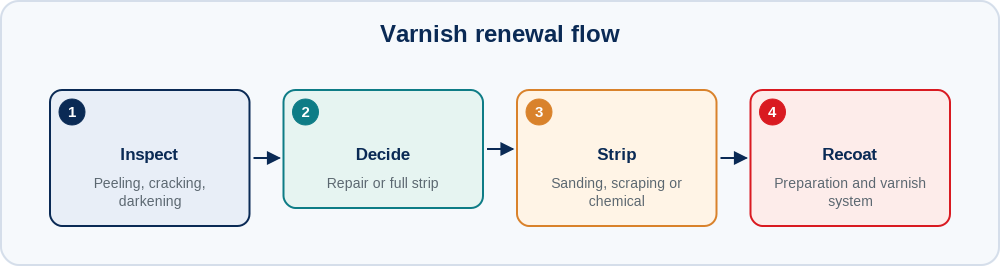
2. Inspection and the decision#
A powerboat magazine article describes brightwork that was once gleaming turning dull, with yellow patches of loose varnish, black stains where water has seeped into the wood and perhaps bare wood showing here and there; it says one must then either do the stripping oneself or call in a professional. The same article adds that stripping varnish is not rocket science, that people with ordinary skills can do the job but it is important not to cause more problems than you solve. That is a magazine account.
A boatbuilding magazine writes that when refinishing and not just recoating, one should determine whether there is enough wood to strip and sand; it adds that sanding removes some wood and one should look at how deep the bungs are and whether they need replacing. Another account says adding at least one more coat to varnish at the start of the season can keep the finish in good condition, while neglect inevitably leads to complete stripping, bleaching, staining and refinishing.
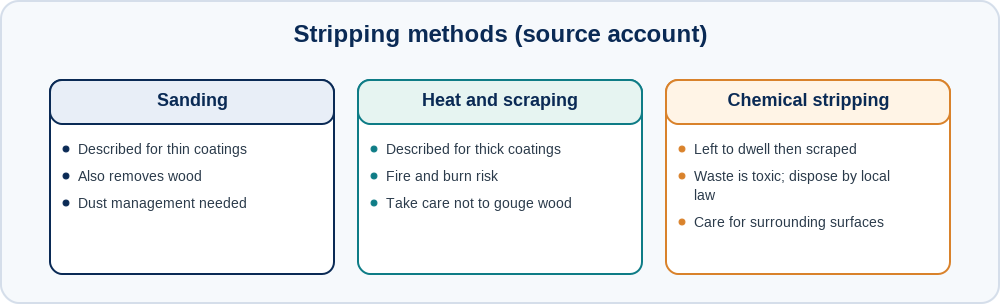
| Method | Sources’ general account | Caution |
|---|---|---|
| Sanding | For thin coatings | Also removes wood; dust |
| Heat and scraping | For thick coatings | Fire and burn risk |
| Chemical stripping | Left to dwell, then scraped | Waste toxic; regulation |
3. Stripping methods#
A magazine describes takedown methods as including sanding for thinner coatings, dry scraping or heating and scraping for thicker finishes, and chemical stripping. Another magazine writes that often the hardest part of refinishing wood on a boat is getting the old finish off, that there is no magic solution, that it usually takes a combination of methods and a lot of elbow grease and patience. A boat-supplies retailer says if the current varnish is in pretty bad shape it is probably best to take all of it off and that most of the time in a varnish job should go to stripping and preparation.
For chemical stripping a magazine relays that some professionals layer the stripper on, cover it for a while and then brush away the released varnish with a toothbrush; another author is quoted as suggesting brushing the stripper on, letting it dwell, then gently scraping with a wide putty knife and scrubbing the wood with bronze wool. Another account describes rinsing stripper residue from the wood with plain water while scrubbing with a pad and wiping dry. The same magazine writes that whatever stripping method or product is used the waste will be toxic and must be disposed of according to local toxic waste law. This article gives no product or time.
Heat guns and scraping are also often mentioned; a boating magazine, in a test of chemical strippers, says that if you can take the boards off the boat to strip them you should. A forum user writes about varnish over epoxy peeling off in thick layers after hitting rocks and worrying that sanding might hit the fibreglass; that is a user question without an answer, but it shows that stripping without damaging an epoxy layer needs specialist assessment.
4. A practical frame#
- Inspect: identify peeling, cracking, darkening and bare-wood areas.
- Decide with a craftsman whether it is repair or full strip, considering the thickness of remaining wood.
- Choose the stripping method by coating thickness and state, with the maker and a craftsman.
- Protect surrounding surfaces; dispose of waste by local regulation.
- Prepare the wood clean and dry; deal with bungs and defects if needed.
- Apply the new varnish system per the maker’s instruction.
- Keep records; read the safety data sheet.
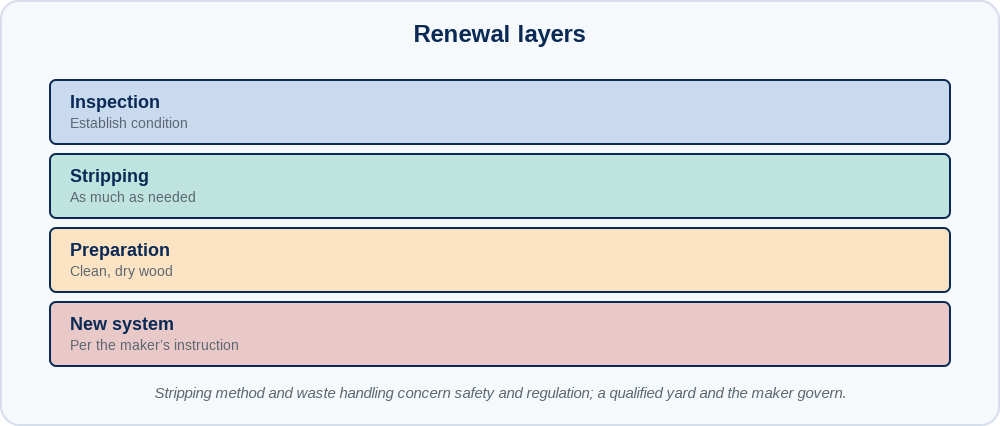
5. Limits#
Sources overlap that widespread peeling means the old coating must come off and that waste is toxic; they differ on which stripping method suits when. One magazine describes sanding for thin coatings and heat and scraping for thick ones while another says a combination of methods is needed. So there is no single right answer; the thickness of the coating, the wood, the boat’s construction and a qualified craftsman’s assessment govern. This article is not application or safety advice.
5b. Where sources differ#
One magazine separates methods by coating thickness; another says there is no magic solution and a combination is needed; the retailer guide recommends stripping badly deteriorated varnish completely; some accounts describe local repair on small areas; chemical stripper accounts also differ, one layering and covering, another brushing on, letting it dwell and scraping with a putty knife. These are sources speaking in different contexts and with different interests. The difference means following your product’s and craftsman’s instruction.
This article is general information; it recommends no product, method, ratio, number of coats or time. The maker’s data sheet and a qualified yard govern.
5c. A practical frame for reading the sources#
The sources are magazines, makers, sellers and forums; each writes in its own context. None knows the thickness of the coating, the amount of wood remaining or your local waste rules of your boat. So taking the shared message and consulting the maker and a qualified yard for detail is reasonable.
Heat guns carry fire and burn risks; chemical strippers can be harmful to skin, eyes and breathing and some have hazardous vapour; sanding dust and old coating residues can carry health risks; stripper waste is toxic and must be disposed of by local regulation. This article describes no personal protection, ventilation or waste method; read the product’s safety data sheet, consult a qualified yard and follow the relevant safety and environmental rules.
Seller and maker statements are the firm’s own account of its product and have not been independently verified. A product’s compatibility with another coating should always be checked in the product’s technical document; where a document and a guide conflict, the maker’s document and a qualified yard’s assessment should be used. Recording decisions and product details helps later maintenance.
6. Common mistakes#
- Applying new coats over peeling varnish.
- Only sanding the surface without removing the failed coating.
- Gouging the wood with heat or scraping.
- Not disposing of stripper waste by regulation.
- Not protecting surrounding surfaces.
- Not reading the safety data sheet.
- Keeping no records.
7. Checklist#
8. Conclusion#
For peeling or widely cracking varnish sources describe a total overhaul, methods such as sanding, heat and scraping or chemical stripping, and disposal of toxic waste by regulation; they differ on method choice. This article is general information; it gives no method, product or time and is not application or safety advice.
Frequently asked questions#
How is peeling varnish renewed?
A boating magazine writes that for widespread peeling and cracking a total overhaul is the only cure and that takedown methods include sanding, scraping or heating and scraping, and chemical stripping.
Which stripping method?
A magazine account describes sanding for thin coatings and scraping or heating and scraping for thick ones; which suits depends on the coating and wood. This article recommends no method.
What happens to chemical stripping waste?
A magazine writes that whatever stripping method or product is used the waste is toxic and must be disposed of according to local toxic waste law.
Does sanding thin the wood?
A boating magazine writes that sanding removes some wood and that whether enough wood remains for refinishing should be assessed; ask a craftsman about dimension.
Can a full strip be avoided?
A magazine describes that adding at least one maintenance coat during the season can keep the finish in good condition and that neglect can lead to a complete strip.
Was this guide helpful?
Thank you! Your feedback has been saved.
Guide content is for general information; in practice, the current technical data sheet of the product applies.
Keep reading
Related guides
Boat Colour Selection and Solar Reflectance: Effect of Heat Absorption on Surfaces
A study of the effect of boat paint colour on solar reflectance and surface temperature.
2 min read Paint and CoatingsCauses and Diagnosis of Paint Blistering
A study of the sources, types and diagnostic approach to blistering on boat paints.
2 min read Paint and CoatingsNumber of Coats in Epoxy Coating Systems
A study of the effect of the number of coats in epoxy coating systems on protective performance and thickness.
2 min read