
Paint and Coatings
Paint Thinning: Choosing the Right Thinner
Thinner choice is a detail often overlooked in boat painting. This article explains the difference between reducer, brushing thinner and cleaning solvent, the consequences of a wrong choice and the correct way to thin, using general sources.
Short answer
To thin paint use the thinner (reducer) the manufacturer specifies for that product; not every thinner suits every paint. Fisheries Supply says using an incompatible thinner can lead to curing problems, poor flow, weak adhesion or surface defects and recommends checking the label and data sheet and choosing the thinner or reducer the manufacturer recommends. West Marine writes that reducers are designed for particular paint chemistries and that polyurethane may need a different solvent from epoxy or antifouling paint. In two-component paint add the thinner slowly after the components are mixed and do not exceed the data-sheet ratio. This article is general information.
Key points
- Use the thinner the manufacturer recommends for that product; not every thinner suits every paint.
- Reducer, brushing thinner and cleaning solvent do different jobs; cleaning solvent is generally not for thinning.
- The wrong thinner can cause curing, flow, adhesion and surface defects.
- In two-component paint add thinner after mixing the components and slowly; the ratio must not exceed the data-sheet limit.
- In hot weather over-thinning increases sagging; consider a hot-weather reducer if the maker offers one.
1. Why thin, and why care is needed#
Paint is thinned to lower viscosity so as to ease spray, brush or roller application, improve flow and adapt to temperature. But thinning is an intervention in the paint’s chemical balance. Fisheries Supply says choosing the thinner or reducer the manufacturer recommends reduces the risk of curing problems, poor flow, weak adhesion or surface defects. Practical Sailor also writes that if you buy a reducer or brushing liquid from the paint manufacturer you can be certain it has been tested and will work, since they know what is in the paint.
This article is a general guide and recommends no thinner or ratio for any product. The correct thinner type and ratio are always in the product’s technical data sheet. For mix ratio, pot life and temperature-humidity see the related articles.
2. Thinner, reducer and cleaning solvent#
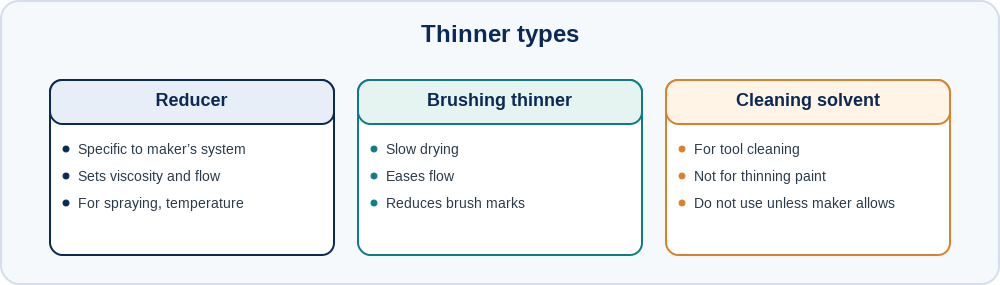
In everyday use the word “thinner” covers different products. West Marine separates three groups: cleaning solvents (remove wax, oil and contaminants from fibreglass and metal, often used before sanding or painting), strong solvents such as lacquer thinner (for cleaning spray equipment and removing coatings; not suitable for all paint types, typically used for equipment maintenance rather than thinning marine coatings) and reducers formulated for particular paint systems (adjust viscosity without affecting performance, designed for particular paint chemistries, essential for spray applications or temperature adjustments). Fisheries Supply also says a reducer adjusts viscosity, flow and evaporation characteristics, particularly for spray application, while marine paint thinner commonly reduces the viscosity of compatible paint for brushing and cleans approved equipment.
The distinction matters in practice: thinning paint with a cleaning solvent can upset the paint’s solvent balance. The evaporation rate, solvency and compatibility of the reducer recommended for a system have been tried by the manufacturer. So approaches like “I have acetone” or “petrol will do” are risky unless the data sheet explicitly recommends them. Some product descriptions also separate types such as a fast-evaporating “special thinner” and a slow-drying “brushing thinner”; these are retailer product descriptions and apply only as far as stated for the paint concerned.
| Type | What it does | Care |
|---|---|---|
| Reducer | Adjusts viscosity and flow; system specific | Use the maker’s recommended one |
| Brushing thinner | Dries slowly, eases flow | Only on suitable paint |
| Fast-evaporating special thinner | Helps drying in cold, eases spraying | May be risky in heat |
| Cleaning solvent | Tool, surface cleaning | Not for thinning paint |
| Strong solvent (e.g. lacquer thinner) | Equipment cleaning, coating removal | Not suitable for most marine paint |
3. Consequences of the wrong thinner#
Fisheries Supply and other retailers say using the wrong thinner can lead to curing problems, poor flow, weak adhesion or surface defects. An army engineering manual also says only the thinner indicated on the can label should be used. A woodworking industry article lists problems such as runs, cracking and dullness among common results of the wrong thinner or solvent additive and adds that many lower-VOC coatings are supplied ready to spray so additional thinner may not be necessary. Because these sources come from different sectors, when adapting the rule to boat paint the product’s own data sheet should be the basis.
In two-component systems the wrong thinner carries an extra risk: some solvents can react with the hardener and spoil cure. For example in polyurethanes some alcohol-containing solvents are not recommended because they react with isocyanate; but this is general chemistry knowledge and cannot replace your product’s instruction. The safe path is to use only the thinner the manufacturer names.
4. How, when and how much to thin#
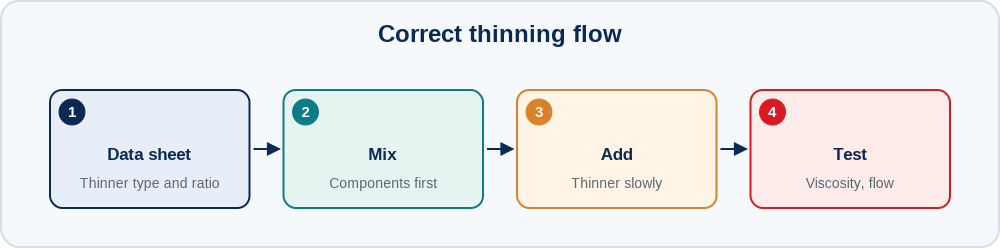
The general principles are: mix the paint well first; add the thinner slowly and while stirring continuously. An army manual advises adding thinner slowly and stirring the paint continuously. In two-component paint the data sheet sets the order; a Sigma product document says the thinner should be added after the components are mixed and gives a volume range such as 10–15 percent for air spray. That is an example; your product may differ. According to retailer information having more paint than thinner helps avoid a paint that is over-thinned and not true to colour; that is a practical principle and does not represent a specific ratio.
Temperature and humidity affect the thinning decision. According to Jamestown Distributors a hot-weather reducer makes paint cure more slowly; Interlux’s fast-evaporating special thinner is sold as improving drying in cold climates and easing spraying. These product descriptions come from retailers; decide from the data sheet which thinner suits your product. Hempel’s hot-climate guide says paint tends to sag in heat and further thinning increases the tendency to sag; that is, thinning more in heat can enlarge sagging problems.
- Identify the thinner type and ratio in the data sheet.
- Mix the paint (components if two-pack) thoroughly.
- Add thinner slowly while stirring.
- Do not exceed the data-sheet upper limit.
- Test viscosity and flow on a small area.
- If temperature and humidity change reassess whether the thinner suits.
- Record the thinner type and ratio used.
5. Risks of over-thinning#
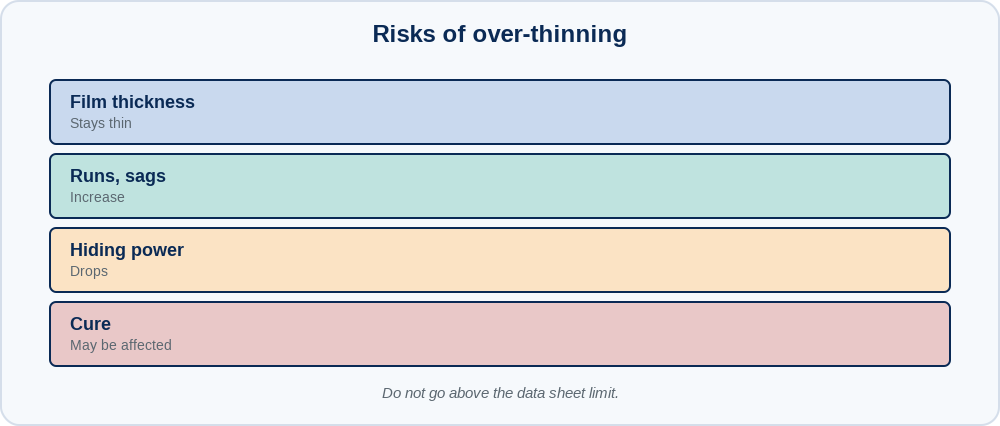
Over-thinning can lead to lower dry film thickness, reduced hiding power, higher sagging and running risk and in some cases effects on cure and adhesion. A mix with lower volume solids leaves less solid material for the same volume; an extra coat may be needed to reach target film thickness. So thin not for convenience but only where really necessary and within the limit the manufacturer allows. Excess solvent also raises VOC emission and fire risk; for environmental rules see local regulations.
Thickness checking is useful here: in thinned paint the ratio between wet film thickness and dry film thickness changes. Check thickness with a wet film comb and adjust the thinning ratio to the data-sheet target. This article recommends no specific ratio.
6. Common mistakes#
- Thinning with a solvent the maker does not recommend.
- Using cleaning solvent as paint thinner.
- Adding thinner fast and without stirring.
- Exceeding the data-sheet limit.
- Over-thinning in hot weather.
- Adding thinner to two-component paint before mixing the components.
- Not recording the thinner and ratio used.
7. Checklist#
8. Conclusion#
Choosing the right thinner is critical for cure, adhesion and appearance. Use the reducer or thinner the manufacturer recommends for that product; do not use cleaning solvent for thinning. Add the thinner slowly while stirring, do not exceed the data-sheet upper limit and avoid over-thinning in hot weather. This article is general information; your product’s data sheet governs.
Frequently asked questions#
Does every thinner suit every paint?
No. Reducers are designed for particular paint chemistries; West Marine says polyurethane may need a different solvent from epoxy or antifouling paint. Use the thinner the manufacturer recommends.
Is reducer the same as cleaning solvent?
No. A reducer is made specifically for a paint system to adjust viscosity, flow and evaporation; cleaning solvent is for tool cleaning and surface preparation.
When do I add the thinner?
For two-component paint a Sigma product document says thinning should be done after the components are mixed; see the data sheet for your own product.
How much can I thin?
Follow the data-sheet ratio. A Sigma product document gives a range such as 10–15 percent for air spray; that is only an example and varies by product.
Is over-thinning a problem in hot weather?
Hempel says paint tends to sag in heat and further thinning increases the tendency to sag; so do not go above the data-sheet limit.
Was this guide helpful?
Thank you! Your feedback has been saved.
Guide content is for general information; in practice, the current technical data sheet of the product applies.
Keep reading
Related guides
Boat Colour Selection and Solar Reflectance: Effect of Heat Absorption on Surfaces
A study of the effect of boat paint colour on solar reflectance and surface temperature.
2 min read Paint and CoatingsCauses and Diagnosis of Paint Blistering
A study of the sources, types and diagnostic approach to blistering on boat paints.
2 min read Paint and CoatingsNumber of Coats in Epoxy Coating Systems
A study of the effect of the number of coats in epoxy coating systems on protective performance and thickness.
2 min read