
Paint and Coatings
Roll and Tip Boat Painting: Technique, Equipment and Tips
For those without a budget or equipment for spraying, roll and tip is the most used boat-painting method. This article explains equipment, working order, direction options and common mistakes, based on sources and user experience.
Short answer
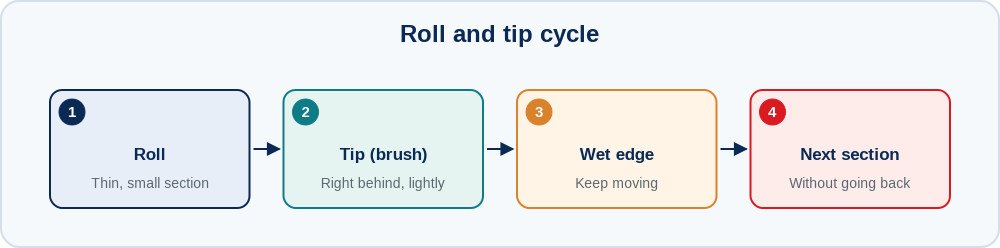
Roll and tip is a fast, non-stop technique in which one person applies a thin coat with a roller and another follows right behind with a brush to remove the roller texture (like orange peel). Sources recommend a high-density closed-cell foam roller, a quality soft brush, small sections about two feet wide, keeping a wet edge and, if possible, two people; one guide says properly done the result can be close to spraying. Some users work alone, but the wet edge gets harder. The data sheet and temperature conditions come first.
Key points
- Roll and tip: one rolls a thin coat, another brushes out the roller texture right behind.
- A high-density closed-cell foam roller and a quality soft brush are advised; large-cell foam makes bubbles.
- Small sections about two feet wide and keeping the wet edge are critical.
- Direction options (horizontal-horizontal, vertical-horizontal) work per sources; test with your paint and hull.
- Working alone is possible but hard for the wet edge; temperature, thinning and prep decide.
1. What is roll and tip?#
A maker’s support page describes the roll and tip method as a non-stop, fast-moving, two-person paint-a-thon where one person applies a thin coat of paint with a roller and the other follows immediately behind with a brush to remove the roller stipple (the so-called orange peel). The aim is to let roller-related bubbles and texture settle out before they set into the surface. A boat guide writes that the method, shown on a dinghy, can achieve results close to that of a sprayed finish. For many DIYers this is the most accessible way of getting a high-gloss result without spray equipment and environment.
The method is used with both one- and two-part paints, but with two-part systems pot life and fast curing raise the time pressure. A boat guide says two-part polyurethane begins to set almost immediately and that painting is a sprint. For a comparison with spraying see our separate article.
2. Equipment: roller, brush and other tools#
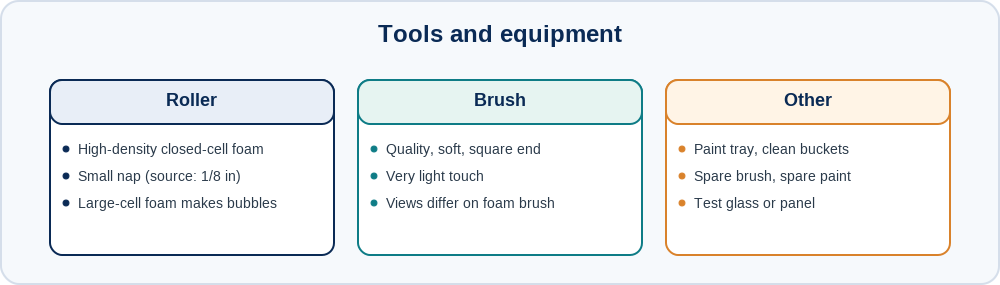
A maker’s support page advises a 1/8 inch nap, high-density, closed-cell foam roller, because large-cell foam rollers cause bubbles in the paint film. A forum reply advises the finest closed-cell foam roller you can get to roll the paint on and a good quality brush for tipping. Another user describes working with a small (six-inch) foam roller and a three-inch natural-bristle brush, advising a lightly loaded roller worked well into the tray. A retailer guide says brushes with long flexible bristles are best for gloss paints.
Views differ on tipping with a foam brush: one user writes that tipping with a foam brush dragged the paint and did not work, while another says foam brushes leave a slightly finer knock-down, hold less paint and are cheap. This contradiction shows user experience varying with product and thinning level; look at your paint maker’s advice and try it on your own test panel. A very light touch is advised when tipping: a source wants the brush to barely touch the wet paint.
| Tool | What sources say | Note |
|---|---|---|
| Roller | High-density closed-cell foam; 1/8 inch nap | Large-cell foam makes bubbles |
| Brush | Quality, soft, square end; very light touch | Views differ on foam brush |
| Section size | About 2 feet wide | Keeps the wet edge |
| Working | Two people: one rolls, one tips | Alone possible but hard |
| Test | Trial on an almost vertical glass or panel | Shows runs and sags |
3. Working order: wet edge and small sections#
A maker’s support page advises applying paint in small sections about two feet wide to keep a wet edge and distribute paint evenly; small sections give the roller enough time to spread paint evenly and the tipper enough time to tip without the brush dragging in drying paint. The roller is rolled back towards freshly tipped paint. A forum user writes that if you stop in the middle and come back later you will see where you left off and where you started again, so keep working non-stop; that is a practical observation.
The time pressure is real: a boat guide says one side of a 26-foot boat should take no more than twenty minutes by roll and tip. So paint, brushes, spare materials and the area must be ready beforehand; a guide advises having a spare clean brush and extra paint at hand and wetting the ground around the boat to keep dust down. The working environment matters too: a forum user writes that air temperature and drying time are crucial.
4. Direction: horizontal or vertical?#
A maker’s support page says people roll and tip in different directions and all work fine: roll horizontally and tip horizontally, roll vertically and tip horizontally (commonly used for boat hulls), or roll horizontally and tip vertically. A forum user writes that tipping horizontally let brush marks settle better as the paint shrank back and also matched the line of the boat. Another user says they tipped vertically at first but his wife switched to horizontal and the finish looked better. These are user experiences; the safest way is a test panel with your own paint and conditions.
5. Working alone and additives#
On a forum several users write that they roll and tipped alone and the result was as good as with two people; but another says that on a large area alone keeping a wet edge will rush you. One user says adding an additive (Owatrol) to the paint lengthens drying time and increases wet-edge time; that is a user and product experience and is not recommended unless compatibility with your paint system is confirmed. Consult the paint maker before using additives.
Another user writes that he rolled a boot-top stripe with a roller only, without tipping, and the result was excellent; this shows tipping may not be needed in some conditions but is not a general recommendation. Correct thinning is critical: a forum user says if you still have brush marks add more thinners and if it sags add more paint; that is one person’s guideline, and the thinner advice in your product’s data sheet comes first.
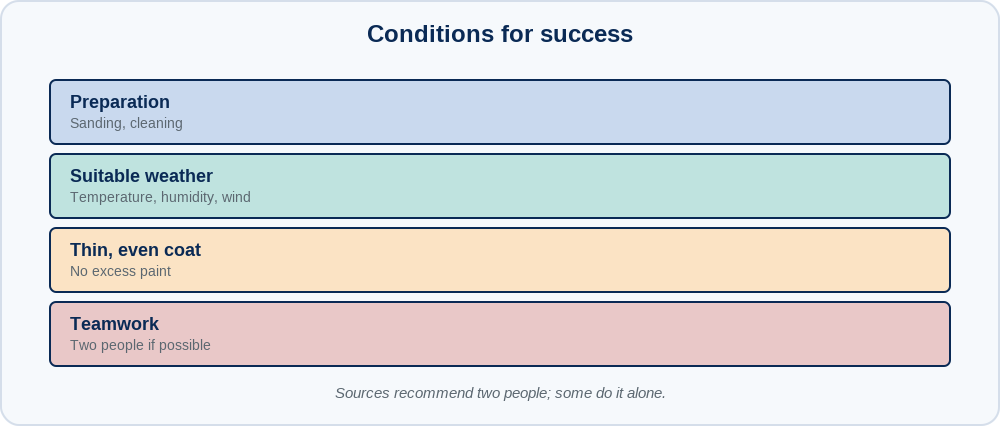
- Sand and clean the surface; apply a compatible primer.
- Check weather conditions (temperature, humidity, wind) and the data-sheet range.
- Prepare roller, brush, spares and paint; try a small test panel.
- Work as two: one rolls a thin coat, the other tips right behind with a brush.
- Move non-stop in sections about two feet wide; keep the wet edge.
- After finishing leave the coat alone; observe drying times.
6. Common mistakes#
- Using a large-cell or low-quality roller.
- Loading the roller with too much paint.
- Pressing hard with the brush.
- Stopping midway and losing the wet edge.
- Painting in difficult weather (too hot, windy).
- Starting without a test panel.
- Not preparing enough spare material.
7. Checklist#
8. Conclusion#
With the right equipment, fast non-stop work, small sections and a kept wet edge, roll and tip can give a result close to spraying; two people are generally advised though some work alone. The result depends on prep, weather and the paint system. This article is general information; the data sheet comes first.
Frequently asked questions#
What is roll and tip?
A two-person boat-painting technique where one applies paint with a roller in a thin coat and the other follows right behind with a brush to smooth the roller texture.
Which roller and brush?
A maker’s support page advises a 1/8 inch nap high-density closed-cell foam roller; large-cell foam makes bubbles. For the brush a quality soft brush is advised; user views differ on foam brushes.
Can I do it alone?
On a forum some who painted alone write it worked; another user says keeping the wet edge on large areas will rush you. Two people are generally advised.
Which direction?
Sources say horizontal-horizontal, vertical-horizontal or horizontal-vertical all work; on hulls vertical roll with horizontal tip is commonly mentioned.
How quickly must it be done?
A guide says two-part paint begins to set almost immediately and one side of a 26-foot boat should take no more than twenty minutes by roll and tip; that is a guide’s figure and depends on the product.
Was this guide helpful?
Thank you! Your feedback has been saved.
Guide content is for general information; in practice, the current technical data sheet of the product applies.
Keep reading
Related guides
Boat Colour Selection and Solar Reflectance: Effect of Heat Absorption on Surfaces
A study of the effect of boat paint colour on solar reflectance and surface temperature.
2 min read Paint and CoatingsCauses and Diagnosis of Paint Blistering
A study of the sources, types and diagnostic approach to blistering on boat paints.
2 min read Paint and CoatingsNumber of Coats in Epoxy Coating Systems
A study of the effect of the number of coats in epoxy coating systems on protective performance and thickness.
2 min read