
Paint and Coatings
Runs and Sags in Paint: Causes and Prevention
Paint coming down a vertical surface in curtains or drips is one of the most common defects in boat painting. This article explains causes, immediate action and lasting prevention, based on sources.
Short answer
Runs and sags are a wet paint film slumping downward under gravity. Sources list among causes too much paint in one coat, short waiting between coats, over-thinning, cool humid conditions, glossy or dirty surface and low air pressure when spraying. While paint is still wet it can be brushed out and redistributed; if dry, wait until fully hard, sand and recoat thinly. The core of prevention is thin coats, the recommended spread rate and enough waiting time. This article is general information.
Key points
- Runs and sags are wet film slumping under gravity; common on vertical surfaces.
- Causes: too much paint in one coat, short waiting, over-thinning, cool humid air, glossy or dirty surface.
- While wet brush out or re-roll; when dry wait for hardening then sand.
- Two thin coats beat one heavy coat; follow the maker’s spread rate.
- Watching the film in reflected light catches developing runs early.
1. What are runs and sags?#
Runs and sags are the downward slumping of a wet paint film under gravity. A paint maker’s source calls it running or sagging of a wet paint film resembling drips or a curtain; another describes a well-defined local thickening in the form of a wavy line or shallow rounded ridges, normally confined to sharply sloping or vertical surfaces. Another source says the same defect is also known as runs, curtains and dripping and comes from heavy application where excess material sits and runs. It is especially common on large vertical surfaces such as a hull, at corners and under rails.
A boat-painting article says thin, flowing marine paints such as Brightsides are prone to runs, sags and drips and that the same flow is why it is so glossy: the idea is to get just enough paint on to be glossy and wet but not too much; too little leaves roller texture. The writer even suggests you can hear excess paint from the roller’s sound on the final pass; that is a user practice.
2. Causes#
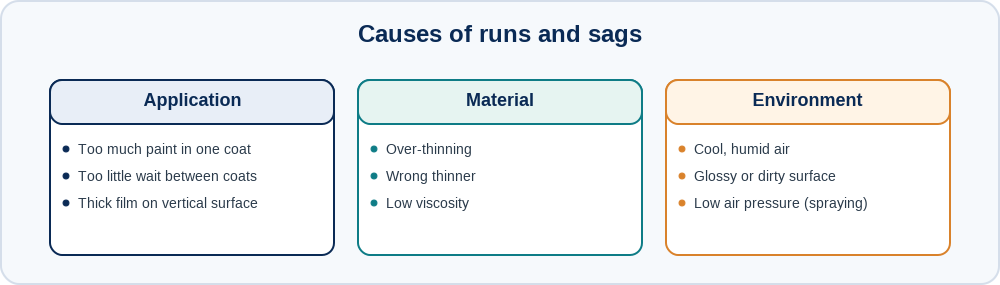
An automotive paint maker lists among causes of runs and sags applying too much paint in one coat, low air pressure, too little flash time between coats, air or surface temperature too low and contamination of the underlying surface. A building-paint maker gives application of too heavy a coat, application in excessively humid or cool conditions, over-thinned paint, painting over a glossy surface and painting over a surface contaminant.
A varnish source writes that over-thinning reduces viscosity enough that the film cannot hold itself in place while it dries and that a thick coat on vertical surfaces leads to drips and unevenness. On a forum a user who had runs despite trying to apply thin got the answer that most people’s mistake is heavy coats and that several thin coats with thinner work best; that is a user view but consistent with the sources.
| Cause | Detail | Prevention |
|---|---|---|
| Too much paint | Heavy film in one coat | Follow maker spread rate; two thin coats |
| Short waiting | Lower coat not ready | Observe time between coats |
| Over-thinning | Viscosity too low | Only recommended thinner and ratio |
| Cool, humid air | Film cannot dry | Work in suitable weather |
| Dirty or glossy surface | Poor adhesion | Clean, abrade |
3. Intervening while wet and after drying#
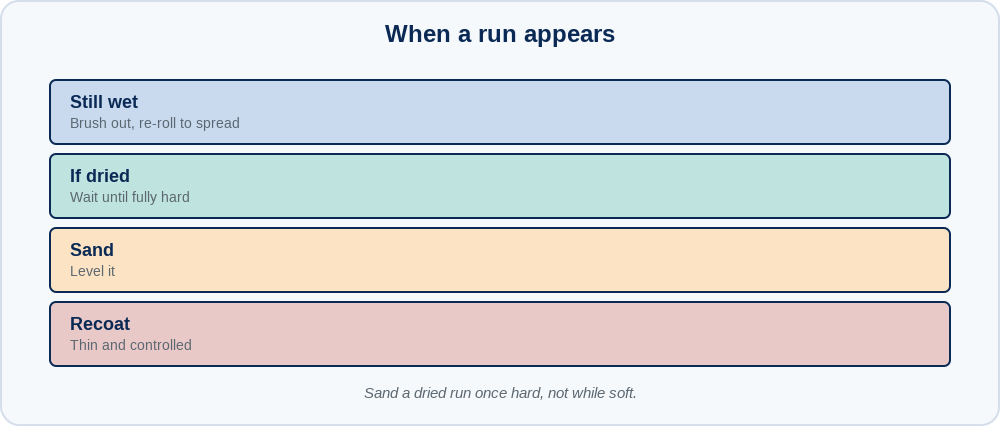
A paint maker advises that if the paint is still wet you should immediately brush it out or re-roll to redistribute the excess evenly, and if it has dried, sand and reapply a new coat. A woodworking source says you should never have runs or sags drying in your finish; watch the film in reflected light, notice developing runs and brush them out, and apply thinner coats. A thinner coat runs more quickly, so the problem is spotted immediately; sometimes that means an extra coat but it is usually worth it.
If a run has dried it must be allowed to harden through: one source says for varnish this can take days, and then it must be sanded or scraped level. Boat painters describe levelling a run with a sharp scraper after it hardens and sanding until shiny, then applying a fresh coat; for a small repair putting a couple of drops of paint on the spot and quickly feathering with a foam brush is also used. These are user experiences; they vary with your paint and the hardness of the film.
4. Prevention: thin coats and spread rate#
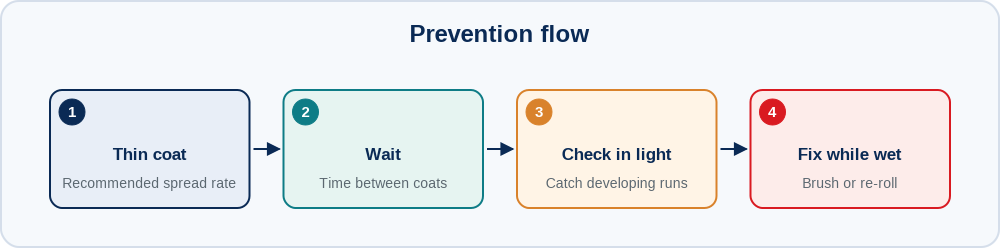
A paint maker advises following the label and data page spread rate (the total area a product can cover) and says two coats at the recommended spread rate are better than one heavy coat. For spraying, using correct technique and gun settings and only the recommended thinner are also on the prevention list. On film thickness a user says recommended thickness per coat is about four mils and suggests verifying with a mil gauge; that is a forum view, the value in your product’s data sheet comes first.
Light and weather matter too: watching the film in reflected light catches developing runs early. Painting in cool humid weather raises run risk. In roll and tip small sections and tipping help catch runs; in spraying lighting and distance are critical. See our related articles.
- Learn the spread rate and coat thickness from the data sheet.
- Thin the paint only with the recommended thinner and ratio.
- Apply thin coats; wait enough between coats.
- Prepare the surface clean and suitably; check weather conditions.
- Watch the film in reflected light; brush out runs while wet.
- Level dried runs once fully hard and apply a thin coat.
5. Common mistakes#
- Applying heavy paint in one coat.
- Not waiting enough between coats.
- Over-thinning or using the wrong thinner.
- Painting in cool, humid weather.
- Working in poor light.
- Trying to sand a dried run while still soft.
- Painting over a dirty or glossy surface.
6. Checklist#
7. Conclusion#
Runs and sags are wet film slumping under gravity; they mostly come from too much paint, short waiting, over-thinning and unsuitable conditions. Brush out while wet; if dry wait for hardening, sand and apply a thin coat. The core of prevention is thin coats and following the spread rate. This article is general information; the data sheet comes first.
Frequently asked questions#
Why do runs and sags occur?
Per sources, because of too much paint in one coat, short waiting between coats, over-thinning, cool humid conditions and a dirty or glossy surface.
What if I notice it while wet?
If the paint is still wet immediately brush it out or re-roll to redistribute the excess evenly.
What if it has dried?
Wait until fully hard (for varnish this can take days), then sand or scrape level and apply a new coat.
One thick coat or two thin?
A paint maker’s source says two coats at the recommended spread rate are better than one heavy coat.
How is it prevented?
Thin coats, the maker’s spread rate, enough waiting, suitable temperature and humidity and checking in reflected light.
Was this guide helpful?
Thank you! Your feedback has been saved.
Guide content is for general information; in practice, the current technical data sheet of the product applies.
Keep reading
Related guides
Boat Colour Selection and Solar Reflectance: Effect of Heat Absorption on Surfaces
A study of the effect of boat paint colour on solar reflectance and surface temperature.
2 min read Paint and CoatingsCauses and Diagnosis of Paint Blistering
A study of the sources, types and diagnostic approach to blistering on boat paints.
2 min read Paint and CoatingsNumber of Coats in Epoxy Coating Systems
A study of the effect of the number of coats in epoxy coating systems on protective performance and thickness.
2 min read