
Paint and Coatings
Spray Technique in Boat Painting: Equipment, Setup and Safety
Spraying can give the smoothest result in boat painting, but the advantage depends on equipment, technique, conditions and paint system matching correctly. This article covers equipment choice, setup, movement technique and safety, based on sources.
Short answer
A retailer guide says spraying gives a smoother, more uniform finish than brush and roller, but only when equipment, technique, conditions and paint system are correctly matched. Sources stress that an HVLP gun gives good atomisation and less overspray, that the gun should be held perpendicular at a constant distance, that passes overlap about fifty percent and that the paint maker’s tip size and pressure advice be followed. Respiratory protection, ventilation and light are essential. This article is general information; the data sheet comes first.
Key points
- With the right match spraying can give a smoother finish than brush and roller; in the wrong conditions it causes defects.
- An HVLP gun gives good atomisation and less overspray; follow the paint data sheet for tip size and pressure.
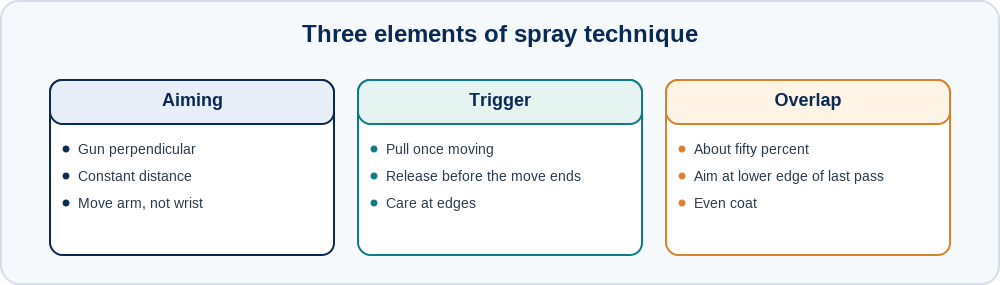
- Technique rests on three elements: aiming (perpendicular, constant distance), trigger use and about fifty percent overlap.
- A test panel, good light and suitable conditions reduce defects.
- Respiratory protection, ventilation and masking are essential; two-part products carry isocyanate risk.
1. When does spraying make sense?#
A retailer guide says spray painting a boat produces a smoother, more uniform finish than brush and roller application, but that the advantage only materialises when equipment, technique, conditions and paint system are all correctly matched, and spraying the wrong paint in the wrong conditions with inadequate equipment produces a poor result. Another guide says some two-part polyurethanes are designed for spray application only. So the decision to spray should be made by paint type, equipment, environment and skill.
In a forum thread a user describes spraying as having “worked very well” but says he would want better lighting next time, since when you cannot see you get thin spots and runs; that is a single experience. Do not think spraying means less work: preparation, masking and environment control matter at least as much as application. For the roller-and-brush alternative see our roll and tip article.
2. Equipment: gun, tip and pressure#
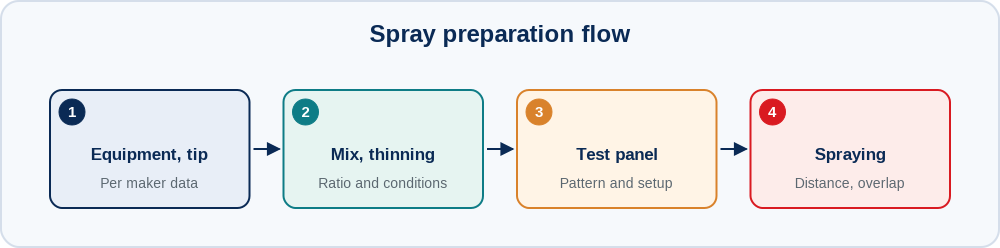
A boat-paint support page says results depend on the type of sprayer and on attention to the paint maker’s recommendations for tip type and size, pressure, flow and angle of spray. Another page says lighter coatings are sprayed with smaller tips, heavier ones such as high-solids primer or topside paint need a larger tip, and some paint makers give equipment, gun type and tip size in their data sheets. A round-up site writes that an HVLP (high volume, low pressure) gun is the industry standard for a mirror-smooth topcoat, giving excellent atomisation and minimal overspray. A forum user notes HVLP produces little atomisation and overspray but still needs a good respirator.
Maker guides give gun type and tip size explicitly for some systems: an Awlgrip guide presents tip size, fluid flow and air pressure ranges for pressure-pot and suction guns in tables. These values vary by product; use those in your own product’s data sheet. Compressor and gun matching matters too; a forum post says a 20-gallon compressor was enough for an HVLP gun, but that is a single experience.
| Topic | What sources say | Note |
|---|---|---|
| Gun type | HVLP: good atomisation, less overspray | Check the data sheet |
| Tip size | Light coating small, high-solids large tip | Maker advice comes first |
| Distance | About 6–12 inches, perpendicular | Varies with equipment |
| Overlap | About 50 percent | Aim at lower edge of last pass |
| Testing | Set up on cardboard or a panel | Do not make first mistakes on the boat |
3. Technique: aiming, trigger, overlap#
A maker’s support page writes that proper spray technique focuses on three things: aiming the spray pattern, trigger technique and overlapping technique. In general sources the gun is held perpendicular at a consistent distance; if angled, the film is thicker on one side; move your arm, not your wrist. The trigger is pulled once the motion has started and released before it ends, preventing build-up at edges. Each pass should overlap the last by about fifty percent; pointing the tip at the bottom edge of the previous pass gives efficient overlap.
One source says proper technique feels almost robotic: consistent distance, right angle, steady speed. Another publication reports that applying paint in thin controlled coats prevents runs and sags. A woodworking site suggests watching the film in reflected light to notice sags as they form. All this comes from general sources; on large vertical surfaces such as a hull you also need a work plan and a rotation order.
4. Conditions, light and environment#
A boating magazine says it is best to paint at 60–80 °F with low humidity; the exact range depends on the data sheet. Thinner choice for paint products matters too: a support page says some thinners are for warm (slow) or cool (fast) conditions and some are for brush-roll or spray only; use the maker’s thinner and quantity. If working outdoors is possible choose a windless day; a forum user suggests this, though dust, insects and moisture are risks.
Masking matters too: a forum user writes newspaper and blue masking tape work well; makers advise masking paper resistant to the paint’s solvents. Preparation, masking and cleaning can take longer than spraying.
5. Safety: respiration and environment#
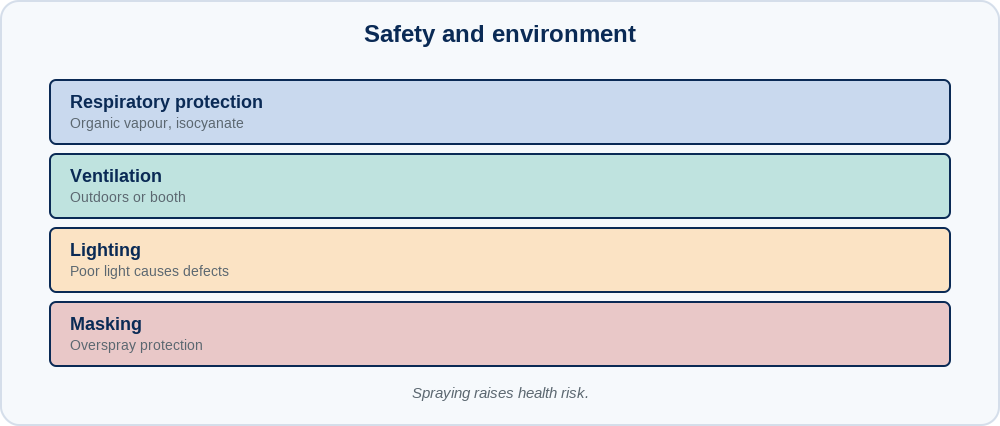
A round-up site says that when spray painting you are dealing with volatile organic compounds and clouds of fine dust, and quality personal protective equipment is non-negotiable. A support article recommends a cartridge-type respirator or fresh supplied air, and gloves, for spraying. A boat guide says for two-part (isocyanate) systems the operator should wear a respirator with new filters for each spray job, noting isocyanate filters degrade over time and should be used for no longer than 30 days. Exact requirements are in the maker’s safety data sheet; see our isocyanate safety article.
- Take gun type, tip size, pressure and thinner information from the data sheet.
- Settle pattern and setup on cardboard or a test panel.
- Check light, temperature and humidity; complete masking.
- Hold the gun perpendicular at constant distance; move your arm.
- Pull the trigger once moving; release before the move ends.
- Overlap each pass about fifty percent; apply thin coats.
- Work with respiratory protection and ventilation.
6. Common mistakes#
- Spraying straight onto the boat without a test panel.
- Holding the gun angled or at varying distance.
- Applying one pass too heavy.
- Working in poor light.
- Ignoring the maker’s tip and pressure advice.
- Neglecting respiratory protection and ventilation.
- Masking inadequately.
7. Checklist#
8. Conclusion#
Spraying can give the smoothest surface when correctly matched; equipment, setup, technique, conditions and safety must be handled together. A test panel, adherence to the data sheet, thin coats and respiratory protection reduce defects and health risk. This article is general information; the data sheet and expert opinion come first.
Frequently asked questions#
Is spraying always best?
A retailer guide says spraying gives a smoother finish but only if equipment, technique, conditions and paint system are correctly matched; a wrong combination gives a poor result.
Why is an HVLP gun preferred?
Per sources it gives good atomisation and less overspray so more paint reaches the surface; a respirator is still needed.
How far from the surface is the gun held?
Per sources typically 6 to 12 inches (about 15–30 cm) and perpendicular; exact distance is set by product and equipment data.
How much overlap?
A maker’s support page advises about fifty percent overlap per pass, aiming at the lower edge of the previous pass.
What if it is my first time spraying?
A forum suggestion is to make the first mistakes on cardboard, not the boat; a test panel helps you settle the setup.
Was this guide helpful?
Thank you! Your feedback has been saved.
Guide content is for general information; in practice, the current technical data sheet of the product applies.
Keep reading
Related guides
Boat Colour Selection and Solar Reflectance: Effect of Heat Absorption on Surfaces
A study of the effect of boat paint colour on solar reflectance and surface temperature.
2 min read Paint and CoatingsCauses and Diagnosis of Paint Blistering
A study of the sources, types and diagnostic approach to blistering on boat paints.
2 min read Paint and CoatingsNumber of Coats in Epoxy Coating Systems
A study of the effect of the number of coats in epoxy coating systems on protective performance and thickness.
2 min read