
Hull Repair
Salt Residue and Dulling of the Hull: Causes, Cleaning and Prevention
If a boat back from the sea shows white, hard marks or dullness on the hull, the source is most often salt. Salt is not only cosmetic; combined with UV and abrasion it shortens gelcoat and paint life. This guide explains causes, cleaning order and product warnings.
Short answer
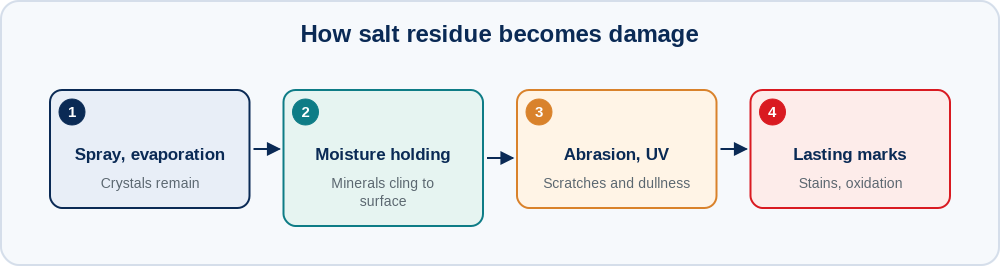
Salt crystals are abrasive, hold moisture and minerals against the surface and, with UV, speed dulling and oxidation. The most effective prevention is a fresh-water rinse after every trip in salt water and regular soap washing. White hard marks that soap does not remove are often mineral deposit from hard water or salt and may need a hull cleaner or descaler; these products strip wax and must not be used on antifouling. The label comes first. This article is general information.
Key points
- Salt crystals are abrasive; rubbed in unrinsed they scratch gelcoat.
- Salt holds moisture and minerals on the surface; with UV, dullness and oxidation speed up.
- A fresh-water rinse after every trip is the highest-return habit.
- White marks soap will not remove may be mineral deposit; a hull cleaner or descaler may be needed.
- Cleaners strip wax and are not for antifouling; renew protection afterwards.
1. How does salt harm gelcoat?#
On salt-water boats spray and splash evaporate on the surface and leave salt crystals. A retailer guide says salt crystals are abrasive, leave scratches if dragged across the surface and that this damage accumulates wash after wash. A seller guide says salt residue accelerates UV damage by holding moisture and minerals against the surface. A boat-rental site also writes that salt crystals act like tiny prisms magnifying the sun’s heat and breaking down protective coatings; such comparisons are seller or popular accounts, but the core message is shared across sources: do not let salt dry and build up.
Salt affects not only gelcoat but metal hardware, stainless rails, the outboard and glass. A publication says salt residue can lead to corrosion, dull finishes and long-term damage to metal components. So rinsing must cover not just the hull but the deck, hardware and engine.
2. The core of prevention: fresh-water rinse#
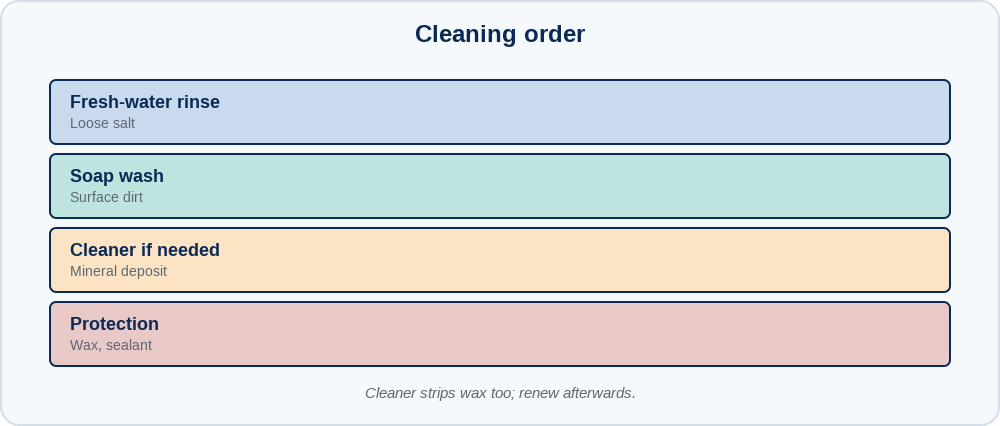
A retailer guide recommends rinsing salt-water boats with fresh water after every trip without exception. It says a thorough rinse from the top down, including the deck, hull sides, engine and exposed metal, removes the bulk of surface salt before it can bond to the gelcoat or begin working on metal. A rinse removes loose salt; a soap wash removes salt deposits crystallised in the surface texture and the biological film at the waterline. Boaters who only rinse and never soap-wash build up over time.
A writer says washing after every use removes salt and residue that would otherwise dry and become part of the fibreglass. Another guide suggests rinsing with a commercial salt-remover product if there is a lot of salt. The effect of such products is mostly a seller claim; the key element is plenty of fresh water. See our washing routine article for order.
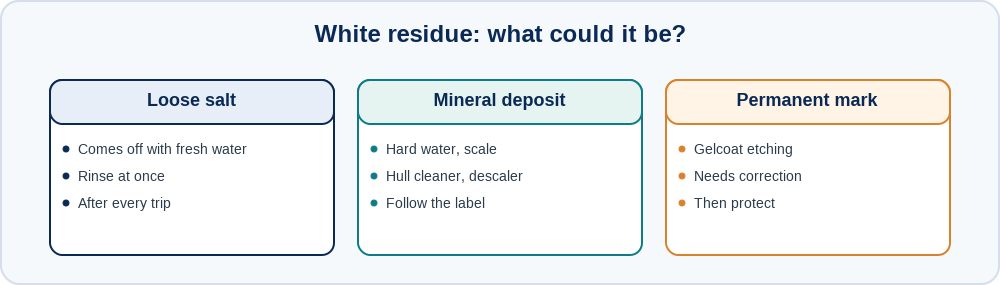
| Sign | Likely cause | Approach |
|---|---|---|
| Loose white dust | Dried salt | Fresh-water rinse, soap wash |
| Hard white crust | Mineral deposit (hard water, calcium, magnesium) | Hull cleaner or descaler, per label |
| Dull after washing | Wax gone or oxidation | Wash, compound if needed, then wax |
| Brown marks on stainless | Salt and rust | Metal cleaner, per label |
3. White, hard marks: salt or mineral?#
A retailer guide says hull cleaner dissolves waterline stains, rust streaks and mineral deposits that soap cannot touch. In the same guide’s diagnosis table, white or grey chalky deposits on hull or hardware may be calcium and magnesium scale from hard water or salt crystallisation, and a hull cleaner or marine descaler is suggested. A boat-care site writes that hard-water minerals bond chemically to gelcoat, vinyl and glass, forming a resilient film; it adds that on lake or river water splash evaporates almost instantly in the sun, leaving a fresh mineral layer.
On a British boating forum a user writes that his boat back from the Caribbean was covered in hard white crystals he thought were sun-dried salt but could not remove with three different boat washes; that is a single experience, but it shows some marks may not come off with ordinary washing. In such a case do not choose a product at random: read the label, test on a hidden area and protect surfaces other than gelcoat.
4. Hull cleaner and cleaner warnings#
A retailer guide gives these warnings for cleaners: rinse with fresh water first; the cleaner removes wax from every surface it contacts; on antifouling paint the acid reacts with paint binders and can damage or remove the coating and void the warranty; on gelcoat in direct sun or on a hot surface it can dry before the dwell time is over and leave chalky residue or surface etching. So work in shade, on a cool surface, section by section, rinse each section fully including run-down areas, and renew wax afterwards.
Use hull cleaner only when truly needed; for routine washing a pH-balanced soap is enough. For any product that touches the underwater zone also check the paint maker’s advice. If the surface is still dull after cleaning the problem may be wax loss or oxidation; then compound and protection are needed. See our oxidation and polishing articles.
5. Prevention plan#
The most effective prevention is routine: fresh-water rinse after every trip, a soap wash every few weeks, wax or sealant at the start of the season and a full wash at season end. A retailer guide notes that with regular upkeep salt and biological film can be prevented before they turn into a big cleaning job. A publication says on coated or waxed surfaces salt crystallises less aggressively and comes off more easily; this depends on products and is no guarantee.
- After every trip rinse deck, hull, engine and hardware with fresh water.
- Every few weeks wash with soap using the two-bucket method.
- Identify marks soap will not remove: salt or mineral?
- If needed use a cleaner suited to the label, in shade and section by section.
- Rinse thoroughly after the cleaner.
- Renew wax or sealant.
6. Common mistakes#
- Letting the boat dry in the sun without rinsing salt.
- Rubbing dry salt with a mitt or brush.
- Using hull cleaner on antifouling or on a hot surface.
- Not renewing wax after a cleaner.
- Assuming all white marks are salt and skipping mineral deposit.
- Using bleach.
7. Checklist#
8. Conclusion#
Salt residue is abrasive, holds moisture and minerals and, with UV, speeds dullness and oxidation. A fresh-water rinse after every trip and regular soap washing are the most effective measures; for stubborn marks use a cleaner suited to the label and renew protection afterwards. This article is general information; the product label comes first.
Frequently asked questions#
Does salt harm gelcoat?
Salt crystals are abrasive and hold moisture and minerals on the surface; with UV they speed dullness and oxidation. Sources report this.
Are white hard marks salt?
Not always; sources say they can be salt crystallisation or mineral deposit (calcium, magnesium) from hard water. A forum user writes three different wash products failed.
Can hull cleaner be used everywhere?
No; a guide says it can damage antifouling because of acid and can dry on hot gelcoat and leave marks. The label comes first.
Is a salt-remover product needed?
Per sellers it can help; but a generous fresh-water rinse after every trip is the basic habit.
Does dulling come back?
Surface dullness from salt residue can lessen with cleaning; if oxidation has developed, compound and polish are needed.
Was this guide helpful?
Thank you! Your feedback has been saved.
Guide content is for general information; in practice, the current technical data sheet of the product applies.
Keep reading
Related guides
Boat Colour Selection and Solar Reflectance: Effect of Heat Absorption on Surfaces
A study of the effect of boat paint colour on solar reflectance and surface temperature.
2 min read Paint and CoatingsCauses and Diagnosis of Paint Blistering
A study of the sources, types and diagnostic approach to blistering on boat paints.
2 min read Paint and CoatingsNumber of Coats in Epoxy Coating Systems
A study of the effect of the number of coats in epoxy coating systems on protective performance and thickness.
2 min read