
Paint and Coatings
Steel Yacht Rust: Early Intervention Methods
On a steel yacht rust is a reality sooner or later; the difference is when and how it is dealt with. This article summarises source accounts with their limits; it is not a product, method or time recommendation.
Short answer
Cruising World likens rust to the toredo worm of a steel boat and writes that a steel boat is anything but maintenance-free but with attention and touch-up work can be kept in her prime for decades. A safe-boating site describes steel hull maintenance as removing rust by sanding, chipping, scraping, grinding or blasting to shining metal and then moving on to painting, and says a phosphoric-acid-based rust preventer converts rust to iron phosphate. In a forum discussion one user reports good results with a rust-converting product while another writes that converters are only a temporary solution on mild steel. BetterBoat separates a light powdery orange stain as surface rust from flaking and small pits as moderate rust. This article is general information; method, product and time vary by maker and situation.
Key points
- On a steel boat rust is a reality; with attention and timely touch-up the hull can be kept in good condition for decades (Cruising World).
- Sources describe removing rust to bright metal; user views on rust converters differ.
- A light powdery stain is described as surface rust, flaking and pits as moderate rust (BetterBoat).
- Rust prevention is described as critical especially on the first coat (forum user relay).
- For deep or hidden rust a qualified specialist and the maker are needed.
1. Why is rust a reality on a steel boat?#
Steel rusts on contact with oxygen, water and salt; a FAO document writes that steel rusts when exposed to oxygen or air and corrodes much faster when water and salt are also present. Cruising World says steel ship designers see rust as a reality while steel yacht designers must often assume the vessel will not rust at all, and likens rust to the toredo worm of a steel boat owner. The same source says a steel boat is anything but maintenance-free but with attention and touch-up work can be kept in her prime for decades. This article is a general summary; it gives no product, method, thickness or waiting time and is not application advice. Some sources are seller or forum accounts and are labelled as such.
The logic of early action is simple: a small stain is far cheaper and easier than a system repair. That is why sources stress regular inspection and touch-up repair.
2. Rust grades#
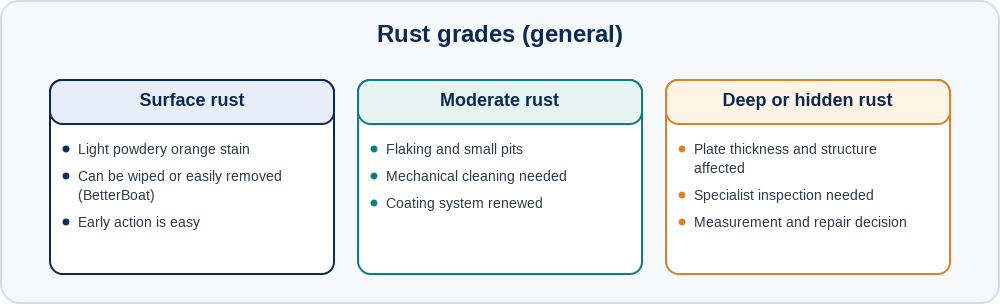
BetterBoat describes a light, powdery orange stain that wipes away as surface rust and flaking and small pits as moderate rust, adding that the method depends not only on the degree of rust but on the type of metal. That is a general classification. International (maker) in its rust and corrosion problem page lists red rust streaks or bubbling on steel surfaces and black areas on steel as signs; causes and remedies vary by product and situation and are not repeated here.
Deep or hidden rust can affect plate thickness and structure; in that case visual inspection is not enough and a qualified specialist is needed. This article does not try to judge the depth of rust from a picture.
| Grade | Sources’ general account | Caution |
|---|---|---|
| Surface | Light powdery orange stain (BetterBoat) | Early action is easy |
| Moderate | Flaking and small pits (BetterBoat) | Mechanical cleaning and system renewal |
| Deep or hidden | Plate and structure may be affected | Specialist inspection |
3. Cleaning and the converter debate#
A safe-boating site describes steel hull maintenance as removing rust by sanding, chipping, scraping, grinding or blasting to shining metal; it then mentions applying a rust converter and preventer to the freshly blasted surface, saying it is basically phosphoric acid converting rust to iron phosphate. That is the source’s general account and may not hold for every system. Cruising World writes that surface scale and rust that develop during fabrication must be removed to protect the steel.
In a forum discussion user views differ: one user writes that a rust-converting product needs only flaking rust removed and needs a rust film and that he has had good results; another says converters are only a temporary solution on mild steel, that they work well with cast iron but are useful for loosening rust. These are user accounts and have not been independently verified; this article neither recommends nor rejects a converter. The maker’s system and data sheet govern.
4. A practical frame#
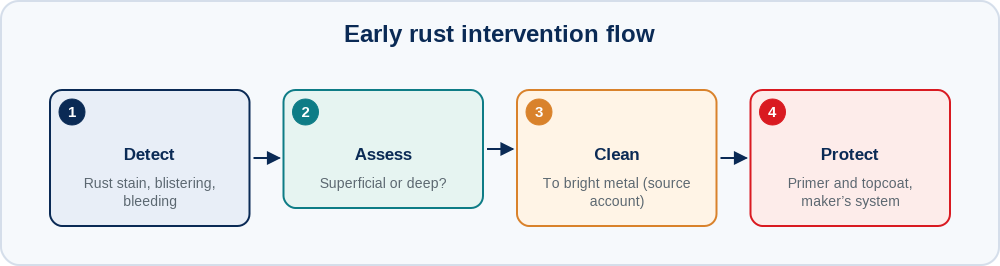
- Inspect regularly: rust stains, blistering, bleeding.
- Assess whether the rust is superficial or deep; in doubt consult a specialist.
- Find out the system the maker recommends for steel.
- Remove the rust to bright metal by the maker’s method.
- Apply primer and topcoats per the plan in the data sheet.
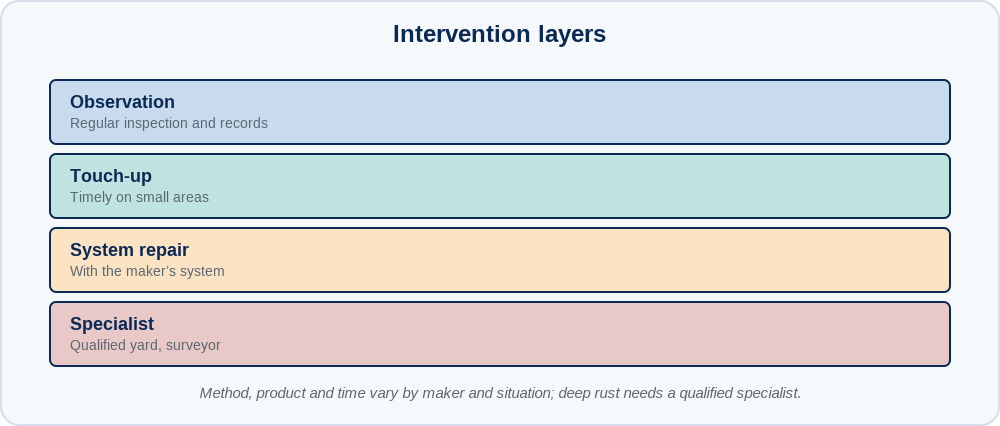
- Touch up small areas in good time.
- Record inspections and repairs.
5. Limits#
Sources agree on the importance of early action on rust; they differ on method. One site describes removing rust to bright metal and then applying a converter and preventer; forum users differ on the value of a converter. So there is no single right method; the maker’s system and a qualified yard’s assessment govern. This article is not application or engineering advice.
5b. Where sources differ#
The safe-boating site describes removing rust to bright metal and then applying a phosphoric-acid-based converter; one forum user says a converter is enough with only flaking rust removed while another writes it is only temporary on mild steel; Cruising World says scale and rust must be removed. These sources speak in different contexts and with different interests: a site describes general maintenance steps, forum users personal experience and a magazine the general approach. The difference means asking the maker for each boat.
This article summarises the sources’ general accounts; it may not hold for a particular boat. For product, method and time the maker’s data sheet and a qualified yard govern.
5c. A practical frame for reading the sources#
The sources are a magazine, a safe-boating site, a maker, a blog and forums; each writes in its own context. None knows your boat’s plate thickness, depth of rust or existing coating. So taking the shared message, that early action on rust matters and a small stain is cheaper than a big repair, and consulting the maker and a qualified yard for detail, is reasonable.
During rust removal sanding, grinding and blasting create dust, sparks and noise; some rust converters also contain acid and can harm skin or eyes. Read the safety information sheet and consult a qualified yard; this article describes no personal protection method. If there is rust bleeding, extensive blistering, pitting or concern about plate thickness consult a qualified specialist.
Finally, dealing with rust is not a solution on its own; the source of leaks, bilge water, ventilation and the anode system also need assessing. Recording decisions and keeping the maker’s instruction helps later maintenance.
In addition, seller and maker statements are the firm’s own account of its product and have not been independently verified. A product’s compatibility with another paint should always be checked in the product’s technical document; where a document and a guide conflict, the maker’s document and a qualified yard’s assessment should be used.
6. Common mistakes#
- Putting off a small rust stain.
- Judging firmly from a picture whether rust is deep or superficial.
- Treating a converter alone as a permanent fix.
- Mixing products without checking the maker’s system.
- Ignoring rust bleeding.
- Skipping personal protection and safety information.
- Keeping no records.
7. Checklist#
8. Conclusion#
On a steel yacht early action on rust separates a small stain from a big repair; sources describe regular inspection, removing rust to bright metal and touch-up repair and differ on rust converters. This article is general information; it gives no product, method or time, and for deep rust a qualified specialist and the maker govern.
Frequently asked questions#
Is rust on a steel yacht inevitable?
Cruising World writes that steel ship designers see rust as a reality and that a steel boat is anything but maintenance-free but with attention and touch-up work can be kept in her prime for decades.
How is rust removed?
A safe-boating site describes removing rust by sanding, chipping, scraping, grinding or blasting to shining metal. The method depends on the degree of damage and the maker’s system.
Do rust converters work?
In a forum discussion user views differ: one reports good results with a converter, another writes converters are only a temporary solution on mild steel. These are user accounts.
How are surface and moderate rust told apart?
BetterBoat describes a light powdery orange stain that wipes off as surface rust and flaking and small pits as moderate rust. This is a general classification; for a firm diagnosis on a steel boat consult a specialist.
When should a specialist be called?
If there is rust bleeding, extensive blistering, pitting or concern about plate thickness consult a qualified specialist; this article does not diagnose.
Was this guide helpful?
Thank you! Your feedback has been saved.
Guide content is for general information; in practice, the current technical data sheet of the product applies.
Keep reading
Related guides
Boat Colour Selection and Solar Reflectance: Effect of Heat Absorption on Surfaces
A study of the effect of boat paint colour on solar reflectance and surface temperature.
2 min read Paint and CoatingsCauses and Diagnosis of Paint Blistering
A study of the sources, types and diagnostic approach to blistering on boat paints.
2 min read Paint and CoatingsNumber of Coats in Epoxy Coating Systems
A study of the effect of the number of coats in epoxy coating systems on protective performance and thickness.
2 min read