
Paint and Coatings
Varnish Application: Coats and Sanding Intervals
On boat varnish the number of coats and sanding between coats are described as the two main matters affecting gloss and life; but sources differ on numbers and method. This article summarises the accounts with their limits; it is not a product, coat count, grit or time recommendation.
Short answer
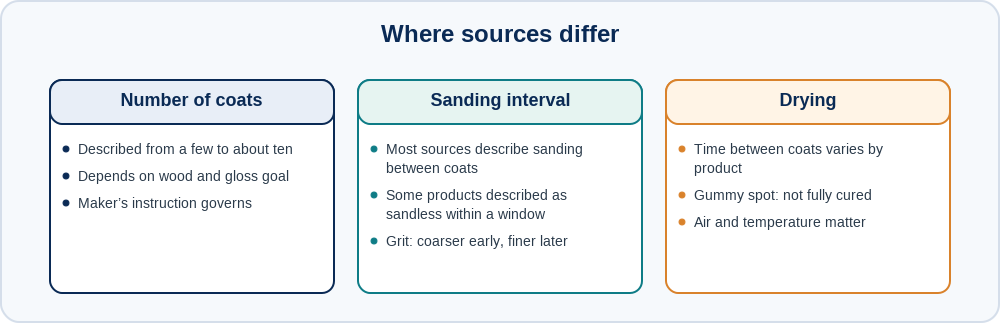
Sources broadly agree that several thin coats of varnish are better than one thick coat, but the total number of coats is described as varying from a few to about ten depending on the wood, the varnish type and the gloss wanted. An insurer’s guide writes that sanding between coats improves gloss and that if omitted each coat becomes progressively rougher; a retailer guide describes finer grit and longer curing for later coats; a boating magazine describes hand-sanding the last two coats to avoid orbital sander swirl marks. A maker says its product can be applied without sanding within a certain window. That is a maker claim; the product instruction governs.
Key points
- Several thin coats are generally described as better than one thick coat; total coats vary with wood and goal.
- Sanding between coats improves gloss; if omitted coats may get progressively rougher (insurer guide).
- Coarser paper early and finer later is described, with hand-sanding of final coats (magazine account).
- Some makers say their products can be recoated without sanding within a window; this is a maker claim.
- For coats, grit and times the maker’s data sheet and a qualified yard govern.
1. Why does the number of coats vary?#
On boat varnish the total number of coats is described in sources as varying from a few to about ten depending on the wood species, its pores, the varnish type and the gloss wanted. A boating magazine writes that the number of coats depends on the wood, its grain and the quality of finish required and that several thin coats are better than a few thick ones because they dry faster. This article is a general summary; it gives no product, coat count, grit, ratio or time and is not application advice. Sources are magazine, retailer, maker and forum accounts and may differ; maker statements are labelled.
2. First coats and preparation#
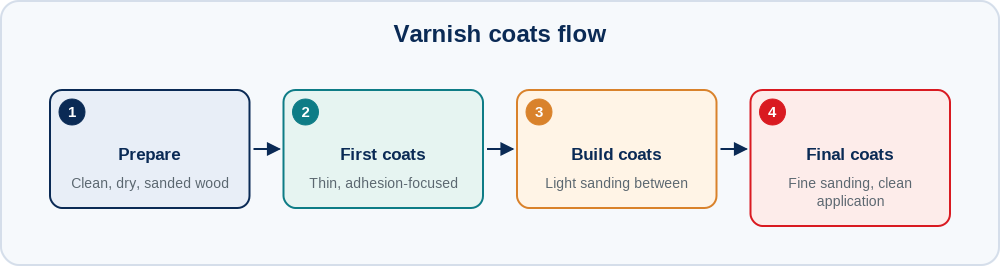
An insurer’s guide describes coarser paper for bare wood, finer for the first thinned coats and much finer between full-strength coats; it writes that the first two thinned coats should sit for a while before the first full-strength coat to let solvents evaporate and the varnish harden. Another magazine guide relays that some professionals do not sand between sealer and first coat, reasoning that roughness gives better grip and will be removed in later layers, though most makers suggest a light sanding to knock off the stubble. These two accounts differ; the maker’s instruction governs.
The same insurer guide writes that every imperfection in preparation will be magnified by later coats; a retailer article says most of the time in a varnish job should go on stripping and preparation. A forum user and some magazine accounts write that general-purpose varnishes not made for marine use can be too brittle; this is described as a caution and the maker should be consulted on varnish choice.
| Topic | General account | Caution |
|---|---|---|
| Number of coats | From a few to about ten; thin coats preferred | Depends on wood and product |
| Sanding between coats | Most sources describe it; improves gloss | Some products state a sandless window |
| Drying | Longer for later coats; gummy spot means uncured | Air and temperature |
3. Sanding between coats and drying#
A retailer guide describes removing ridges when sanding between coats but not sanding through the previous coat, a smooth surface being needed for a mirror result, allowing at least a day for coats to dry, later coats needing longer to cure before sanding again, and gummy spots when sanding showing the varnish has not fully cured. The same guide describes coarser wet-or-dry paper for early coats and finer for later and reminds that wet sanding is more aggressive. This is a retailer account and values vary with the maker’s instruction.
An insurer’s guide writes that one can go on without sanding between coats but it does not recommend this, since every imperfection is magnified by each following coat, sanding improves gloss and if omitted each coat gets progressively rougher in look and feel. By contrast a maker says its product can be recoated within a certain time after the previous coat without sanding or solvent wiping; that is a maker claim and holds only for that product within that window. In a forum thread one user also describes applying coats without sanding within a short window using a quick-drying product; that is a user experience.
A boating magazine describes hand-sanding the last two coats rather than using an orbital sander so that sanding swirls do not show through the final finish. The same article adds that leaving brushes in thinners for a long time can contaminate the next use. These are magazine accounts and general tips.
4. A practical frame#
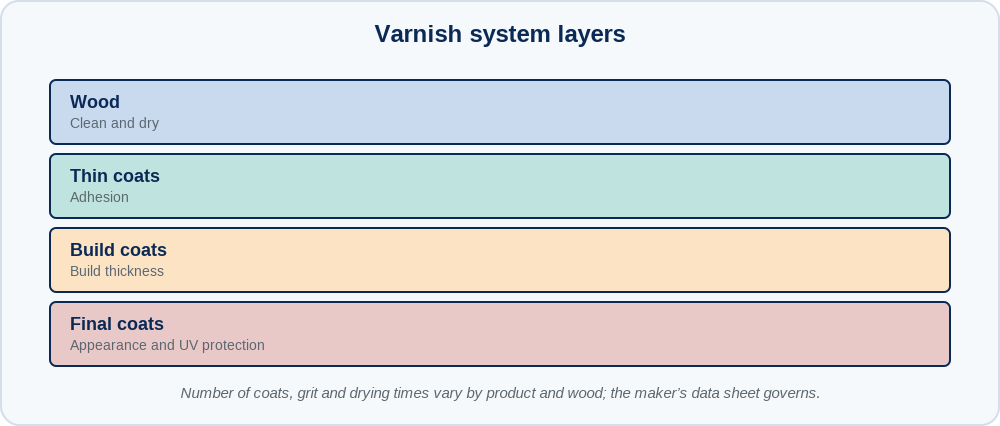
- Read the product data sheet: for drying between coats, sanding and number of coats it governs.
- Prepare the wood clean, dry and evenly sanded; preparation faults are magnified by later coats.
- Apply thin coats; several thin coats are described as preferable to a thick one.
- Between coats prepare the surface by the maker’s method; if there is a gummy spot wait for full cure.
- Apply the final coats in a clean, dust-controlled place.
- Check air and temperature conditions per the maker’s instruction.
- Keep records; read the safety data sheet.
5. Limits#
Sources overlap that several thin coats are preferred and that preparation matters; they differ on the number of coats, whether sanding between coats is needed and drying times. An insurer guide recommends sanding while some makers state a sandless window; the two apply to different products and contexts. So there is no single right answer; the varnish type, wood, weather and the maker’s instruction govern. This article is not application advice.
5b. Where sources differ#
The insurer’s guide strongly recommends sanding between coats; a boating magazine describes hand-sanding final coats; some professionals are relayed as not sanding between sealer and first coat though makers generally suggest a light sanding; a maker says its product can be recoated without sanding within a window; the retailer guide describes drying times and gummy spots. These are sources speaking in different contexts and with different interests. The difference means following your own product’s instruction.
This article is general information; it recommends no product, method, ratio, number of coats or time. The maker’s data sheet and a qualified yard govern.
5c. A practical frame for reading the sources#
The sources are magazines, makers, sellers and forums; each writes in its own context. None knows wood species, current varnish state or weather conditions of your boat. So taking the shared message and consulting the maker and a qualified yard for detail is reasonable.
Sanding dust and varnish vapours can carry health and fire risks, and varnish-soaked rags can self-heat. This article describes no personal protection, ventilation or waste method; read the product’s safety data sheet, consult a qualified yard and follow the relevant safety rules.
Seller and maker statements are the firm’s own account of its product and have not been independently verified. A product’s compatibility with another coating should always be checked in the product’s technical document; where a document and a guide conflict, the maker’s document and a qualified yard’s assessment should be used. Recording decisions and product details helps later maintenance.
6. Common mistakes#
- Rushing preparation.
- Applying a thick coat.
- Sanding while there is a gummy spot.
- Assuming the recoat window without reading the instruction.
- Treating one maker’s claim as valid for every varnish.
- Leaving swirl marks in final coats.
- Keeping no records.
7. Checklist#
8. Conclusion#
The number of coats and sanding between coats are matters sources describe differently; several thin coats and good preparation are the shared message, while numbers and the need to sand vary by product. This article is general information; it gives no product, coat count, grit or time and the maker and a qualified yard govern.
Frequently asked questions#
How many coats of varnish?
Sources describe numbers from a few to about ten; the number depends on wood, product and gloss goal. This article recommends no number; see the maker’s instruction.
Is sanding between coats necessary?
Most sources describe sanding between coats for gloss and smoothness; some makers say their products can be recoated without sanding within a window. See the maker’s instruction.
Which grit?
Sources describe coarser paper early and finer later; for a specific value see the maker’s instruction, this article recommends no grit.
How long between coats?
Time varies by product and weather; a retailer guide describes longer curing for later coats and says gummy spots when sanding mean the varnish has not fully cured.
Should an orbital sander be used?
A boating magazine describes hand-sanding the last two coats so swirl marks do not show; that is a magazine account.
Was this guide helpful?
Thank you! Your feedback has been saved.
Guide content is for general information; in practice, the current technical data sheet of the product applies.
Keep reading
Related guides
Boat Colour Selection and Solar Reflectance: Effect of Heat Absorption on Surfaces
A study of the effect of boat paint colour on solar reflectance and surface temperature.
2 min read Paint and CoatingsCauses and Diagnosis of Paint Blistering
A study of the sources, types and diagnostic approach to blistering on boat paints.
2 min read Paint and CoatingsNumber of Coats in Epoxy Coating Systems
A study of the effect of the number of coats in epoxy coating systems on protective performance and thickness.
2 min read