
Refit and Maintenance
Teak Deck Renewal: Removal, Bonding and Seam Caulking
A teak deck is one of the most valuable and most demanding surfaces on a boat. Renewal means keeping the substrate sound so that planks and seams work together again.
Short answer
Teak deck renewal is the process of removing old planks and seam filler, checking and preparing the substrate, bonding new planks with a suitable adhesive, and closing the seams with a dedicated filler. Moisture and watertightness are checked at every step.
Key points
- If the substrate is unsound, new planks will not last long.
- The adhesive gives both bond and flexibility between plank and substrate.
- Seam filler absorbs plank movement while keeping water out.
- Work during removal must avoid damage to the substrate.
The nature of a teak deck#
Teak resists moisture and salt well because of its oil content and dense structure. But the deck is a surface that works continuously under the sun and in water. Over time the planks dry out, their edges lift, seams crack and water finds its way beneath the planks. At that point surface maintenance is no longer enough and renewal is needed.
Removal#
Removal begins by separating the seam filler from the planks. The old filler is carefully cut out with a blade or a specialist tool, keeping the cutting edge parallel to the surface so as not to damage the plank. The planks are then lifted one by one. Adhesive residue and the substrate surface beneath each removed plank are scraped, cleaned and checked. The substrate is usually laminate or plywood; it is inspected for rot, moisture and cracks.
| Finding | Meaning | Decision |
|---|---|---|
| Sound, dry substrate | Suitable for renewal | Continue with new planks |
| Slightly damp substrate | Drying needed | Bond after it dries |
| Rotten or soft spot | Structural problem | Repair or replace the substrate |
| Crack or hole | Risk of water entry | Repair before bonding |
Bonding#
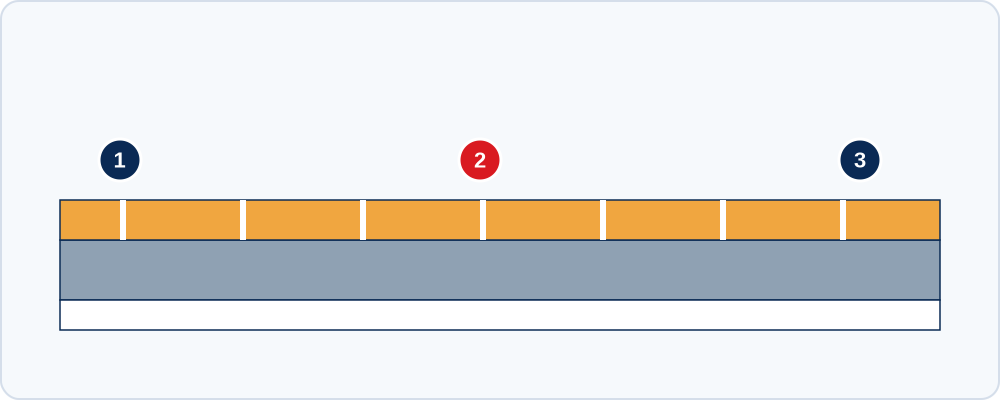
New planks are laid with an adhesive suited to the substrate. The adhesive both bonds the plank to the substrate and gives flexibility to absorb plank movement. Planks are positioned with edges properly aligned and the specified seam width kept between them. Each plank is held under pressure until the adhesive sets.
Seam filling#
Seam filler closes the gap between planks and stops water reaching the substrate. A choice is made between traditional fillers and modern flexible fillers; flexible fillers accommodate the planks' shrinking and swelling better. Filler is applied when the seam is clean and dry, and any excess is fully removed from the plank surface.
Records and acceptance#
During renewal the type and thickness of planks used, the type and batch number of the adhesive, the seam width and the type of filler are recorded. The result of the substrate check and the watertightness test after renewal are added to the file.
Renew or repair?#
Renewing a teak deck entirely is a large job, so the decision rests on the deck's remaining life. The key measure is the thickness of timber left above the seam compound. A teak deck thins over the years through cleaning, sanding and natural wear. When the wood between seams approaches the seam depth, the compound can no longer hold and water begins to leak. Thickness is measured at several points and remaining life is estimated from those readings.
If thickness is adequate, renewing the seam compound and lightly fairing the surface may be enough. Individual loose or split planks can be replaced locally. If the planks are thin throughout, screw heads are showing and leaks are widespread, full renewal is the better decision.
The risk of old screwed decks#
Many older teak decks are screwed to the deck beneath. Each screw is a hole through the deck laminate. As the teak thins, the plugs covering the screw heads fall out and water reaches the laminate through the holes and then the core of a sandwich deck. A wet core leads to softening and rot.
When an old deck is removed, every screw hole is dealt with individually. Holes are cleaned, the surrounding core is checked and the holes are filled with epoxy. Wet core is dried or repaired before the new deck is laid, and the new deck is laid where possible with a screwless bonding method.
Preparing the substrate#
New teak bonds well only to a sound, even substrate. Old adhesive and seam residue is removed, the surface is sanded and dust is cleared. Hollows and bumps lead to uneven adhesive thickness, so the surface is faired where needed. Substrate moisture is measured; bonding is not done onto a damp surface.
Movement of teak#
Teak is a natural material that changes size with moisture and temperature. This movement requires the seam compound to stay flexible. The compound is applied in a width and depth able to carry the movement, and a bond-breaker tape is placed at the base of the seam so the compound sticks only to the two side faces. If it also bonds to the base it is held on three sides and tears as the wood moves.
Cleaning and care#
Wrong cleaning shortens a teak deck's life more than anything else. Pressure washers and hard brushes erode the soft grain and leave grooves. The deck is cleaned with water and a soft brush, working across the grain. Strong chemical cleaners are used only when needed and as the manufacturer advises.
Is synthetic teak an alternative?
For some boats it is. It needs less maintenance but looks different and heats up differently from natural teak.
How often is seam compound renewed?
When it loses adhesion, hardens or pulls away from the wood. The whole deck does not always need doing at once.
Conclusion#
Teak deck renewal depends more on the soundness of the substrate than on the surface. Correct removal, careful substrate inspection, suitable adhesive and flexible seam filler, applied together, let the deck serve again for many years. The next article covers the non-skid coating and the sealing of deck hardware bedding on the same deck.
Was this guide helpful?
Thank you! Your feedback has been saved.
Guide content is for general information; in practice, the current technical data sheet of the product applies.
Keep reading
Related guides
Steel Hull Refit: Thickness Gauging, Plate Renewal and Corrosion Protection
How is plate thickness measured on a steel boat, when is plate renewed and how is corrosion prevented? Principles of gauging, welding and coating.
7 min read Refit and MaintenanceAluminium Hull Refit: Galvanic Corrosion and Compatible Coating Systems
Why an aluminium boat corrodes differently, how galvanic corrosion is prevented and which coating system is compatible. Insulation and paint selection.
6 min read Refit and MaintenanceFilling and Fairing: Rebuilding the Hull Form
How is a hull surface corrected with filler and fairing compound? Filler selection, straightedge checks and coat thickness principles.
6 min read