
Decision Guide
The 25 Most Asked Yacht Maintenance Questions: Teak, Safety, Propeller and Bilge
The same questions come up again and again in yacht maintenance. This page gives short, source-based answers to 25 questions on teak decks, paint safety, propeller and drive paint and bilge and tank coating, and points to the detailed guides.
Short answer
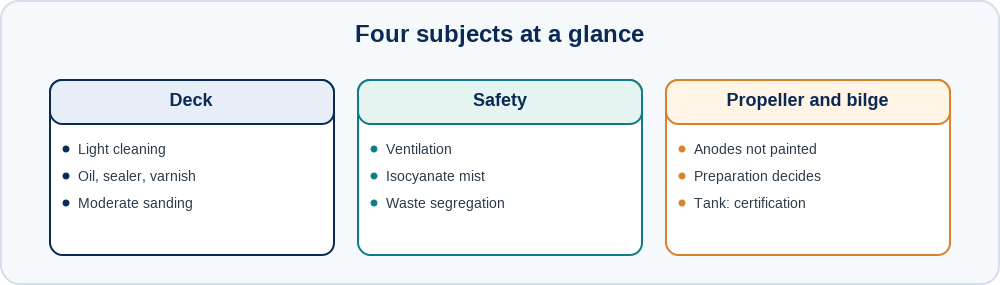
What the short answers share is this: look at the maker’s data sheet first, test on a small area and follow the times. For teak, light cleaning and moderate sanding; for paint, ventilation and protection against isocyanate mist; for propellers, do not paint anodes and use a specific product on an aluminium drive; for bilges, careful preparation and correct cure decide the result. Tanks need certification and maker approval. This content is general information; regulations, the product data sheet and the maker’s written advice come first.
Key points
- The shared answer to every question: maker’s data sheet first, then a small test.
- On teak, stiff brushes and strong chemicals are the biggest source of damage.
- Spraying makes respiratory and ventilation precautions more important; isocyanate mist is the main hazard in polyurethane.
- Propeller anodes are not painted; an aluminium drive needs an aluminium-specific product.
- Most bilge paint problems come from preparation; tank coating needs certification and maker approval.
Why quick answers?#
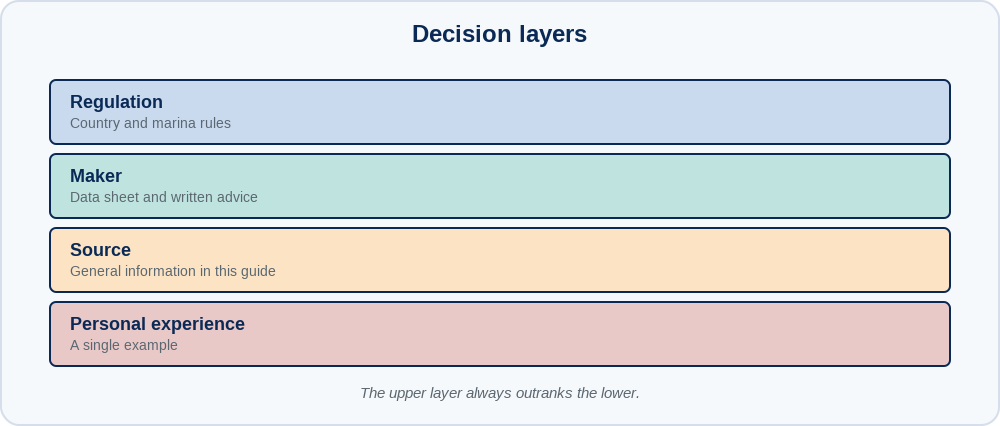
Our detailed guides are long; this page gathers the most asked questions in one place, briefly. The answers rest on the sources in our guides to teak deck care, paint safety, propeller and drive paint and bilge and tank coatings. One rule applies at the end of every answer: first the product data sheet and the maker’s written advice, then this general information and last personal experience. Treat forum experiences as single examples.
1. Deck and teak#
How is teak cleaned?#
A marine insurer-affiliated body says cleaning is when teak is most damaged; stiff brushes and strong chemicals wear away the soft grain and leave a “washboard” look. Start with mild, diluted products and scrub along the grain; strong two-part cleaners are a last resort. Test each product on a small area first.
Oil, sealer or varnish for teak?#
These are three different routes: oil and sealer need more frequent renewal (one source mentions sealer every two to three months), while varnish looks better but is harder to repair once damaged. The choice depends on the look you want, how often you will maintain it and how the boat is used.
Should teak be sanded, and at what grit?#
One source treats annual sanding as standard and suggests 120 grit; another expert mentions sanding every two years. The 15–20 year life quoted for teak is one expert’s opinion. Over-sanding thins the wood; keep it moderate.
Which deck cleaners need care?#
One-part cleaners may contain oxalic acid, which can affect finishes and filler. In one source unwaxed gelcoat was etched and a dark mixture damaged seams. Dilute the product and test it on a small spot first.
2. Safety#
Is brushing safer than spraying?#
OSHA says that in spray painting workers are exposed to more hazardous substances than with brush or roller. Respiratory and ventilation precautions therefore matter more when spraying.
What is isocyanate and why does it matter?#
It is a class of compounds that are the raw material of polyurethane products. When spraying polyurethane the main hazard is breathing the droplet mist containing isocyanate. If ventilation is in doubt an air-supplied respirator may be needed; decide with a specialist.
What about painting in an enclosed space?#
Vapours accumulate in low and enclosed spaces, displace air and lower oxygen. Make a ventilation plan, keep a second person outside, control spark and static sources and keep ventilating after painting until the space is gas-free.
What happens to waste paint and wipes?#
Segregate and label waste; decontaminate brushes, rollers and wipes before disposing of them as hazardous waste. Check local regulations and the product SDS. This content is not legal advice.

3. Propeller, shaft and drive#
Can a bronze propeller take bottom paint?#
According to a test publication, copper-based hull paint can go on a bronze propeller but does little good because the more noble metals in the bronze use up the copper biocide. Check the manufacturer’s system and primer advice.
What paint for an aluminium drive?#
Aluminium must be coated with an antifouling specially formulated for such surfaces. One expert calls painting a barrier-coated drive with copper paint high-risk. The drive maker’s written advice comes first.
What is the difference between foul-release and antifouling?#
Antifouling discourages growth with a biocide or copper; foul-release forms a slick, biocide-free surface. Abrasive cleaning such as pressure washing and scraping can damage foul-release and it does not replace anodes.
Are propeller anodes painted?#
No. Painting zinc anodes beside the shaft seriously reduces their effectiveness; mask or remove them when painting.
4. Bilge, engine room and tanks#
Which paint for a bilge?#
According to one maker the standard choice is an epoxy-based bilge paint that forms a hard film resisting oil, fuel and moisture. One-pack products are also used in always-dry places. Check the data sheet.
Why does bilge paint peel?#
Mostly because of preparation: if oil and dirt were not fully removed or the surface is damp, adhesion suffers. On an epoxy substrate one maker asks for 5–7 days of cure, washing off amine blush and sanding at 220–320 grit.
Is there a temperature rule for application?#
One bilge paint’s data sheet asks for surface temperature at least 3 °C above dew point. In closed, cool spaces the surface can be colder than the air; measure the surface temperature.
Can a water or fuel tank be coated?#
For drinking water only with a certified product (for example NSF/ANSI 61), watching the capacity limit; most certified products have a minimum capacity. For fuel tanks our sources are silent; do not coat without the makers’ written approval.
5. Times, testing and records#
Why is a small test recommended?#
Cleaners, paints and coatings can behave differently on different surfaces and old coatings. One agency recommends diluting the product and trying it on a small area first. Having an unwelcome result in a hidden corner is far cheaper than having it across the whole deck or hull.
Is there a time rule between primer and topcoat?#
Yes. A sailing magazine stresses that primer and antifouling application must follow the maker’s time windows for the chemical bond. Some propeller paints ask for at least twelve hours of drying before launch. The times in your own product’s data sheet are decisive.
Why should I record every job?#
Writing down which product you applied, on what date and in what weather and surface conditions makes next season’s choice easier; it also helps with warranty and paperwork. Also record the type of protective equipment and the filter change dates.
6. Colour, visibility and inspection#
Which colour for a bilge?#
One maker says colour can be chosen to make problems stand out or disappear. A light colour brightens the space and makes oil, antifreeze or fuel leaks easier to spot, so it has an inspection advantage.
Is heat a problem in the engine room?#
A forum thread raises concern about heat-related peeling. Check the temperature resistance in the product data sheet and ask the maker about its heat-resistant system for very hot surfaces such as exhaust and manifold.
How long should a tank coating cure?#
One maker asks for the coating to cure 7 days at a minimum of 75 °F to meet drinking-water criteria. This is specific to that maker; the cure and rinse instructions in your own product’s data sheet come first.
7. Damp, expert advice and cleaning#
Can paint go on a damp surface?#
No. Painting over a source of damp does not solve the problem; the surface must be dry at application. First find and fix the leak, condensation or crack. Our blistering and peeling guide helps explain why paint lifts.
When should I consult a specialist?#
When in doubt about polyurethane spraying, working in an enclosed space, an aluminium drive, or a fuel or potable water tank. The information in these guides is a general framework; the product maker’s written advice and an occupational-safety or boat specialist always come first.
How is a foul-release coating cleaned?#
Makers say abrasive methods such as water-blasting and scraping can damage the top coat. Maker claims concern their own products; compare them with independent experience and use the non-abrasive method the product recommends.
Conclusion: the shared rule#
The shared lesson of the four subjects is the same: read the maker’s data sheet, test on a small area, do not cut preparation short, follow the times and record what you did with date and product. On sensitive subjects such as safety and tanks, if in doubt do not apply but consult a specialist. This page is general information; regulations, the product data sheet and the maker’s written advice always come first. See our guides for detail.
Frequently asked questions#
Are these answers legal or engineering advice?
No. They are general information; regulations, the product data sheet and the maker’s written advice come first.
Where do the answers come from?
Maker data sheets, marine publications, workplace-safety bodies and user forums; forum experiences are single examples.
What is the most common shared mistake?
Starting without reading the product data sheet and cutting preparation short.
Where do I find the detail?
Each section ties to the matching detailed guide: teak, paint safety, propeller and drive, bilge and tank.
What should I do in doubt?
Ask the maker for written advice and consult a specialist.
Was this guide helpful?
Thank you! Your feedback has been saved.
Guide content is for general information; in practice, the current technical data sheet of the product applies.
Keep reading
Related guides
Teak Deck Care: Cleaning, Oil, Sealer and Varnish Choice
On a teak deck most damage often happens during cleaning. We explain the right cleaning method, sanding frequency and the choice between oil, sealer and varnish, based on sources.
10 min read Decision GuideYacht Paint Safety: Isocyanate, Solvent Vapour, Ventilation and Waste Paint
Paint is not just a surface job; it carries breathing, fire and skin risks. We explain isocyanate in polyurethane, solvent vapour, ventilation, protective equipment and waste handling, based on sources.
10 min read UnderwaterPropeller, Shaft and Drive Paint: Antifouling, Foul-Release and Primer Choice
On the propeller and shaft paint adhesion and function are much harder than on the hull. We explain bronze propellers, aluminium drives, foul-release coating, primer choice and anodes, based on sources.
10 min read