
Refit and Maintenance
What Is a Yacht Refit? Scope, Classification and Decision Criteria
A refit is a planned engineering project that rebuilds a yacht’s technical life, not only its appearance. A refit whose scope is poorly defined wears out the budget and the schedule long before it improves the vessel.
Short answer
A yacht refit is the renewal of a vessel’s hull, coatings, deck, interior and systems on the basis of a condition survey, carried out to a defined scope, sequence and set of acceptance criteria. It differs from routine maintenance in that it addresses the vessel as a whole rather than a single fault, and in that every stage is verified by measurement.
Key points
- A refit differs from maintenance and repair in scope, planning and documentation.
- Scope can be grouped into four classes: cosmetic, technical, structural and comprehensive.
- The decision should rest on measured condition, intended use and economic life, not on age.
- Work is sequenced from structure to surface and from dirty trades to clean ones.
Conceptual framework: what does a refit mean?#
In marine practice, a refit denotes the planned renewal of the structure, coatings and equipment of a vessel in service, during a period in which she is deliberately withdrawn from use. In everyday speech the word is often treated as a synonym for “major maintenance”, yet the difference between the two lies less in scale than in method. Maintenance answers a known pattern of wear at a known interval: antifouling is renewed, anodes are replaced, engines are serviced. A refit questions the present condition of the vessel as a whole, aims to restore lost function and, in many cases, to raise the yacht to a higher technical standard than she had when new.
Classifying the scope of a refit#
Every refit is specific to its vessel; nevertheless, grouping scope into four classes simplifies planning and clarifies communication between owner and contractor.
Cosmetic refit#
The renewal of visible surfaces without touching structure or systems: topside paint, gelcoat restoration, varnish, deck coverings and interior finishes. The word cosmetic should not suggest light work; the quality of a polyurethane topcoat depends on the fairness of the filler and primer beneath it, and preparation accounts for most of the labour.
Technical refit#
The renewal of the systems that make the yacht function: machinery, shaft line, electrics, plumbing, navigation electronics and deck equipment. Here the criterion is not appearance but reliability and conformity with standards.
Structural refit#
Work that affects the load-bearing integrity of the hull: laminate repair in fibreglass, osmosis treatment, plate renewal in steel or aluminium, planking and frame replacement in wood, repair of deck cores. Structural work always precedes coating work, because returning to the structure beneath a painted surface means doing the job twice.
Comprehensive refit#
The case in which all three classes are combined in a single project. The yacht usually remains ashore for a season or longer, equipment is removed and each zone is addressed in turn. The real difficulty of a comprehensive refit is organisational rather than technical: dozens of work items wait on one another, and poor sequencing lets a later trade damage a finished surface.
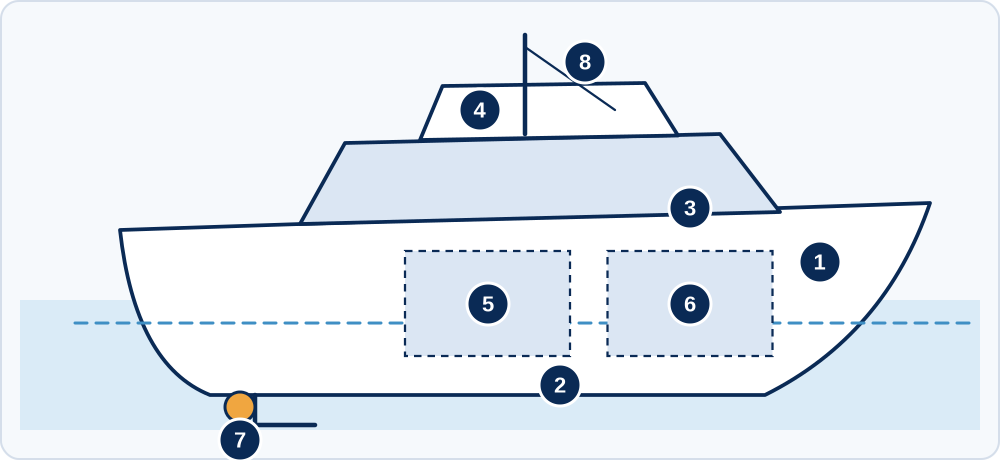
- Topsides: paint and gelcoat renewal
- Underwater hull: osmosis treatment, epoxy barrier and antifouling
- Deck: teak, non-skid coating and hardware bedding
- Superstructure: paint, glazing and sealing
- Engine room and shaft line
- Interior, electrics and plumbing
- Propeller, rudder and cathodic protection
- Mast, rigging and antennas
The degradation mechanisms that make a refit necessary#
To understand why a yacht comes to need a refit, one must look at how materials age at sea. Deterioration has no single cause; four mechanisms operate at once and reinforce one another.
The first is ultraviolet radiation. Sunlight breaks down the binder of paint and gelcoat from the surface inwards; gloss falls, pigment chalks and the film thins. The second is water. A fibreglass laminate absorbs water vapour over the years, timber moves, and on metal surfaces corrosion starts at the smallest defect in the coating. The third is mechanical fatigue: wave loading, vibration and contact with quays produce hairline cracks in the laminate and loosen the bedding of hardware. The fourth is technological obsolescence of systems; a twenty-year-old switchboard may still work without meeting present expectations of load and safety.
On which criteria should the decision rest?#
A common mistake is to tie the decision to the age of the vessel. Age is only an indicator; a well-kept twenty-year-old hull may need less work than a neglected ten-year-old one. Four criteria should be weighed together.
- Measured technical condition: moisture readings, plate thickness, coating adhesion, the sound of the laminate, insulation and pressure tests of the systems. These data are gathered during the condition survey.
- Intended use: a family yacht used for coastal cruising and a yacht planned for ocean passages do not share the same expectations of safety and endurance.
- Economic life: the cost of the refit compared with the post-refit value of the yacht and the expected period of use. This is examined in the article on budgeting.
- Regulation and insurance: renewals required by a classification society, flag state or insurer set the lower limit of the scope.
The general flow of a refit#
Whatever its scope, a sound refit follows the same logical order. Its principle can be stated in two sentences: structure first, then surface; dirty work first, then clean work. No primer is applied until blasting, grinding and welding, which generate dust and sparks, are finished; no joinery is refitted until the plumbing and wiring behind it are complete.
- Condition survey: Readings and findings report
- Scope and plan: Work breakdown, budget, schedule
- Preparation: Haul-out, removal, protection
- Structural work: Hull, laminate, plating
- Coating: Filler, primer, topcoat
- Systems: Machinery, electrics, plumbing
- Handover: Trials and record file
The output of each stage is the input of the next.
Although the flow appears linear, stages partly overlap in a real project. Interior strip-out continues while the hull dries; work proceeds in the engine room while the paint tent is erected. What makes overlap possible is scheduling the trades so that they do not contaminate one another.
Qualities to look for in a contractor#
A refit requires different trades to work on the same vessel within the same schedule. The first quality to seek in a contractor is therefore not individual craftsmanship but the ability to coordinate. At the quotation stage the following questions should already be answered.
At DR. YACHT we conduct refit work within this framework: measurements are taken at the survey, the scope is tied to a written plan and each stage is documented with photographs and readings. Details of how we work are given on our refit page.
Conclusion#
A refit is the single largest decision that extends the life of a yacht, and its success depends on definition at the desk before it depends on skill in the yard. Classifying the scope, basing the decision on measurement and sequencing work from structure to surface form the common foundation of every topic developed in the following articles. The next article addresses the first step of that foundation: the pre-refit condition survey.
How long does a refit take?
It depends on scope. A cosmetic refit limited to topside paint is measured in weeks, whereas a comprehensive project including structural repair and system renewal may take a season or longer. A realistic duration can only be given after the condition survey.
How do I decide between a refit and buying a new yacht?
If the hull is structurally sound and the yacht suits her intended use, a refit is usually the more economical course. The decision should weigh the cost of the refit against the yacht’s post-refit value and the expected period of use.
Do I need to be present during the refit?
No. As long as each stage is documented with photographs and measurement records, the process can be followed remotely; written approval is obtained at critical decision points.
Was this guide helpful?
Thank you! Your feedback has been saved.
Guide content is for general information; in practice, the current technical data sheet of the product applies.
Keep reading
Related guides
Yacht Service in Turkey: One Team, One Plan
Yacht service in Turkey: paint, hull repair, antifouling, joinery, sealing and refit work run under a single plan. The DR. YACHT approach explained.
3 min read Refit and MaintenanceTank Inspection, Maintenance and Repair: Holiday Testing, Thickness Measurement and Records
Inspection, thickness measurement, holiday testing, repair approaches and records for steel boat tanks, summarised from source accounts with their limits.
10 min read Refit and MaintenanceGrey Water, Black Water and Shower Tanks: Corrosion, Lining and Design
Why grey, black and shower tanks on steel boats corrode, what an internal lining does and design details, summarised from source accounts.
11 min read