
Underwater
Buying Biocidal Antifouling in Germany: The New Rules
To most boat owners antifouling looks like an ordinary paint taken off a shelf, yet it is a biocidal product and in Germany its sale has been subject to special rules since 2025. This article explains in general terms what the rules say, how they read from the seller's and buyer's side and which questions remain open. It is not legal advice; the current legislation and the competent authority remain the authority.
Short answer
The ChemBiozidDV rules on selling biocidal products in Germany have applied since 1 January 2025. According to law-firm and news accounts, unrestricted self-service sale of antifouling products (product type 21) is banned; the person handing over the product must have expertise, the buyer must be checked and a documented sales consultation held, and for online sales these steps must be completed before the contract. Exceptions are described for professional users. This article is general information, not legal advice; the current legislation and the competent authority are the authority.
Key points
- Sales of biocidal antifouling in Germany have been subject to the ChemBiozidDV sales rules since 1 January 2025.
- According to sources, unrestricted self-service sale of antifouling is banned and a knowledgeable person must hand over the product.
- The sale involves a buyer check and a consultation covering alternatives, risks, storage and disposal.
- For online sales the consultation must take place before the contract, in a verifiable way.
- This is not legal advice; legislation can change.
1. Why is antifouling sale subject to special rules?#
Antifouling paints contain biocide to prevent organisms settling on the hull. In the European Union biocidal products fall under a separate authorisation regime, and the German Federal Environment Agency says antifouling products must undergo an environmental risk assessment for authorisation. The same agency says it estimates that about seventy tonnes of copper from antifouling paints on pleasure craft enter German surface waters every year, and that antifouling paints are reapplied every one to two years because the biocides wash out. That is an official agency's account and shows the background to the rules.
The background helps explain why sale rules have been tightened specifically for antifouling: the product looks aimed at the boat owner, but it has an effect on the environment. A legal rule rests on the idea of backing the product with information and checks at the point of sale. This article explains that logic; for the legislation itself and its interpretation the competent authority and a legal adviser are the authority.
This article is not legal advice and gives no summary of rules for countries other than Germany. The information comes from law-firm publications, news sources and official agency pages; legislation changes over time and summaries may be incomplete. Pay attention to the type and date of each source.
2. ChemBiozidDV: since when and what does it cover?#
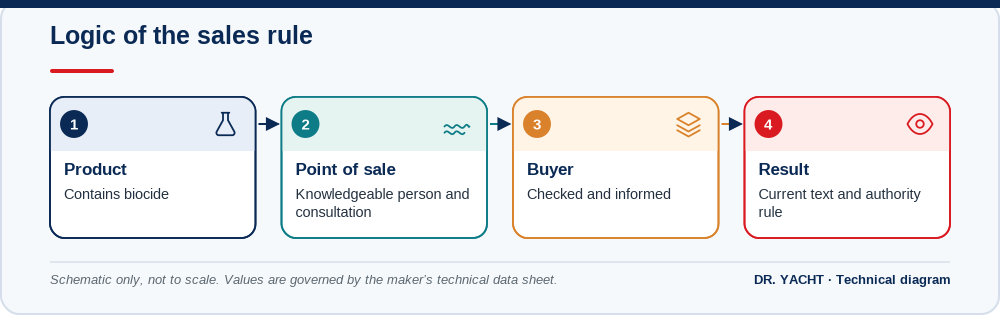
According to sources, the ChemBiozidDV rules on selling biocidal products have been binding since 1 January 2025. A law-firm summary says the rules rest on sections ten to thirteen of the ordinance and aim to protect health, animals and the environment. A news source also reports that the rules concern sellers and buyers, and that customers will no longer have direct access to these products and must seek advice from knowledgeable persons.
According to the law-firm summary, the absolute ban on unrestricted self-service covers certain biocidal product types, and antifouling products (the product type for watercraft and water structures) are in this group. For some other types, such as coating preservatives and wood preservatives, a limited self-service ban combined with a prior consultation is described. For the details and scope of that distinction the current text is the authority.
A news source further writes that antifouling must be sold by knowledgeable persons in shops as well as in online orders, that the products must be stored securely and locked by the seller, and that the aim is for boat owners to learn about biocide-free alternatives before buying. These are summaries, not the text of the rule.
3. The knowledgeable person and the sales consultation#
The law-firm summary says the person handing over the product must have the technical knowledge and skills needed to use the products properly and that this must be shown by suitable training and certification. It also notes that sellers should keep proof of their expertise up to date. That reflects the idea that the shop employee is not only someone who stocks the shelf but someone who can explain the product.
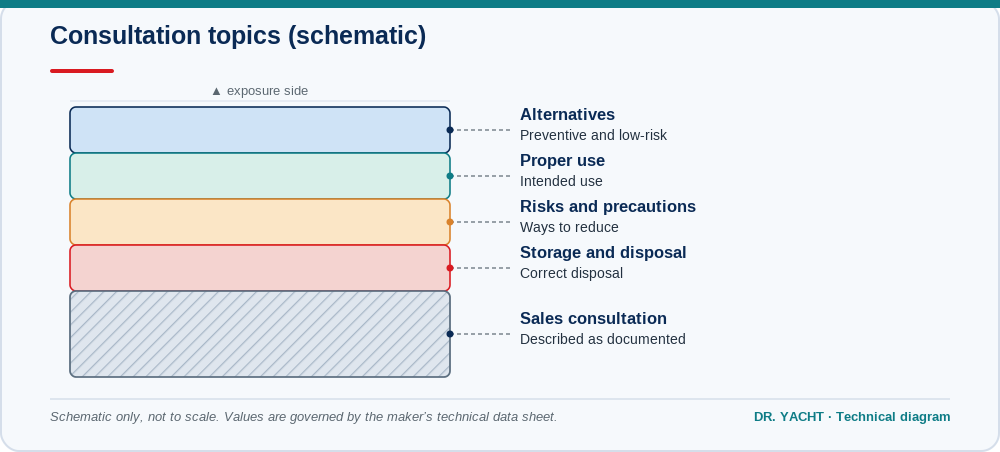
For the content of the sales consultation the summary lists preventive and low-risk alternatives, intended and proper use, risks and mitigation, necessary precautions and proper storage and disposal. It also says the seller must confirm that the buyer belongs to the user category in the authorisation and intends proper use, and that the consultation must be documented.
A yachting magazine article describes one practical consequence for the boat owner: someone who needs the product may not have to hold a particular certificate, so need for the product and holding a certificate are separate matters for the boat owner. The article also says the mandatory sales conversation causes problems especially in online trade. These are publication accounts, and the current legislation is the authority for details.
| Array | Array | Array | Array |
|---|
4. Online sales: consultation before the contract#
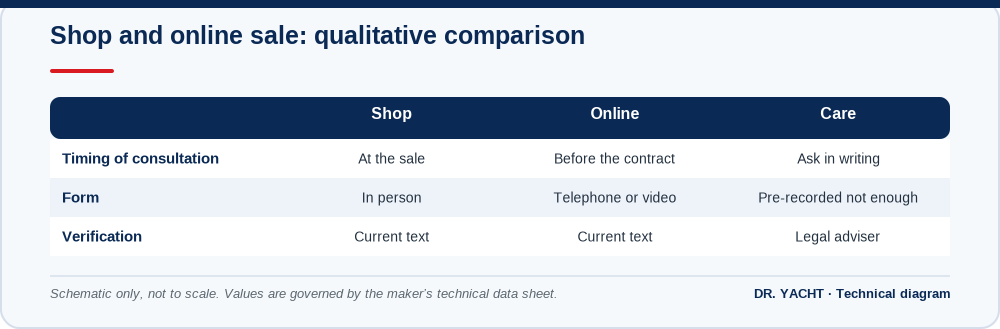
According to the law-firm summary, buyer verification and consultation also apply to online and mail-order sales. Before the contract is concluded, technical or organisational measures must ensure that a qualified person verifies the buyer and holds a telephone or video consultation. The consultation must be verifiable; a pre-recorded video without live interaction is not sufficient, and product descriptions containing only safety and disposal information do not meet the requirement.
The summary also says online sale cannot proceed until the consultation has been held and documented, and that sellers must build a technical gateway into the checkout. For a boat owner this may in practice mean meeting a consultation step during an online order. Details of the practice may vary from seller to seller, and the current rule text is the authority.
This article does not say how any particular shop applies the rule. For the form of application look to the seller and the current legislation; consulting an expert for legal interpretation is general good practice.
5. Professional users and exceptions#
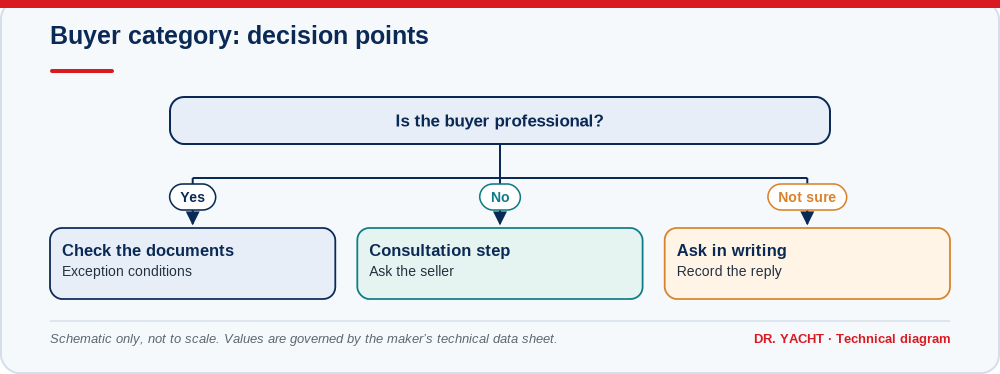
The law-firm summary says the rules do not apply to products with simplified authorisation or to verified professional users, and that prior consultation is not needed if the seller knows the buyer is professional or the buyer proves with suitable documents that the product will be used in their professional activity. The same summary also notes that it does not define "private" buyers, which shows the boundaries are not always clear.
For boat owners this raises a question: is a product bought through a yard or professional applicator subject to the same rules? Accounts say there is a separate route for professional users, but a boat owner buying alone and an applicator buying may have different consequences. This article offers no interpretation; the current text and the competent authority are the authority.
Conditions that the seller knows or that the buyer proves by documents also create a documentation concern in practice. Keeping records is described as general good practice for both sides.
A small scenario: how does a boat owner proceed in Germany?#
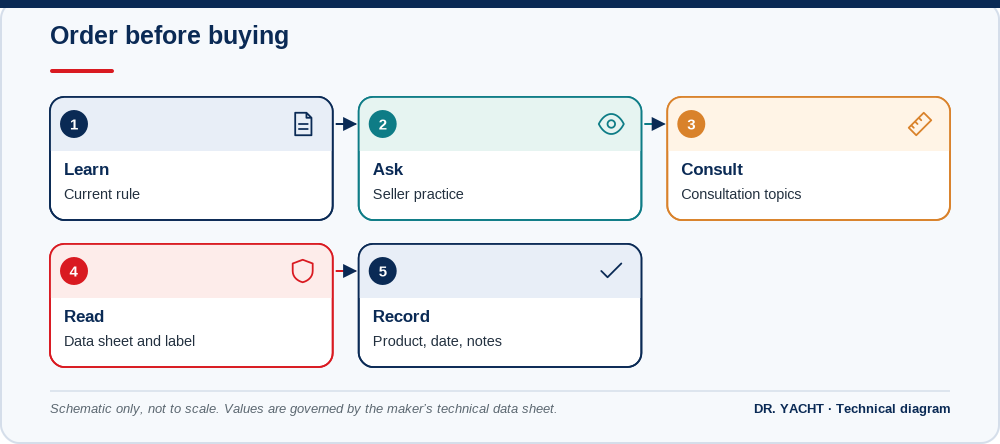
Suppose a boat owner wants to buy antifouling for use in Germany. The first step is to find out how the point of sale applies the rule: is there knowledgeable staff in the shop, is there a consultation step in online sale? The second step is to note what topics were discussed: alternatives, proper use, risks, storage and disposal. The third step is to read the product's data sheet and label.
None of these steps is a legal interpretation. When something is uncertain, asking the seller in writing and keeping the reply is general good practice. For the details and exceptions of the rule the current text, the competent authority and a legal adviser are the authority.
6. Common misreadings#
The first misreading is to take the rule as a ban aimed at the buyer; accounts mostly describe conditions of sale. The second is to think the rule applies to all paints; accounts speak of particular biocidal product types. The third is to take a news summary for the text of the rule. The fourth is to think a video description replaces a consultation in online sale; according to accounts it does not.
The fifth is to assume the rules are the same for every country; a yachting publication describes a different partial restriction in Denmark, and each country has its own rules. The sixth is to assume the rule settled in 2025 and will not change. The seventh is to take this article as legal advice.
| Array | Array | Array | Array |
|---|
7. Environment, safety and records#
The background to the rule is the environment: according to the official agency, copper is the most commonly used biocide in antifouling paints, and paints account for about a fifth of the total copper entering German surface waters; the impact is ecotoxic for bacteria, algae, crayfish and fish. That is an official agency's estimate and helps explain why the rules are taken seriously; for product choice the current data sheet and the competent authority are the authority.
During application and cleaning, gloves, breathing protection, eye protection and waste handling are general good practice. Keeping a record also helps: which product, which seller, which date and what consultation notes? Such a record saves time next season and in case of questions. Read this as general good practice, not an obligation.
Finally, remember that rules can change over time. The accounts in this article are summaries from a particular date; for the text in force and its interpretation the competent authority, current legislation and a legal adviser are the authority.
Frequently asked questions#
Why did antifouling sales change in Germany?
According to sources, the ChemBiozidDV rules on selling biocidal products have applied since 1 January 2025. The aim is described as protecting health, animals and the environment.
Is self-service sale banned outright?
According to the law-firm summary, antifouling products may not be offered for sale without restriction. For details, the current text and the competent authority are the authority.
What is discussed in the sales consultation?
According to accounts: preventive and low-risk alternatives, intended and proper use, risks and mitigation, precautions, and storage and disposal. The consultation must be documented.
How does it work for online sales?
According to summaries, the consultation must take place before the contract, by telephone or video and in a verifiable way; a pre-recorded video is not enough. That is a seller obligation; legislation governs the details.
Is this article legal advice?
No. It is general information; sources are labelled and the legislation may change. Current legislation, the competent authority and a legal adviser are the authority.
Was this guide helpful?
Thank you! Your feedback has been saved.
Guide content is for general information; in practice, the current technical data sheet of the product applies.
Keep reading
Related guides
How to Read the Awlgrip Topcoat Technical Data Sheet: Solids, Dry Film, Cure Time
A data sheet is not a recipe card; it is a reference written for specific conditions. This article explains how to read the solids, dry film, wet film, coverage and cure lines, and where their limits lie.
13 min read Paint and CoatingsWet Edge and Speed in the Roll-and-Tip Method: The Logic Behind a Professional Finish
In roll-and-tip the result is often decided less by the product than by keeping the wet edge. This article explains how the edge line forms, what speed and division of work change, and where sources disagree.
13 min read Paint and CoatingsAwlgrip in Hot Weather: Fast Drying, Dry Spray and Choosing a Reducer
As temperature rises, solvent leaves quickly, paint pulls fast and the wet edge shortens. This article explains the logic of hot-weather problems, the reducer families the maker separates by temperature band, and their limits.
11 min read