
Paint and Coatings
Awlgrip in Hot Weather: Fast Drying, Dry Spray and Choosing a Reducer
In hot weather paint begins to lose its solvent before it reaches the surface, or just after. The results are dry spray, a rough film, a short wet edge and visible joins. Makers therefore offer reducers separated by temperature band. This article explains the logic of the problems and how to read the reducer families; it recommends no ratio, time or reducer. The current data sheet and the maker's technical service remain the authority.
Short answer
Heat, wind and a hot surface make solvent leave too quickly, which raises the risk of dry spray, a short wet edge, poor flow and film defects. For Awlgrip the maker describes fast, standard and hot-weather reducers for different temperature bands, while retailer notes describe moving to a slower-evaporating reducer in the heat. The right choice depends on product version, method and environment. This article is general information, not an application instruction; the current data sheet and technical service are the authority.
Key points
- Heat makes solvent leave fast; the risk of dry spray, a short wet edge and film defects rises.
- The maker separates reducers into families such as fast and hot-weather by temperature band.
- The hot-weather reducer evaporates more slowly and in most accounts is blended with others rather than used alone.
- Surface temperature, wind and sun must be read separately from air temperature.
- This is general information; the current data sheet and technical service are the authority.
1. What does hot weather do to paint?#
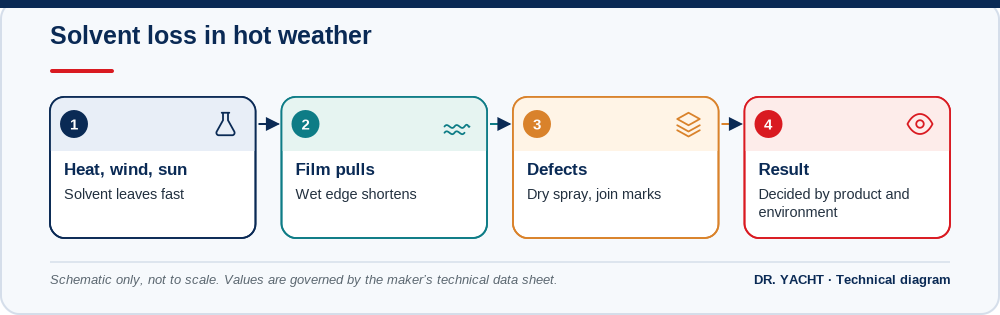
The flow of paint depends on its solvent. As solvent leaves, viscosity rises, the film pulls and the wet edge shortens. Hot air, a sun-warmed surface and wind speed this up. The paint then begins to pull before it has spread and levelled on the surface. The logic holds for spray, roller and brush alike, but the symptoms look different.
In spraying the solvent also leaves while the droplet is in the air. If droplets partly dry before reaching the surface the result is a rough, dull and sandy texture, called dry spray. With roller and brush the wet edge shortens and joins and brush lines become visible. A publication comparison reports that some polyurethane products dried faster than others, making it harder to hold a wet edge.
This article is not an application instruction. Its aim is to explain the logic of hot-weather problems and how to read the reducer families the maker offers. No figure, ratio or time is suggested, because the right values depend on product version, method and environment.
2. Dry spray: when droplets dry before reaching the surface#
Dry spray happens when sprayed droplets dry before they reach the surface, or too soon after to flow. The result is a rough, dull texture instead of a smooth film. General paint guidance from another maker says that high surface temperature, heat radiating from the substrate and strong wind promote dry spray, and that painting as close to the surface as possible and extra thinning often help. That is a hot-climate note written for a different brand; the logic is general, the values are product-specific.
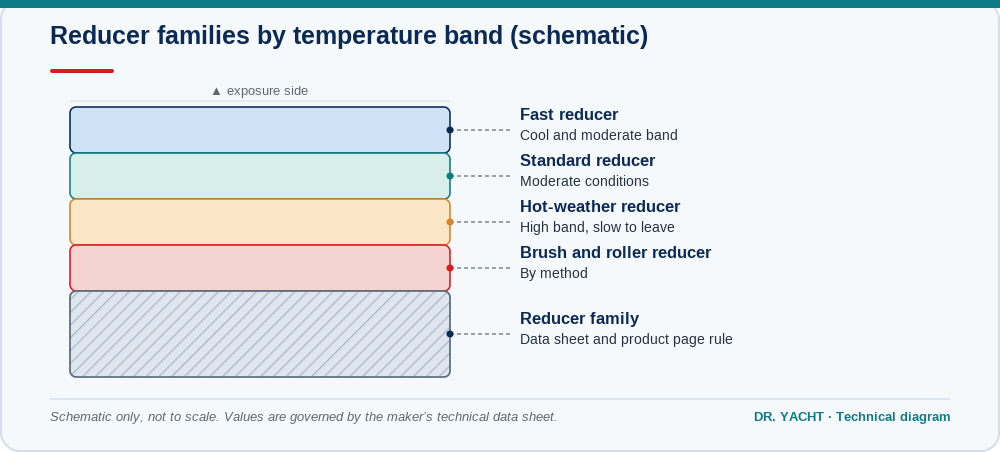
Another cause of dry spray is a very fast-evaporating reducer. Using a fast reducer meant for cool weather in a hot environment can do the opposite of what is wanted. In the maker's own descriptions fast reducers are set for cool and moderate temperatures and the hot-weather reducer for high temperatures. Which product belongs to which band must be read from the current product page.
Dry spray is not always easy to fix afterwards; a flawed film usually calls for sanding and reapplication. So prevention means thinking ahead about how the defect forms. Even so, this article gives no prevention list; the data sheet and technical service are the authority for product and environment.
3. Reducer families: fast, standard and hot weather#
The maker defines different reducers for Awlgrip and ties them to temperature bands. On the maker's product pages a fast-evaporating reducer is described for moderate temperatures, a faster one for cooler temperatures and a hot-weather reducer for high temperatures. The limits of these bands may differ by product version and region; this article proposes no limit, and the product page and data sheet are the authority.
Retailer notes say the hot-weather reducer evaporates very slowly, is mostly blended as an additive with other reducers and is seldom used alone. One retailer page also writes that increasing the amount of reducer in hot conditions helps compensate for the factor. These are retailer accounts and must be verified against the maker's data sheet; this article recommends no ratio or percentage.
Reducer choice has a limit: a very slow reducer may improve flow but delays drying and hardening and lengthens dust and insect exposure. The balance has to be judged together with product and environment. Asking the maker's technical service in writing also puts the answer on record.
| Array | Array | Array | Array |
|---|
4. Surface temperature, wind and sun#
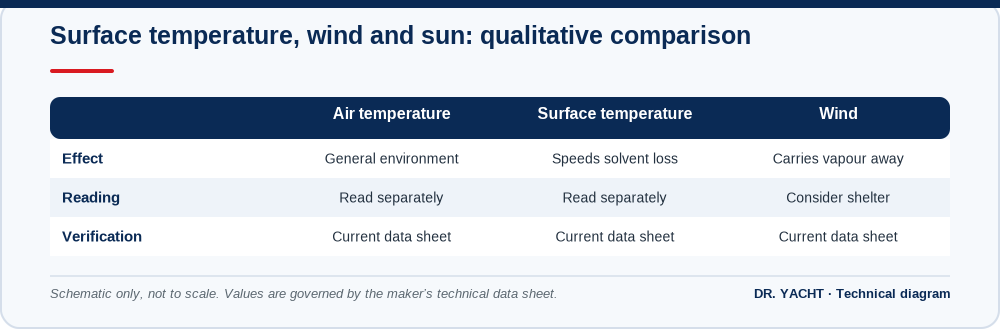
Air temperature alone is not enough. A dark surface in the sun can be far hotter than the air, and when paint meets that hot surface solvent leaves quickly. Makers state surface temperature and proximity to dew point separately on their data sheets. This article proposes no threshold; read the relevant lines on the current sheet.
Wind matters too: moving air carries solvent vapour away fast and pulls the film. Wind direction and shelter matter for outdoor work for this reason. General paint guidance from another maker says to paint sun-exposed surfaces first and shaded ones last; it is a different brand's hot-climate note and reminds the reader in principle to think about heat load.
Temperature and humidity together set dew risk. Towards evening a cooling surface can collect condensation, while in the heat of the day defect risk rises in another way. So the time of day for working is judged together with temperature, wind and humidity. This article proposes no time window.
5. Wet edge, roller and brush#
In spraying dry spray stands out; with roller and brush it is the shortening wet edge. Even if the section is kept small, in hot weather paint pulls fast and the time between roller and brush stroke shrinks. That raises the risk of joins and brush lines. A retailer page says moving to a slower reducer can extend workability for spray and brush; that shows the general role of a reducer.
Brush and roller reducers and spray reducers can be different products. The product and band the maker describes differ by application method, and using the reducer described for one method in another may change the result. This article gives no method-specific recommendation.
Team arrangement matters too: in hot weather the section plan, join points and division of work should be thought out in advance. Working with a short wet edge makes continuity even more important. The detail of this is covered in the roll-and-tip article with its general logic.
A small scenario: how a plan is built for a hot day#
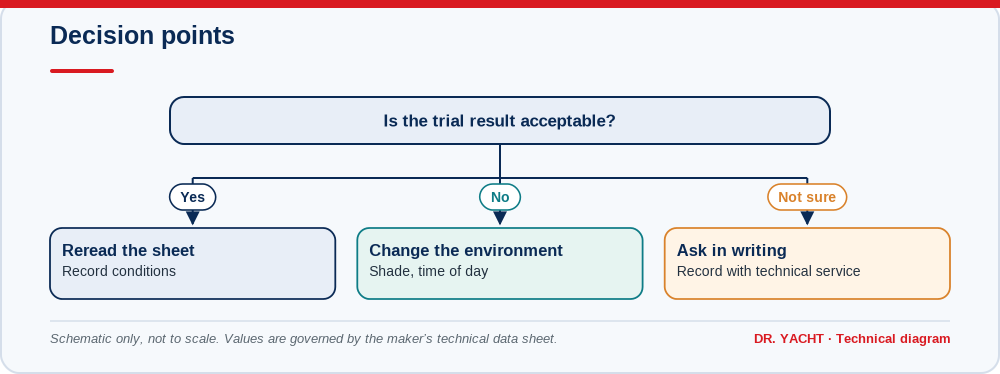
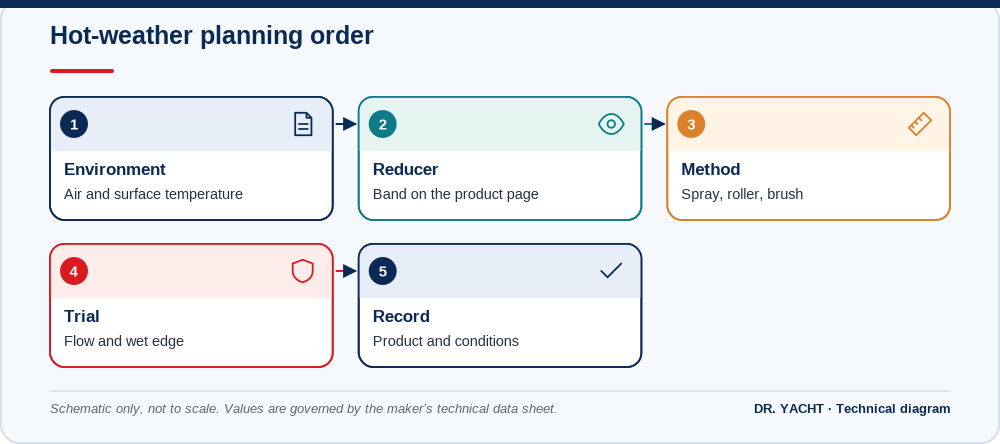
Suppose a topsides surface is to be painted on a day when high temperatures are expected. The first step is to read the environment: air and surface temperature, sun, wind and humidity. The second is to check on the maker's product page which reducer family is described for which band and what the data sheet says for this product. The third is to watch flow and wet edge on a small trial.
None of the three steps proposes a ratio or time, because the right values depend on product version and environment. If the trial goes badly, postponing the work or changing the environment (shade, time of day) is described as general good practice, but the decision should be made with technical service.
6. Common misreadings#
The first misreading is to assume the hot-weather reducer solves every hot-weather problem; a slow reducer brings its own limits. The second is to think more reducer is always better; excess thinner can affect film properties. The third is to confuse air temperature with surface temperature.
The fourth is to put a retailer note in place of the maker's data sheet. The fifth is to carry the values in another brand's hot-climate guide over to Awlgrip. The sixth is to neglect safety: solvent vapour can be denser in the heat; breathing protection and ventilation are general good practice.
| Array | Array | Array | Array |
|---|
7. Storage, transport and records#
Hot weather affects not only the moment of application but the storage of paint and reducer. Containers left in the sun can warm and the product may behave differently when used. For storage conditions the shelf-life and storage notes on the data sheet are the authority. This article proposes no storage temperature.
A short record after application is useful later: which product, which version, which reducer family and under which conditions? Such a record saves time when the cause of a defect is sought and eases correspondence with technical service. Working in the heat often means a narrow window, and planning that window in advance makes the record more valuable.
Frequently asked questions#
Why do problems arise in hot weather?
Solvent leaves too quickly, so paint pulls before reaching the surface or just after. That can cause dry spray, a short wet edge and poor flow. Real thresholds vary with product and environment.
What is dry spray?
It is when droplets partly dry before reaching the surface and leave a rough, dull texture. Hot, windy air and a very fast-evaporating reducer raise the risk.
What does a hot-weather reducer do?
According to the maker it is a slower-evaporating reducer defined for high temperatures for Awlgrip. Retailer notes say it is mostly blended with other reducers to improve flow. The current data sheet governs use.
Are surface temperature and air temperature the same?
No. A surface in the sun can be much hotter than the air. Makers state surface temperature separately; read the relevant line on the data sheet.
Is this article an application instruction?
No. It recommends no ratio, reducer, time or method. The current data sheet and technical service are the authority.
Was this guide helpful?
Thank you! Your feedback has been saved.
Guide content is for general information; in practice, the current technical data sheet of the product applies.
Keep reading
Related guides
How to Read the Awlgrip Topcoat Technical Data Sheet: Solids, Dry Film, Cure Time
A data sheet is not a recipe card; it is a reference written for specific conditions. This article explains how to read the solids, dry film, wet film, coverage and cure lines, and where their limits lie.
13 min read Paint and CoatingsWet Edge and Speed in the Roll-and-Tip Method: The Logic Behind a Professional Finish
In roll-and-tip the result is often decided less by the product than by keeping the wet edge. This article explains how the edge line forms, what speed and division of work change, and where sources disagree.
13 min read Paint and CoatingsThe Fisheye Paint Defect: The Contamination Chain and Prevention
A fisheye is a crater-like defect where paint pulls away from a contamination point on the surface. This article explains the contamination chain, why silicone is special and the logic of prevention in general terms.
11 min read