
Paint and Coatings
Wet Edge and Speed in the Roll-and-Tip Method: The Logic Behind a Professional Finish
Roll-and-tip means spreading paint on the surface with a roller and immediately smoothing it with a brush, known as tipping. It promises an appearance close to spraying, but the outcome is usually decided by keeping the wet edge and by the pace of the work. This article explains the logic of the edge line, the role of speed and division of labour, and the differing views in publications and forums. It gives no numbers, ratios or times; the current data sheet and the maker's technical service remain the authority.
Short answer
In roll-and-tip, the edge line is the boundary where fresh paint meets paint that is still wet. If new paint is added before that boundary has started to skin and pull, the line disappears; if you are late, a mark remains. For that reason section size, team arrangement, the thinner's effect on flow and ambient temperature are linked. Publications and forums differ on details: some describe roller and brush together, others the roller alone. This article is general information, not an application instruction; the current data sheet and technical service are the authority.
Key points
- The edge line is the boundary where wet paint meets new paint before it skins over.
- Speed and section size must be thought of together with the environment and the product's drying behaviour.
- The brush stroke is described as calming roller texture and bubbles, not as spreading paint.
- Sources differ on direction, team arrangement and whether tipping is needed; the differences are labelled.
- This is general information; the data sheet and technical service are the authority.
1. What does roll-and-tip promise?#
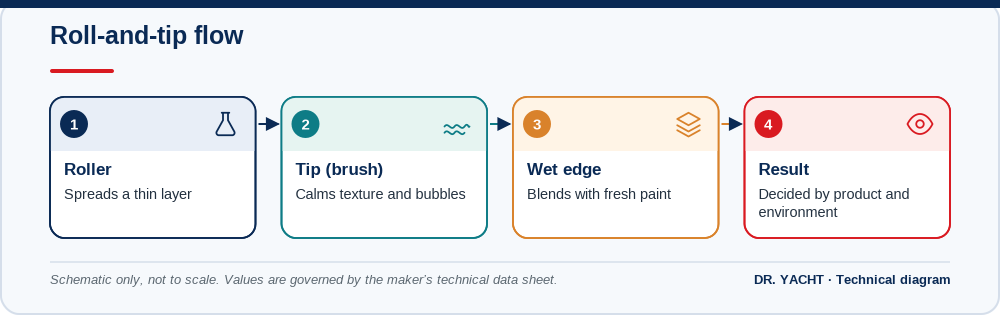
Roll-and-tip is a method in which paint is spread in a thin layer with a roller and then tipped with a soft brush straight away. Tipping means the brush touches the surface lightly to calm roller texture, bubbles and small marks. Retailer and publication accounts present the method as a reasonable way to approach the look of a sprayed finish. That is not a maker guarantee; it is a widely repeated account of practice.
The attraction of the method is its low equipment cost and the absence of a booth. The price is timing and skill: you must move before the paint begins to set, know how much to touch the surface and read the environment. Some publications say a sprayed look can only be approached with enough practice and experiments with flow. So the method is not "easy"; it is "accessible".
This article does not give the steps as an instruction. Its focus is the logic that decides the result: why an edge line forms, why speed matters, what division of work changes and where sources differ. No figure, ratio or time is suggested, because the right values depend on product version, environment and the job.
2. How does an edge line form?#
An edge line is the boundary where two regions of paint meet. After application the solvents evaporate, viscosity rises and the film loses its flow. If new paint is added to the neighbouring region while the old paint at the boundary is still fluid, the two films blend and the line disappears. If the old paint has pulled too far, the new paint rides over it and leaves a visible strip or a difference in thickness.
So "keeping the wet edge" means holding the boundary in a state where it can still blend. A principle that recurs in accounts is to work from the wet region into the dry region and not to stop in the middle of a section. Sources say that leaving a section half done raises the risk of a line. That is an account of experience; real times vary with product, temperature and humidity.
How an edge looks also depends on light. In low-angle light or on a glossy surface small differences in thickness stand out. Some accounts say that misting the surface lightly with water and looking along it at a narrow angle helps to see flaws after sanding; that is a practical check for before painting, not for the edge during painting.
3. Speed: why continuity matters more than haste#
In roll-and-tip accounts speed does not mean working in a panic but working continuously and in order. Support notes from retailers describe the method as a job that keeps moving: the person rolling needs time to spread paint evenly and the person tipping needs time to move with a light touch before the paint dries. This is an account of use and may change with product version.
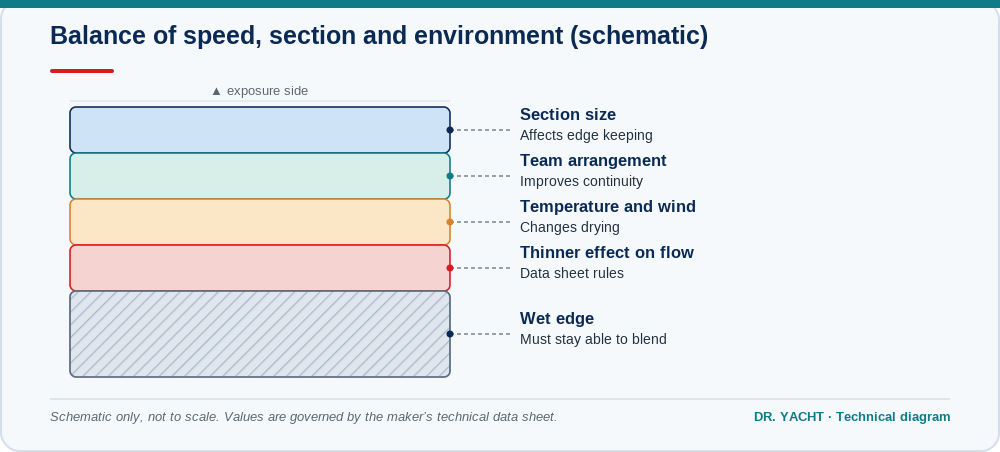
Speed and section size are linked. A very large section makes the wet edge hard to hold; a very small one means many joins. Publications describe this balance with different measures, some favouring small sections and some larger ones. That difference changes with the product's drying behaviour, the environment and the team, so no single number is right. This article suggests no section size.
The environment affects speed directly. In hot, windy weather paint pulls faster; in cool, humid weather more slowly. One publication comparison reports that some polyurethane products dried faster than others, making a wet edge harder to keep and raising the risk of holidays. That is a reminder that product differences can change how fast you need to work.
| Array | Array | Array | Array |
|---|
4. The brush stroke: calming, not painting#
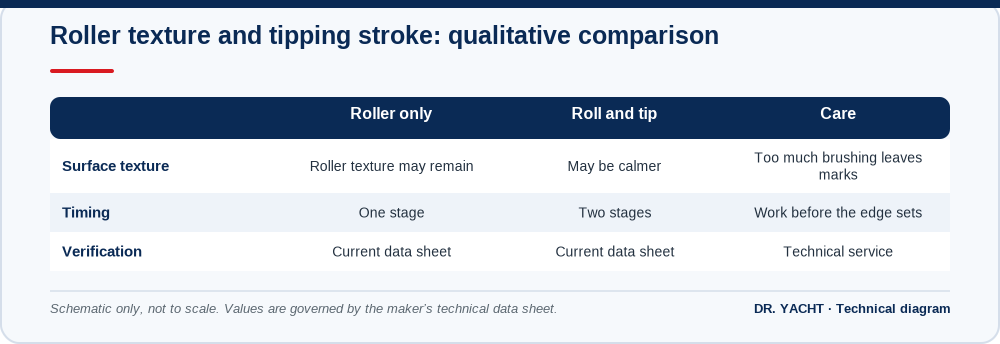
In accounts the purpose of the tipping stage is usually summed up this way: the brush is used not to spread paint but to ease roller texture and bubbles. One publication puts it by saying the brush is there to knock down bubbles, not to paint. A light touch aims to avoid overworking the film and leaving a thickness difference or mark.
Accounts differ on brush type and stroke direction. Some choose different directions for roller and brush, some work in the same direction, and some suggest rolling one way and tipping the other. One forum account says a vertical brush mark is harder to see; another prefers a foam brush and says it leaves a finer knock-down. These are personal experiences and cannot be generalised.
What to do if the brush begins to drag is also described differently. A retailer support note describes adjusting flow with a little thinner if the brush drags slightly, while other accounts remind readers that too much thinner can cause runs and weaken the film. This article gives no advice on thinner type, amount or timing; the product data sheet and technical service are the authority.
5. Division of work: two people or one?#
Publications often describe a two-person arrangement on large areas: one person applies the paint with a roller and the other tips straight behind. The reasoning is that each person can focus on one job and the wet edge is easier to keep. One forum account says an extra pair of hands makes working with a wet edge easier. That is an account of experience and does not hold for every job.
In single-person work the section can be kept smaller and tipping can follow the roller more closely, but accounts say this also takes practice. In some accounts a helper keeps the tray filled and watches for runs and holidays, which is another form of dividing the work. Which arrangement suits depends on the size of the area, the environment and the team.
Another aspect of division of work is the start and finish point. One publication account says that starting and ending at the same end helps avoid an obvious joint line. That is a planning idea and may not be the same answer for every boat. What matters is to think about the joins in advance.
6. Where do sources differ: is tipping required?#
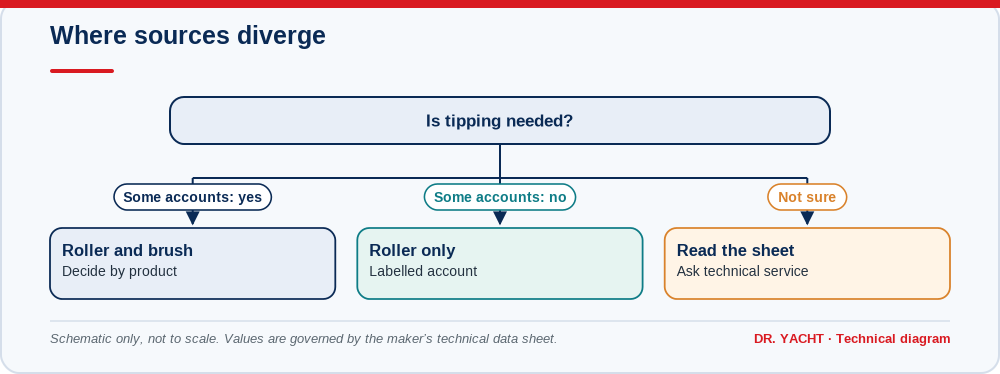
The interesting part is that sources differ on whether tipping is needed. Some publication and forum accounts describe brushing after rolling as part of a good result. Other accounts say that with certain maker products rolling alone gave a very good result; one publication reports being told that the maker's representative now recommends rolling without tipping. Those reports are second-hand and unverified, so they should be read as labelled.
There are possible explanations for the difference: product version, thinner type, ambient condition, the person's skill and the surface expectation. This article cannot say which applies to your job. The right approach is to take the product's current data sheet and the technical service's method note as the authority and to treat accounts as a source of ideas.
Another lesson from the disagreement is to be sceptical of "one right method" claims. The same product gives different people different results because the result depends on surface preparation, environment and skill as well as on the product. When comparing, compare conditions too.
A small scenario: how section, team and environment are thought through together#
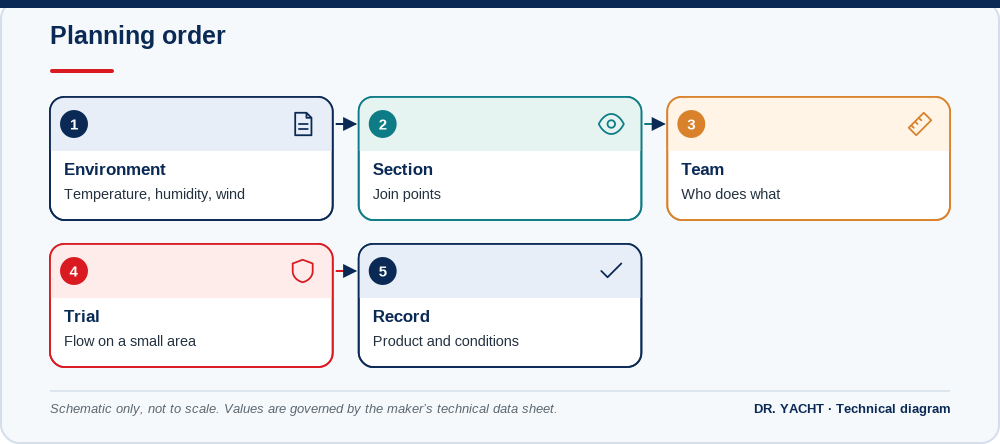
Suppose a topsides surface is to be painted by two people. Planning starts with the environment: shade or sun, wind, and whether temperature and humidity are close to the sheet's conditions. The second step is to decide sections and division of work: who rolls, who tips, where the joins will be. The third step is a small trial to see how the paint flows and how the brush behaves.
None of the three steps proposes a number, because the right section size and timing depend on product version and environment. For every point left uncertain, the current data sheet and technical service are the authority. If something unexpected happens mid-job, such as rising wind or paint tightening, calmly rethinking the plan looks safer than breaking the method in a hurry.
7. Common misreadings#
The first misreading is to take roll-and-tip as a method with a guaranteed result; the result depends on product, environment and skill. The second is to treat a section size or mix quoted in one publication as a universal rule. The third is to use the brush to spread the paint. The fourth is to stop in the middle and lose the wet edge.
The fifth is to carry a method described for one product straight over to another; products differ in drying speed. The sixth is to put a forum or retailer account in place of the maker's data sheet. The seventh is to neglect safety; breathing protection, ventilation and eye protection against solvent vapour and paint mist are general good practice.
| Array | Array | Array | Array |
|---|
8. Records and later maintenance#
A short record after application is useful for later maintenance and repair: which product, which version, under which conditions and with which arrangement was it applied? Such a record saves time when the cause of a defect has to be sought. This article imposes no record format; it only explains the value of one.
Finally, a roll-and-tip result may not match professional spraying exactly. Some publications say the result looks very good from a distance but roller or brush marks can be noticed up close. Setting expectations at the start reduces disappointment at the end.
Frequently asked questions#
What is roll-and-tip?
It is an application method in which paint is spread with a roller and then lightly smoothed with a brush straight away. The aim is to remove roller texture and bubbles. The result depends on product, environment and skill.
Why does the wet edge matter?
If new paint is added after the earlier paint has begun to dry, the boundary can stay visible. Keeping the wet edge is an attempt to avoid that visible line. The real time varies with product and environment.
Do you have to work in pairs?
No, but publications and forums describe a roller-and-brush pair as easier on large areas. That is an account of experience, not a rule.
Can you roll without tipping?
Some publication and forum accounts say that with certain maker products rolling alone was used and gave good results. Those claims are labelled; for your product the current data sheet and technical service are the authority.
Is this article an application instruction?
No. It recommends no ratio, section size, time, brush or roller; it explains general logic. The current data sheet and technical service are the authority.
Was this guide helpful?
Thank you! Your feedback has been saved.
Guide content is for general information; in practice, the current technical data sheet of the product applies.
Keep reading
Related guides
How to Read the Awlgrip Topcoat Technical Data Sheet: Solids, Dry Film, Cure Time
A data sheet is not a recipe card; it is a reference written for specific conditions. This article explains how to read the solids, dry film, wet film, coverage and cure lines, and where their limits lie.
13 min read Paint and CoatingsAwlgrip in Hot Weather: Fast Drying, Dry Spray and Choosing a Reducer
As temperature rises, solvent leaves quickly, paint pulls fast and the wet edge shortens. This article explains the logic of hot-weather problems, the reducer families the maker separates by temperature band, and their limits.
11 min read Paint and CoatingsThe Fisheye Paint Defect: The Contamination Chain and Prevention
A fisheye is a crater-like defect where paint pulls away from a contamination point on the surface. This article explains the contamination chain, why silicone is special and the logic of prevention in general terms.
11 min read