
Paint and Coatings
How to Read the Awlgrip Topcoat Technical Data Sheet: Solids, Dry Film, Cure Time
The numbers on a technical data sheet are misread as often as those on the back of a paint can. For a two-component polyurethane such as Awlgrip Topcoat, the sheet gathers volume solids, film thickness, coverage, cure and product version on one page, and these concepts are linked. This article explains how to read that page; it gives no numbers and no application instructions. The current sheet and the maker's technical service remain the authority.
Short answer
A technical data sheet is a reference document the maker writes for specific conditions and a specific product version. Volume solids describes the share of the film that remains after drying, and that share links wet film to dry film. Coverage figures are theoretical and exclude application loss. Cure times must be read together with temperature and humidity. Different versions of the same product name (spray, VOC-compliant, brush and roller) may carry different values, so the current sheet for the version in your can is the one to use. This article is general information, not application advice.
Key points
- A data sheet is a reference for specific conditions and a specific product version, not a general rule.
- Volume solids is the share of wet film that becomes dry film; it can differ between versions.
- Coverage figures are theoretical; loss, roughness and method change the real value.
- Cure and recoat times must be read with the temperature and humidity they were written for.
- The current sheet and technical service are the authority; this is not application advice.
1. Why a data sheet is not a recipe#
A technical data sheet is the reference document in which the maker describes a product for particular conditions, a particular method and a particular version. It is not a recipe to follow identically in every setting; it is a framework describing how the product behaves. That distinction matters: lifting a number out of its condition and moving it to another environment is the most common way of misreading a sheet.
For two-component polyurethanes such as Awlgrip Topcoat, the sheet typically covers what the product is, where it may be used, the mixing arrangement, application methods, film thickness values, coverage, cure and safety notes. The maker's own sheets also state that the information is not exhaustive, that documents change over time, and that the user must verify suitability. That warning is not decoration; it tells you how to read the document.
This article explains the logic of reading line by line. It recommends no ratio, number of coats, time or sanding grade, because correct values depend on product version, environment and scope of work. The maker statements quoted here are labelled and are not independent test results.
2. Volume solids: the multiplier hidden in one line#
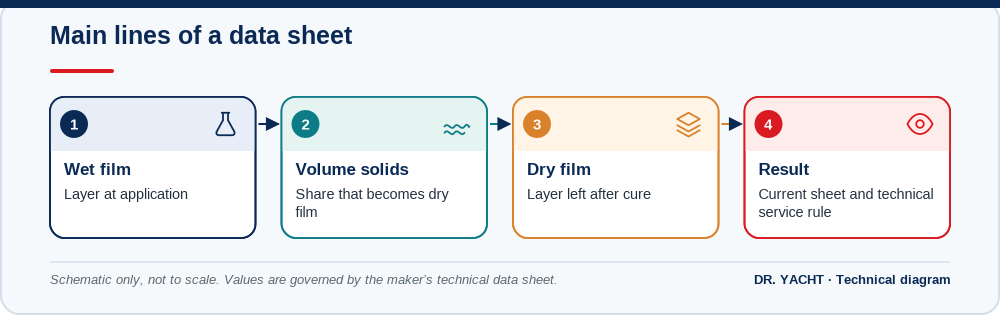
Volume solids is the share of the mixed paint that remains in the film once it has dried and the solvents have left. On sheets it appears as "volume solids" and is given as a percentage. This line is the bridge between wet film thickness and dry film thickness: the same wet film leaves a thicker dry film in a product with a higher solids share.
It is important to know that there is no single "Awlgrip Topcoat number". Across the maker's published sheets, different solids values appear depending on product version and colour; the older spray sheet, the VOC-compliant version and the current spray sheet do not carry the same percentage. Applying one version's number to another gives a wrong result. That is why the code on your can and the publication date of the sheet should be matched.
A higher solids percentage does not automatically mean "better" either. Higher solids means less solvent for the same dry film and matters for emissions, but flow, appearance and application behaviour cannot be deduced from this one number. If a comparison is to be made, the current sheets of the same product family should be read side by side under the same conditions.
3. Wet film and dry film: two separate thicknesses#
Wet film thickness is the layer on the surface at the moment of application; dry film thickness is what remains once solvents have left and the film has cured. Sheets give the two on separate lines. The relationship between them is a simple ratio set by volume solids: only part of the wet film becomes dry film.
In practice this means a wet film value measured or calculated on the surface can be compared with a dry film target only if the right solids value is used. Use the solids value of the wrong version and the dry film estimate is wrong too. The maker also notes that dry film builds over several coats rather than one pass, and sheets may give values for the total number of coats rather than for a single coat.
Sanding and polishing reduce dry film. Some of the maker's sheets note that polishing and sanding lower the total dry film and that additional coats may be applied if needed. That note is a reminder that the dry film target is a total to be protected through the process, not the value on the finished surface. This article gives no thickness target; the current sheet is the authority.
| Array | Array | Array | Array |
|---|
4. Coverage: theoretical yield versus real consumption#
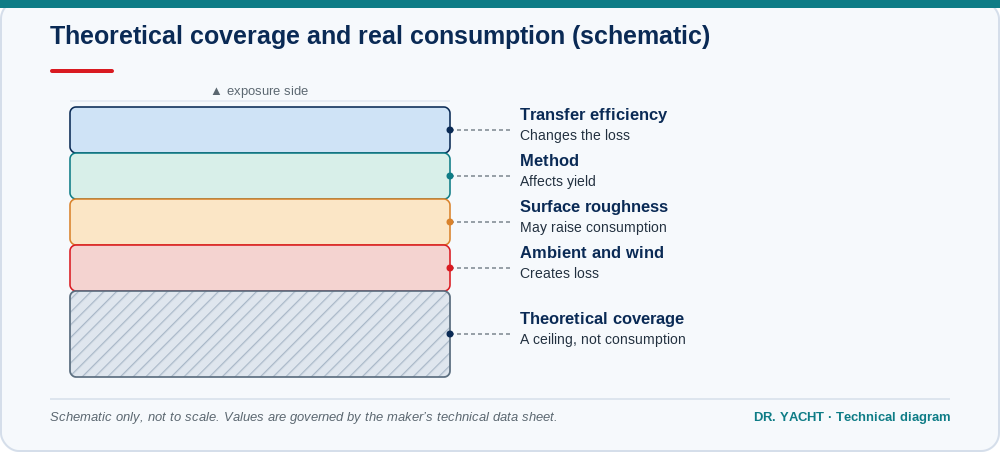
The coverage line on a sheet shows, in theory, how many square metres a unit volume covers at a given dry film thickness. By the maker's own wording this calculation is theoretical, and real yield varies with equipment, technique, part size and environment. So the figure on the sheet is a ceiling; on its own it is not enough for a budget or an order quantity.
Factors that influence real consumption include transfer efficiency, application method, surface roughness, wind and masking arrangement. Some of the maker's sheets also state that the coverage calculation is based on a stated reduction and carries an assumption about transfer efficiency. Whether those assumptions hold on your own job is learned from the shop floor, not from the sheet.
For that reason a coverage figure is not a good yardstick for comparing two products by itself. A more meaningful comparison puts values calculated under the same conditions and assumptions side by side, and that can only be done with current sheets together with the maker's technical service.
5. Cure time: a condition-dependent curve, not one number#
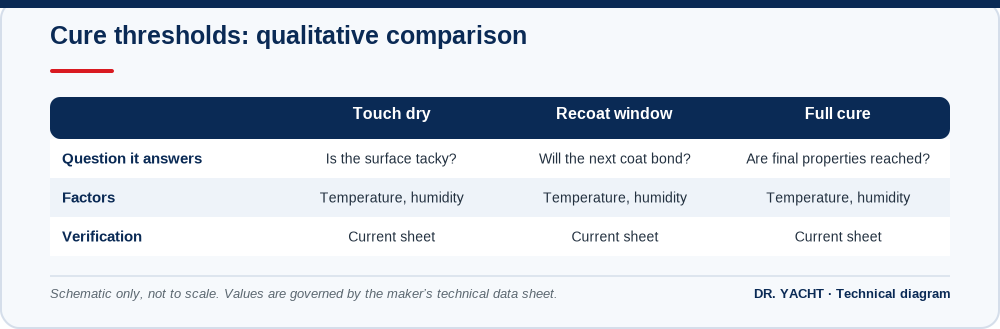
On sheets, cure and recoat times are given at a stated temperature and relative humidity. When the environment cools or humidity rises, times may lengthen; when it warms they may shorten. The maker's accelerator and retarder additives exist to adjust this behaviour, but their use depends on the product version and on the sheet.
Cure covers several separate thresholds: touch dry, recoat window, light service and full cure. Each answers a different question. The recoat window concerns how one coat bonds chemically to the next; full cure concerns the film reaching its final properties. This article suggests no time for any threshold; read which threshold is given at which time from the current sheet.
A frequent mistake is to carry a time given for a stated condition straight into the working environment. The same product can behave differently in the shade, outdoors or in a closed shop. That is why makers separately state ambient conditions such as surface temperature and dew point.
6. Same product name, different sheets: version confusion#
For Awlgrip Topcoat the maker has published more than one sheet over the years: older spray sheets, US-only VOC-compliant versions, brush and roller versions and the current spray sheet. Lines such as solids value, converter code and mix arrangement may differ between them.
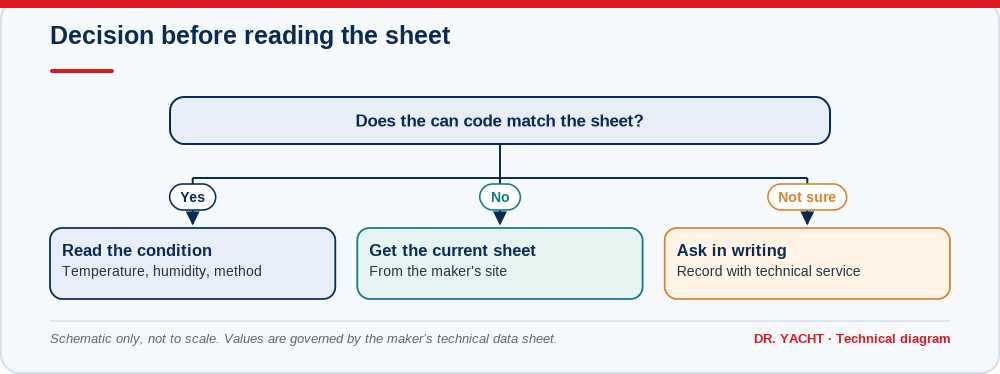
This variety means an old sheet found online may not apply to today's product. Summaries of sheets in retailer catalogues may also be out of date. Rather than relying on an undated or old document, it is general good practice to take the current sheet matching the code on the can directly from the maker's site and, if needed, to ask technical service.
A similar warning applies to related products such as HDT: there the solids value of the mixed product is given together with the activator, and the dry film target is said to be reachable in two or three coats. That sentence belongs to the HDT sheet and should not be taken to apply to Topcoat.
A small scenario: two sheets, two results#
Suppose two people calculate the same colour for the same boat. One reads from an old sheet, the other from the current one. If the solids and coverage lines differ, the quantity that comes out for the same dry film target will differ too. The error is not in the arithmetic but in the source. The remedy is to match the code on the can and the date of the sheet first, then take the current document as the authority.
The second step is to read which assumptions the calculation rests on: how much it was reduced, how transfer efficiency was assumed, and whether the dry film target is for one coat or the total. The third step is to put every remaining uncertainty to technical service in writing. None of these three steps proposes a numerical value, because the correct value is specific to product, version and environment.
7. Common misreadings#
The first misreading is to take the solids value as the "quality" of the product, when it is meaningful only as the share left in the film and in the emissions context. The second is to count the coverage figure as real consumption. The third is to read the wet film value as the dry film target. The fourth is to follow cure times as an unconditional calendar.
The fifth is to use the sheet of one version for another. The sixth is to substitute a retailer or forum summary for the maker's sheet. The seventh is to treat the word "recommended" on a sheet as an absolute rule for every condition; the sheet itself says the information is not complete and that the user must verify suitability.
| Array | Array | Array | Array |
|---|
8. Tying the sheet into a workflow#
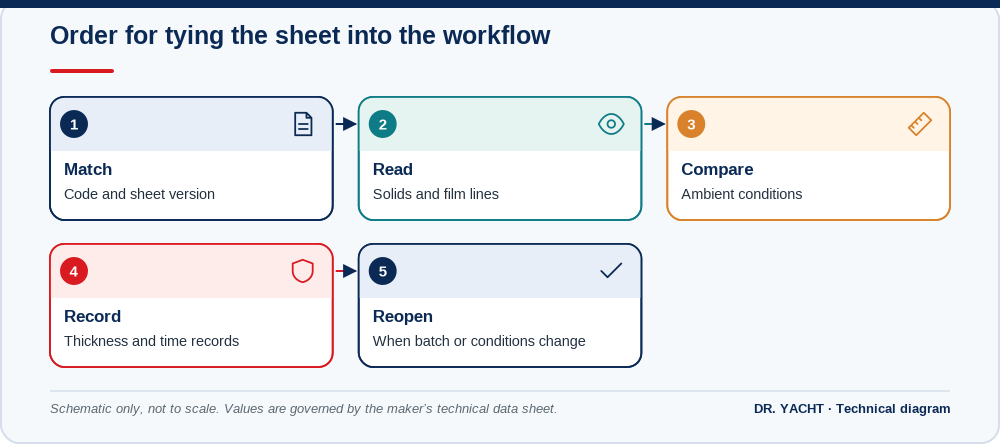
A data sheet should not be a document read once before buying; it should be a record consulted throughout the job. At purchase the version and code are matched; before application the ambient conditions are checked; during application thickness and time records are kept. Such a flow answers, at the end of the job, the question of what was done and according to which document.
Another benefit of keeping records is knowing the existing system at the time of later maintenance and repair. If it is known which product was applied in which version, the question of compatibility is answered more clearly when choosing a topcoat or repair product. This article imposes no workflow; it only explains the logic of using the sheet as a living reference.
Finally, the language of the sheet must be read as well. Words such as "recommended", "approximately" and "typical" indicate that a value is a range or a general tendency. Asking technical service in writing also puts the answer on record and shows later what information the work relied on.
Frequently asked questions#
What does volume solids mean?
It is the share of volume that remains in the film after the solvents have left. It determines how much of the wet film becomes dry film. The value can differ by product version, so check the current sheet.
Are wet film and dry film the same thing?
No. Wet film is the thickness at the moment of application; dry film is what remains after solvents leave and the film cures. Sheets list them on separate lines, linked through volume solids.
Does the coverage figure give real consumption?
No. The coverage on a sheet is theoretical, and the maker notes that real yield varies with equipment, technique and environment. Allow for loss separately.
Is cure time one number?
No. Times are given for a stated temperature and humidity; when the environment changes, so do the times. Always check which condition the sheet was written for.
Is this article an application instruction?
No. It is a general reading guide and recommends no ratio, number of coats, time or method. The current data sheet and the maker's technical service are the authority.
Was this guide helpful?
Thank you! Your feedback has been saved.
Guide content is for general information; in practice, the current technical data sheet of the product applies.
Keep reading
Related guides
Wet Edge and Speed in the Roll-and-Tip Method: The Logic Behind a Professional Finish
In roll-and-tip the result is often decided less by the product than by keeping the wet edge. This article explains how the edge line forms, what speed and division of work change, and where sources disagree.
13 min read Paint and CoatingsAwlgrip in Hot Weather: Fast Drying, Dry Spray and Choosing a Reducer
As temperature rises, solvent leaves quickly, paint pulls fast and the wet edge shortens. This article explains the logic of hot-weather problems, the reducer families the maker separates by temperature band, and their limits.
11 min read Paint and CoatingsThe Fisheye Paint Defect: The Contamination Chain and Prevention
A fisheye is a crater-like defect where paint pulls away from a contamination point on the surface. This article explains the contamination chain, why silicone is special and the logic of prevention in general terms.
11 min read