
Refit and Maintenance
Osmosis Treatment: Drying, Moisture Readings and Epoxy Barrier
Osmosis is blistering caused by water that has passed through the gelcoat into the laminate beneath. Treatment is built on cutting off the water source, drying the laminate and protecting it again.
Short answer
Osmosis treatment is a process in which water that has entered the laminate is measured, the laminate is dried under controlled conditions and then sealed with an epoxy barrier. Success depends on controlling the drying rate and the application conditions of the barrier correctly.
Key points
- Osmosis is caused by water passing through resin and reacting with hydrophilic compounds.
- Moisture readings determine when drying is finished.
- Drying controls heat and ventilation together.
- An epoxy barrier applied over damp laminate fails quickly.
What osmosis is#
On a GRP hull, osmosis is the blistering that results when water that has passed through the gelcoat and laminate reacts with hydrophilic compounds inside the laminate. Gelcoat and resin are not completely impermeable; over time water moves through microscopic gaps between molecules. Where the water reaches, a chemical reaction starts and liquid collects. The liquid inside the blisters can be acidic, and it weakens the resin bond and softens the laminate over time.
Osmosis does not endanger a hull immediately, but untreated osmosis can advance into the structural laminate. That is why early detection and controlled treatment matter. The moisture in the laminate beneath a blister matters as much as the number of blisters.
Moisture readings#
Treatment decisions rest on moisture readings. The laminate moisture is read at several points with a moisture meter. Measurement points are taken around the blistered areas and in apparently sound areas of the hull, so that the difference between dry and wet zones becomes visible. The readings are recorded and repeated after drying.
A single moisture reading is not enough; temperature and relative humidity are recorded too. If ambient humidity is high, readings can be misleading. Measurements are taken on a cool, dry day where possible and before the hull has warmed in the sun.
Drying#
Drying means evaporating water from inside the laminate and letting it out. The process must be slow, because rapid heating of the surface can cause water inside to vaporise and form blisters. Drying is usually done with controlled heating and ventilation. The hull is kept in a tent, air is moved through it, and the temperature is raised gradually.
The drying time depends on hull thickness and the starting moisture level. At the end of the period moisture is measured again, and drying continues until the value falls within an acceptable range. If the barrier is applied before drying is complete, the remaining water is trapped beneath it and the problem grows. Drying ends by measurement, not by the calendar.
| Value | When checked | Purpose |
|---|---|---|
| Laminate moisture | At each drying stage | Determine whether drying is complete |
| Surface temperature | Continuously during heating | Prevent rapid vaporisation and blisters |
| Relative humidity | Inside the tent | Prevent condensation |
| Number of blisters | At start and end | Assess the effect of treatment |
Opening and cleaning#
Blisters are opened in a controlled way with a spatula. The liquid inside is collected and can be analysed, which indicates how far the osmosis has progressed. Opened cavities are dried thoroughly to remove the liquid and then filled. During opening, the upper layer of each blister is removed rather than digging deeper, so the sound laminate is not damaged.
Cleaning matters too. Acidic residue left in opened areas prevents the barrier from adhering. Each area is washed with a suitable cleaning solution and dried thoroughly. Afterwards the pH is checked and recorded.
Epoxy barrier#
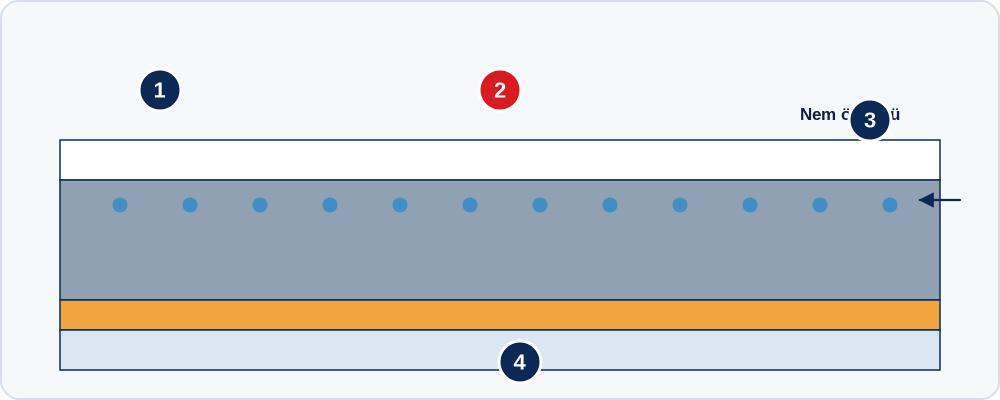
The barrier is a layer of epoxy applied over sound, dry laminate. It prevents water from re-entering the laminate. It is applied over the whole hull or at least over the area showing osmosis; partial application can let moisture from the surroundings enter at the edge of the barrier. For this reason the barrier extends slightly beyond the identified osmosis area.
The barrier is applied in three steps: a bonding coat first, then the main epoxy coats, and finally a topcoat. Each coat goes on after the previous one has cured, within the time window in the product data sheet. The final thickness must reach the value stated on the data sheet.
Acceptance check#
When treatment is complete, the barrier thickness, surface smoothness and final moisture readings are recorded. The inspection confirms that no new blisters have formed, the barrier is not lifting anywhere and adhesion is complete. The records become the reference for later maintenance periods.
The causes of osmosis#
Osmosis begins when water slowly entering a fibreglass laminate combines with soluble substances inside it. Neither gelcoat nor laminate is completely waterproof; water molecules penetrate over time. If the laminate contains uncured resin residues, binders or voids, the water combines with these to form a dense liquid. Because this liquid is more concentrated than the seawater outside, it draws in more water and builds up pressure. The pressure pushes up blisters beneath the gelcoat.
Several factors set the pace of osmosis: how long the boat stays afloat, the water temperature, the build quality of the laminate and the thickness of the gelcoat. Boats kept continuously afloat in warm water tend to show osmosis earlier. Boats that spend part of the year ashore give the laminate a chance to dry out, and the process slows.
Not every blister is osmosis#
Not every blister on a hull means osmosis. Moisture trapped between old paint layers, an unsuitable primer or poor surface preparation can also form blisters. These stay within the paint layers and do not reach the laminate. To tell them apart, a blister is opened, the smell and nature of the liquid are examined, and it is checked whether the laminate surface has been reached. Liquid from an osmotic blister is usually acidic with a sharp smell.
This distinction directly sets the scope of treatment. Blisters confined to the paint may only need the paint system renewed, while true osmosis requires removing the gelcoat, drying the laminate and applying an epoxy barrier.
How long does osmosis treatment take?
Most of the time goes into drying. Depending on conditions and the starting moisture, drying can take weeks or months; the decision is made on moisture readings.
Does antifouling prevent osmosis?
No. Antifouling stops marine growth from settling; the layer that protects the laminate from water is the epoxy barrier.
Conclusion#
Osmosis treatment is not just a matter of closing blisters; it is built on cutting off the water at its source. When accurate moisture readings, controlled drying and a sound epoxy barrier are applied together, the laminate is protected again. The next step in this series looks at how steel hulls relate to sheet thickness and corrosion protection.
Was this guide helpful?
Thank you! Your feedback has been saved.
Guide content is for general information; in practice, the current technical data sheet of the product applies.
Keep reading
Related guides
Structural Repair of GRP Hulls: Laminate Schedule and Scarf Ratio
How is structural repair done on a GRP hull? Laminate schedule, glass selection, scarf ratio and what to watch during cure.
6 min read Refit and MaintenanceUnderwater System: Antifouling Selection and Coating Plan
How is antifouling selected for the underwater part of a boat, and how is the coating plan set up? Marine growth, tie coats and maintenance periods.
4 min read Refit and MaintenanceTank Inspection, Maintenance and Repair: Holiday Testing, Thickness Measurement and Records
Inspection, thickness measurement, holiday testing, repair approaches and records for steel boat tanks, summarised from source accounts with their limits.
10 min read