
Refit and Maintenance
Structural Repair of GRP Hulls: Laminate Schedule and Scarf Ratio
A crack in a GRP hull looks like a surface flaw, but the laminate beneath may have lost its load-carrying strength. Structural repair restores the load path, not just the surface.
Short answer
Structural repair of a GRP hull means removing the damaged laminate area by scarfing and rebuilding it layer by layer with glass fabric and resin. The layer order, weight, orientation and scarf ratio make the repair behave like the original laminate.
Key points
- Repair strength depends on the new laminate bonding to the original.
- The scarf ratio sets the slope that spreads the load transfer.
- Layers are laid in sequence with matching orientation.
- Thickness is not increased during cure without monitoring temperature and humidity.
Surface versus structure#
On a GRP hull a hairline crack or surface scratch often affects only the gelcoat. But a crack that cuts through the laminate beneath means that area can no longer carry load. Stresses on that zone when the boat meets a wave or is hauled out are far higher than on sound areas. The first question in structural repair is therefore how deep the damage goes. Surface damage can be covered with paint; damage through the laminate requires the laminate itself to be rebuilt.
This distinction sets the scope of the repair. For surface damage, a gelcoat repair is enough. For deep damage, the damaged laminate must be removed and rebuilt. The decision is made by opening the surface and taking a section, not by guesswork.
Finding the extent of damage#
The limit of damage is first located by tap testing. The surface is tapped lightly with a small hammer: sound laminate gives a clear, solid note, while delaminated or water-saturated areas sound dull or hollow. This test reveals delamination that cannot be seen. The marked area is drawn slightly wider than the visible damage, because weak laminate left at the boundary can continue to deteriorate under a new repair.
The survey is then supported by moisture readings. If the laminate holds water, drying is needed before repair; otherwise the new resin cannot bond to the wet laminate beneath. This issue is covered in detail in the osmosis treatment article.
Laminate schedule#
A laminate schedule defines the order of the layers, the type and weight of each glass reinforcement, the orientation of each layer and the resin ratio. The schedule of the original hull is found in manufacturer documentation or by measuring a section. The repair schedule must give the same strength as the original: a thinner schedule is as wrong as a thicker one, because the hull then has two sections with different flexibility.
The type of glass matters. Chopped strand mat carries no directional load but bonds the layers together. Woven fabrics carry load in their direction. Repairs usually alternate mat and woven fabric. The orientation of each layer must also be written in the schedule; the wrong orientation changes the flexibility of the hull.
| Component | Function | Point to watch |
|---|---|---|
| Chopped strand mat | Bonds layers and carries resin | Weight and resin ratio must match |
| Woven glass fabric | Directional strength | Orientation and weight must match the original schedule |
| Resin (epoxy or polyester) | Binds fibres and transfers load | Follow the manufacturer's cure conditions |
| Peel ply | Gives the final layer a smooth finish | Must be removable after cure |
Scarf ratio#
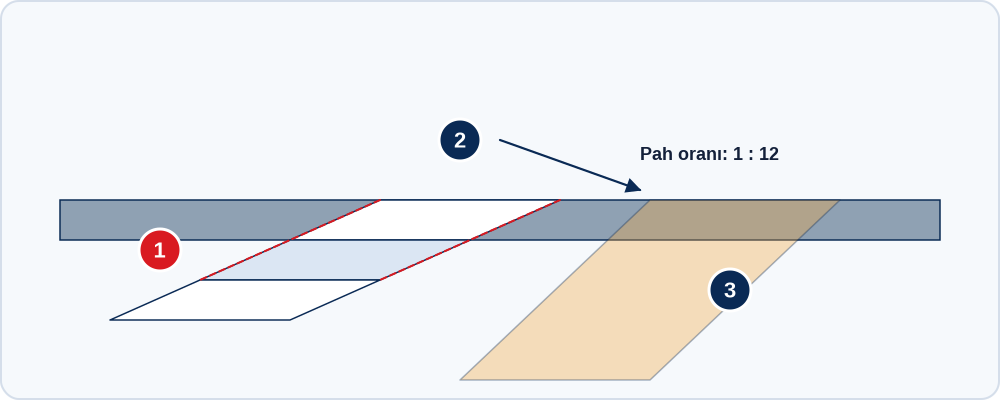
A scarf is the sloped surface along which the new laminate is bonded to the old. The scarf ratio is the length of the scarf divided by the thickness of the laminate. A ratio of 1:12, for example, means a twelve-millimetre scarf for a one-millimetre laminate. The steeper the scarf, the more concentrated the load transfer becomes and the smaller the bonding area. A shallower scarf gives more bonding area but requires more laminate to be removed.
The scarf ratio is chosen according to hull thickness and load. The exact value comes from an engineering calculation or the manufacturer's recommendation. In practice the ratio is set so that each layer overlaps the one before it on the scarf, bonding to the old laminate along its length.
Sequence of application#
The damaged area is opened first, the edges are sanded to the scarf ratio, and dust is removed. The surface is then degreased with solvent, and the first layer is laid in wet resin. Each layer goes on before the resin of the previous one gels; otherwise the bond between layers weakens. Bubbles are removed from the glass with a roller or brush. At the end of each layer the resin ratio is checked: excess resin adds weight without adding strength, while too little resin leaves fibres dry.
The last layer is usually finished with peel ply. Temperature and humidity are monitored during cure. At low temperature cure is slow; at high temperature the resin gels quickly and bubbles may form. The thickness of each layer is checked, and the repair is complete when the required thickness is reached.
Acceptance check#
Once the repair is complete, the surface is checked again by tap testing. The new area should sound close to the sound laminate around it. A thickness measurement confirms that the new laminate has reached the planned thickness. These results are recorded with photographs and measurement logs.
Conclusion#
Structural repair of a GRP hull is less about covering a surface and more about restoring the load path. Damage depth, laminate schedule, scarf ratio and layer order all work together. Keeping that balance requires measuring the damage, defining the schedule from the original hull and recording every layer. The next step deals with the moisture that often lies beneath such repairs: osmosis treatment.
Was this guide helpful?
Thank you! Your feedback has been saved.
Guide content is for general information; in practice, the current technical data sheet of the product applies.
Keep reading
Related guides
Osmosis Treatment: Drying, Moisture Readings and Epoxy Barrier
How does osmosis form in a GRP boat, how is moisture measured, and how are drying and an epoxy barrier applied? Step-by-step treatment principles.
6 min read Refit and MaintenanceYacht Repair in Turkey: Diagnosis, Repair, Handover
Yacht repair in Turkey: correct diagnosis and work order for gelcoat, GRP, osmosis, timber and sealing repairs. DR. YACHT’s measurement-based method.
3 min read Refit and MaintenanceTank Inspection, Maintenance and Repair: Holiday Testing, Thickness Measurement and Records
Inspection, thickness measurement, holiday testing, repair approaches and records for steel boat tanks, summarised from source accounts with their limits.
10 min read