
Refit and Maintenance
Removing Old Coatings: Sanding, Blasting and Chemical Stripping
In a refit, a new coating is only as good as the removal of the old one. Stripping is the craft of removing the old layers completely while protecting the sound laminate underneath.
Short answer
Removing old coatings means taking them off by mechanical methods (sanding and blasting) or chemical methods without damaging the laminate or metal beneath, and without leaving residues. The choice of method depends on the coating type, the substrate and the thickness readings.
Key points
- The method is chosen by coating type and the material underneath.
- Blasting is fast but can thin the top laminate easily.
- Chemical strippers leave residues unless neutralised.
- The surface is recorded by thickness measurement after removal.
Why stripping is a separate operation#
Repainting an old boat often looks simple: a new coat goes over the old one. But when several paint, primer and gelcoat layers pile up, the bond between them weakens. The new coat bonds to the old layer rather than to the surface, and the old layer itself is weakly bonded to the laminate. The next cold season separates the weakest link, and the result returns as blisters or delamination.
For this reason stripping is a distinct and careful stage of the refit. The aim is to remove the old layers and expose sound material beneath. The wrong method can also remove sound laminate, leading to over-thinning and areas that need repair later.
Measure first, then choose the method#
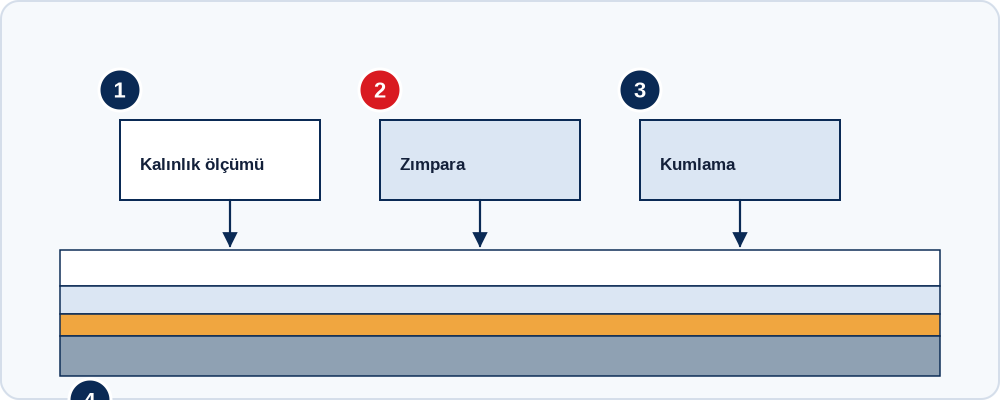
The method is not chosen without knowing what is on the surface. Three facts are needed: the coating type (polyurethane, epoxy, alkyd, gelcoat or old varnish), the total thickness, and the substrate. Thickness is read at several points with a coating thickness gauge. Measurement points are chosen to represent areas such as bow, stern, keel and deck.
Substrate knowledge is equally important. On a GRP hull, the structural laminate lies under the gelcoat; its thickness is often between one and several millimetres and it thins with every pass. On aluminium or steel hulls the purpose of stripping is also to reveal corrosion on the metal. On a wooden hull, stripping must not open the grain or let water in.
| Method | Speed | Effect on laminate | Suitable when |
|---|---|---|---|
| Sanding (electric, orbital) | Medium | Controlled, leaves a smooth surface | Thin and adhesive coatings, localised work |
| Blasting (abrasive) | High | Can thin the top layer easily | Thick, hard, multi-layer coatings, metal surfaces |
| Blasting (soft media) | Low | Less damage | Thin laminate and sensitive areas |
| Chemical stripper | Slow | Does not abrade, but can leave residue | Recesses and hard-to-reach areas, thin layers |
Sanding#
Sanding gives the most control. An orbital sander moves in random orbits across the surface and leaves no directional marks. A coarse grit first removes most of the old coat; then a finer grit smooths the surface without disturbing its flatness. Thickness is measured after each pass, and sanding stops before the laminate is down to a thin layer.
The most common mistake in sanding is working one spot for too long. The laminate heats up and thins there, and after a while a soft hollow forms. Keeping the sander moving and watching the surface temperature prevents this.
Blasting#
Blasting uses pressurised air to project abrasive particles onto the surface and lift the layers. It is fast and far more efficient than sanding on thick, hard coatings. On metal hulls, blasting is the most effective way to remove corrosion and old paint completely. On a GRP hull, however, aggressive abrasive can quickly wear the gelcoat and the top laminate.
For this reason a soft medium is chosen on fibreglass. Plastic-based, bicarbonate or similar light media affect the top laminate less. Blasting pressure is set according to the product data sheet and the hull thickness. Work starts at low pressure, and the result is checked in a test area for each zone. Dust and residue from blasting are fully cleaned before the next stage.
Chemical stripping#
Chemical strippers remove old coating by softening or dissolving it. They are useful in recesses, corners and areas that mechanical tools cannot reach inside the hull. However, chemical stripping carries three risks: leaving residue on the surface, attacking the laminate resin, and preventing new coatings from bonding if not cleaned thoroughly.
Manufacturers' safety data sheets must be read and followed when using a chemical stripper. The stripper stays on the surface for its dwell time, then is scraped off mechanically. The surface is then washed with the neutraliser recommended by the product and plenty of water. If neutralisation is skipped, acid or alkali left on the surface can start a chemical reaction under the next coat.
Safety#
All three methods carry safety requirements. Sanding and blasting produce fine dust that causes serious health risks if inhaled. Respiratory protection, eye protection and dust extraction equipment are mandatory. Chemical strippers can burn skin and eyes on contact, so gloves and protective clothing are used. Waste produced during stripping is collected and disposed of according to local regulations; older paints may contain lead or other heavy metals, which makes waste management an additional priority.
Checking after stripping#
When stripping is complete, the surface is checked for readiness for the next stage. The check should answer three questions: has the laminate or metal been reduced below the designed thickness? Is any residue, contamination or chemical remnant left? Are there pits, breaks or water-absorbed areas? The results are recorded and the surface is photographed. This record becomes the key reference for later steps such as osmosis treatment and structural repair.
Conclusion#
Stripping old coatings is one of the least visible yet most determining stages of a refit. The method is chosen by coating type and the material beneath: sanding gives control, blasting gives speed, and chemical strippers reach difficult areas. Reading the trace each method leaves through measurement and records protects both the laminate beneath and the new coating.
Was this guide helpful?
Thank you! Your feedback has been saved.
Guide content is for general information; in practice, the current technical data sheet of the product applies.
Keep reading
Related guides
Blasting Inside Tanks: Surface Preparation Standards and Good Practice
How blasting is described for the interior surface preparation of steel tanks: Sa grades, profile, salt and humidity limits and confined-space safety, summarised from standards and maker accounts.
14 min read Refit and MaintenanceSteel Hull Refit: Thickness Gauging, Plate Renewal and Corrosion Protection
How is plate thickness measured on a steel boat, when is plate renewed and how is corrosion prevented? Principles of gauging, welding and coating.
7 min read Refit and MaintenanceTank Inspection, Maintenance and Repair: Holiday Testing, Thickness Measurement and Records
Inspection, thickness measurement, holiday testing, repair approaches and records for steel boat tanks, summarised from source accounts with their limits.
10 min read