
Paint and Coatings
Superyacht Paint: Multi-Coat Systems, Colour Matching and Gloss Quality Control
On a superyacht, paint is less a matter of appearance than a matter of management. Expectations are high, coats are many and the programme is tight. This article summarises an approach that does not leave quality to chance: records, an inspection plan and early decisions.
Short answer
On a superyacht paint can account for roughly 5 to 10 percent of new-build cost (according to one yard article), and quality rests on fairing and sanding discipline, coat and thickness records, a controlled environment and inspection at different angles and in different light. Tools such as a Paint Inspection Plan (PIP/ITP) set targets up front for fairness, gloss and orange-peel levels. Colour, especially in bespoke matches, should be decided early and approved with a test panel.
Key points
- On a superyacht paint is a significant share of new-build cost (about 5 to 10 percent according to one yard).
- Quality comes from fairing, sanding, coat and thickness records, a controlled environment and inspection.
- A Paint Inspection Plan (PIP/ITP) writes the fairing, gloss and orange-peel targets up front.
- Bespoke colour matches are made in a laboratory and should be approved with a test panel in different light.
- Topcoat life is reported as roughly three to four years in normal conditions; plan renewal up front.
1. Why is superyacht paint a separate matter?#
On a motor yacht or sailing yacht paint is often one maintenance item among many. On a superyacht it is a direct part of the vessel’s image. An industry article says a high-gloss, well-applied finish contributes to the perception of a superyacht’s overall quality and can even influence resale value when well maintained. A yard article says the paint of a superyacht can account for roughly five to ten percent of new-build cost.
Superyacht paint is therefore as much a project-management subject as an aesthetic one: expectations must be written clearly, the process recorded and the inspection plan set up from the start. This article presents the outline of that approach. The text is not product or application advice.
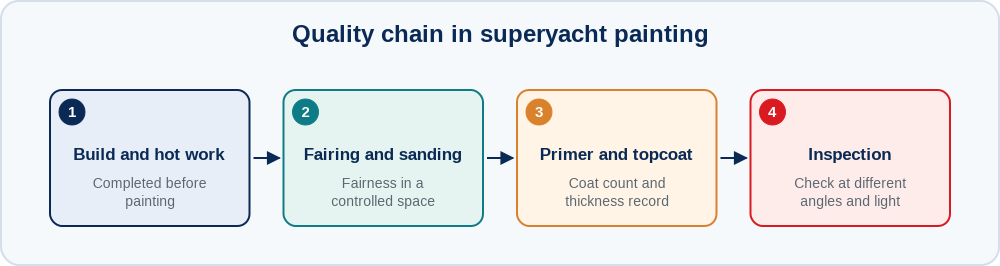
2. The quality chain: order matters#
An industry article stresses that the first step for new-build paint is completing construction and hot work before painting. The steps that follow are choosing a suitable polyurethane or acrylic urethane topcoat, a primer for good adhesion, fairing compounds for perfect smoothness and doing this work in a controlled environment. Lighting and inspection also matter: defects should be checked before final cure at different angles and in varied lighting conditions for inconsistencies in gloss, colour or texture.
The same article notes that HEPA air-filtration systems can reduce contamination risk. These seem small but are noticed at high gloss, because high gloss does not hide surface defects; it reveals them.
3. Fairing and sanding: the visible result of invisible work#
A yard article describes problems arising when paint crews do not keep to agreed procedures. It says that many fairing problems come from improper sanding when corners are cut, that sanding leaves matte surfaces and that these defects are seen only once a glossy coat is applied. Another manufacturer describes the traditional sequence in which a finish primer is applied and sanded, a separate high-gloss show coat is applied to reveal defects, defects are repaired and sanded again, and the final topcoat follows; it claims a high-gloss primer lets defects be seen earlier. That is a manufacturer’s claim; still, the visibility principle is right: the earlier you see a defect, the cheaper it is to correct.
| Fault | Cause | Early detection |
|---|---|---|
| Uneven fairing | Uncontrolled environment, insufficient sanding | Inspection at different angles with light |
| Matte sanding marks | Short-cut sanding | Gloss show coat or light test |
| Thickness deviation | Difference in coat count and method | Dry film thickness (DFT) measurement |
| Colour difference | Different batch or light | Test panel and same batch |
4. The Paint Inspection Plan: writing the expectation down#
A yacht-paint specialist explains that every superyacht owner has an idea of the colour but may not have voiced expectations for the finish in terms of fairness, gloss and orange-peel levels. Here tools such as an Inspection and Test Plan (ITP) or Paint Inspection Plan (PIP) help formalise the procedure and oversee quality control throughout the paint process. The same specialist says the system should be able to log any information wanted, such as daily climate conditions, dry film thickness measurements, final orange peel and gloss readings, and that the whole process, from control of the initial metalwork to the application of every coat including stripe coats, should be traceable and transparent.
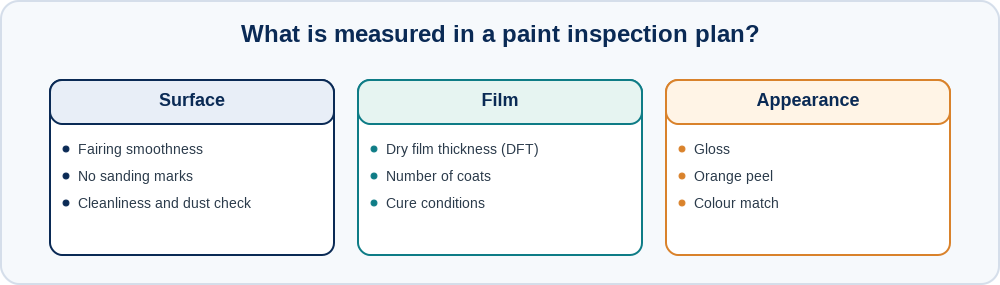
The value of this approach is having the discussion up front rather than afterwards. The question “is the gloss sufficient?” becomes a subjective argument after application; a target and measurement written in advance move the discussion onto a numerical footing.
5. Colour matching: from laboratory to test panel#
When a superyacht owner asks for the exact colour of a car, the matter is not simply hitting a shade. One manufacturer’s colour laboratories are reported to be designed to reproduce very specific requests, including matching luxury-car finishes, and to develop bespoke coatings that aim to preserve colour, gloss and finish quality for years despite UV, salt water and changing climates. An industry article stresses that reliable advice and guidance on colour should be obtained at an early stage of the process.
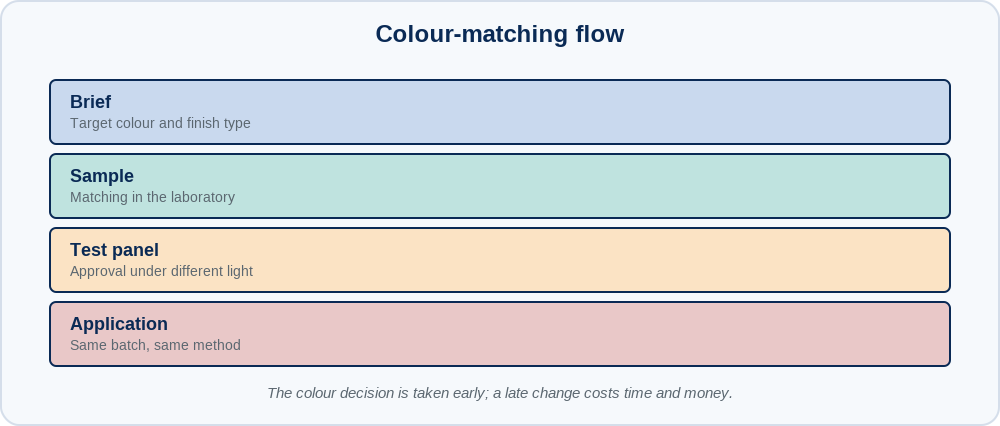
- Brief: target colour, gloss and finish type (solid, metallic and so on) are set in writing.
- Sample: matching is done in the colour laboratory.
- Test panel: approval under different light conditions (daylight, artificial light, direct sun).
- Application: with the same batch and the same method so that it is consistent across the whole surface.
- Record: colour code, batch number and application conditions are kept; needed for later touch-ups.
6. Topcoat life and renewal planning#
An industry article says that on a boat used in normal conditions and coated in a non-metallic polyurethane system the topcoat should last three to four years and that many boats repaint every third year. The same article says freshly applied topcoats used to be considered untouchable, whereas today many after-treatment products promise gloss retention and easier cleaning, which confuses captains and owners. The effect of these products on the topcoat’s integrity and on a later repaint should be asked about and the manufacturer’s approval obtained.
For the underwater area a specialist says that in a two-coat antifouling application the method can change the result markedly: coats applied by roller give roughly 100 to 120 microns while two coats by airless spray can reach roughly 250 microns and provide up to three years of trouble-free service. These figures are a specialist’s statement; they depend on product and conditions.
7. Regulation and sustainability#
Another factor facing superyacht paint is regulation. A yard article says increasingly strict environmental legislation has meant certain components must be left out of paint, which makes the painting process more difficult. An industry article says that as legal requirements for products, facilities and the application process grow, it becomes harder to meet high quality demands. This requires planning product choice and application environment (booth, filtration, waste) from the start.
8. A short case: two projects, two ways of managing#
In the first project the owner says “dark blue, glossy” and nothing else is written. After application a disagreement arises about gloss and orange peel; there are no measurements and no records. In the second project a paint inspection plan was written at the start: gloss and orange-peel targets were set, dry film thickness was measured and recorded on every coat, and the colour was approved with a test panel in different light.
Problems can arise in the second project too; but where and why they arose is known and the correction is faster. A record does not guarantee quality, but it makes quality manageable.
9. Checklist for owner and representative#
10. Common mistakes#
- Leaving expectations verbal; not writing a measurable target.
- Changing the colour at a late stage.
- Cutting corners on fairing and sanding.
- Not recording dry film thickness and climate conditions.
- Giving colour approval under a single light condition.
- Not asking about the effect of topcoat after-treatments on the renewal process.
11. Conclusion#
On a superyacht, paint is management more than appearance. Write the expectation up front, set up records and an inspection plan, approve the colour with a test panel in different light and plan renewal from the start. Quality is achieved not by chance but in sequence, by measuring and recording.
Frequently asked questions#
How much of the cost is superyacht paint?
A yard article says paint can account for roughly 5 to 10 percent of new-build cost; the ratio varies by project.
What is a Paint Inspection Plan?
An Inspection and Test Plan (ITP) or Paint Inspection Plan (PIP) is a tool that formalises the procedure and oversees quality control through the whole paint process; it clarifies expectations on fairness, gloss and orange peel up front.
How is colour matched?
The colour laboratories of some manufacturers produce bespoke requests, even matching luxury car colours. The process consists of a brief, a sample, a test panel and approval.
How many years does a topcoat last?
According to an industry article, in normal conditions and a non-metallic polyurethane system a topcoat lasts three to four years; many yachts repaint every third year. The real period depends on use.
Why do records matter?
Keeping information such as daily climate, dry film thickness, orange peel and gloss readings traceably supports quality and tracing the source of any problem.
Was this guide helpful?
Thank you! Your feedback has been saved.
Guide content is for general information; in practice, the current technical data sheet of the product applies.
Keep reading
Related guides
Colour Stability and UV Resistance in Yacht Paints
A study of the fading caused by sunlight on paint colours, UV resistance and the components that preserve this property.
2 min read Paint and CoatingsBoat Colour Selection and Solar Reflectance: Effect of Heat Absorption on Surfaces
A study of the effect of boat paint colour on solar reflectance and surface temperature.
2 min read Paint and CoatingsApplication Mistakes and Remedies in Awlgrip-Type Systems
Most defects in two-part polyurethane systems come from surface contamination, wrong mixing, conditions and technique. We describe common mistakes, causes and remedies based on sources.
8 min read