
Paint and Coatings
Yacht Paint in Cold Climates: Winter Lay-Up, Dew Point and Application Conditions
Painting in the north, or in a winter boatyard, is very different from painting in a hot climate. The problem is not only cold but condensation, slow cure and ice. This article offers a practical framework for yacht paint in cold climates.
Short answer
The biggest risk of cold-weather painting is the dew point: if the hull is colder than the air, moisture condenses on the surface and the paint hardly adheres at all. So not just the air but the hull temperature must be measured and the surface confirmed to be above the dew point. Low temperature also affects paint viscosity, solvent evaporation and curing; resin hardens late and recoat intervals lengthen. The manufacturer’s temperature range must be followed and, where possible, an enclosed, climate-controlled space used.
Key points
- In the cold the main risk is moisture condensing on the hull and the dew point.
- Hull temperature, not air temperature, must be measured; a hull cooled overnight warms late in the day.
- Low temperature affects viscosity, solvent evaporation and curing.
- The manufacturer’s application temperature range and recoat intervals are decisive.
- The winter lay-up is used for preparation and measurement; storing ashore also reduces moisture uptake.
1. Why is cold climate a separate subject?#
When yacht paint is discussed, sun, UV and warm water usually come to mind. Yet in work done in a boatyard in winter, even in the Mediterranean, the real problem is cold. Cold does not just slow the paint; it creates moisture on the surface, impairs adhesion and upsets the recoat schedule. Painting in the cold is therefore not only a “seasonal problem” but an application-conditions problem.
This article offers a practical framework for application in the cold. The text is not product or application advice; the manufacturer’s data sheet, local conditions and the applicator’s judgement are decisive.
2. Dew point: the invisible enemy#
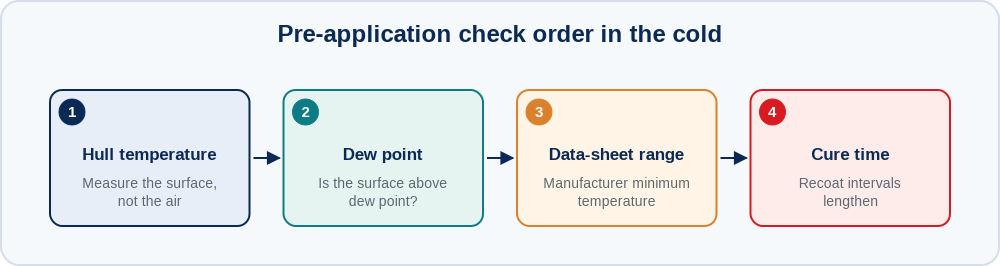
The dew point is the temperature at which water vapour in the air starts to condense. A yachting magazine explains that the dew point comes into play as soon as the hull and the environment are not at the same temperature. A yard manager says that with antifouling, varnish and paint the dew point is particularly problematic: when the temperature falls below it, moisture forms on the surface and the material hardly adheres at all.
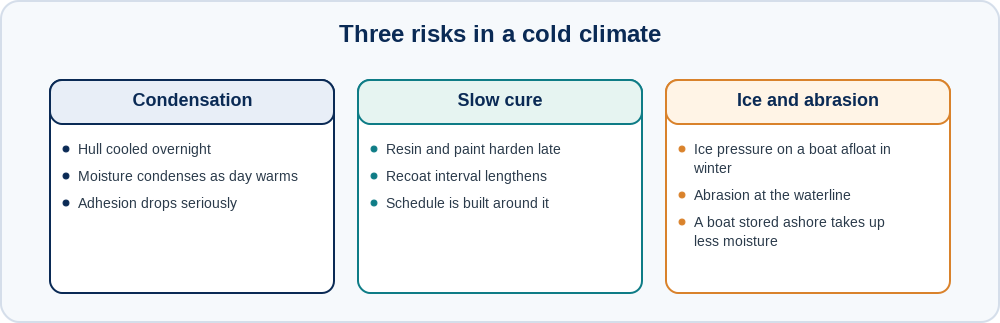
This happens especially in spring and autumn, when sunny days are followed by icy nights. Air warms much faster than a hull or a keel; a hull cooled overnight stays cold through the day and the moisture in the air condenses on it. So saying “the air is 15 degrees” is not enough; the hull’s temperature and its relation to the dew point must be measured.
An antifouling specialist says one of the most overlooked points in cooler climates is the minimum application temperature set by manufacturers, and that in doubt the hull temperature should be measured with an infrared pyrometer.
| Measurement | Why? | How? |
|---|---|---|
| Hull (surface) temperature | Condensation and adhesion | Infrared thermometer |
| Air temperature and humidity | To calculate the dew point | Thermo-hygrometer |
| Dew point | Surface must stay above it | Calculation or device |
| Paint and thinner temperature | Viscosity and flow | Keep the product in a heated area before application |
3. Slow cure and viscosity#
Cold matters beyond the dew point. A yachting magazine reports that temperature governs a paint’s viscosity, solvent evaporation and the curing of resins and paint. A yard manager says the problem with applying resin at too low a temperature is that it takes so long to cure. A varnish article notes that in the cold recoat times lengthen markedly and the day’s schedule must be built around it, that material kept cold in storage needs time to warm, and that some manufacturers specify a faster-evaporating thinner for cold weather.
The common message is this: in the cold not only does waiting lengthen; the material itself behaves differently. The temperature range and recoat intervals in the manufacturer’s data sheet are therefore not a loose suggestion but the frame of the application.
4. Ice and abrasion#
For a boat afloat in winter, ice is a separate risk. A marine retailer’s guide speaks of the unavoidable consequences of keeping a boat where ice can develop to over three feet thick. On commercial ships too, ice build-up on the hull is a separate difficulty at northern dry docks. Ice and friction can increase abrasion at the waterline and at hull corners.
On the other hand a boat hauled out is less exposed to moisture-related problems such as blistering; the same guide says storing a boat ashore in winter reduces the cumulative water exposure that allows blistering. Even where ice is not heavy, storing ashore gives an opportunity to see, measure and repair the surface through the winter.
5. The winter lay-up: plan and use it#
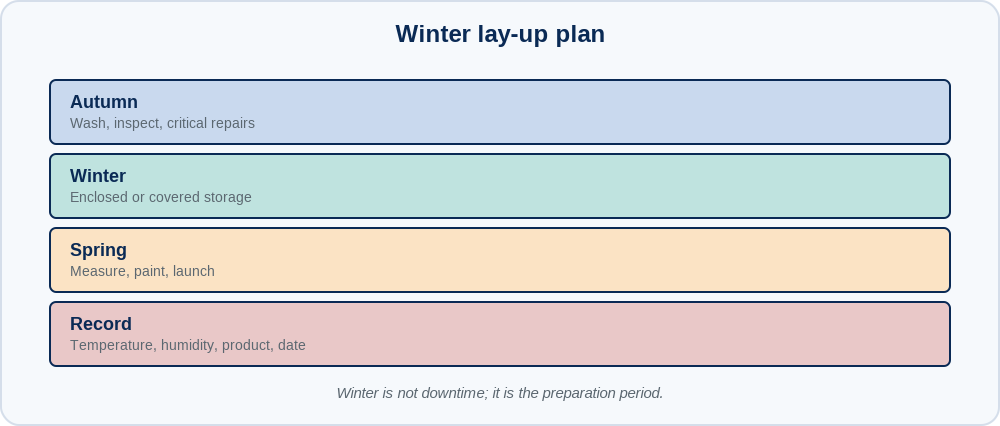
- In autumn wash the hull and inspect it on a clean, dry surface; note cracks, blisters and gelcoat damage.
- Do critical repairs in autumn as far as weather allows; do not step outside the manufacturer’s temperature range.
- Through winter keep the boat in an enclosed space or under a well-ventilated cover; prevent condensation.
- In spring measure surface temperature and humidity; apply the topcoats and antifouling in suitable conditions.
- At every stage record temperature, humidity, product and date.
6. Jobs that can be done in the cold and in winter#
Listing the winter jobs that can be done despite the cold, a yachting magazine notes that yard experts follow the manufacturer’s instruction and application temperature range. In practice cold weather does not just mean “waiting”; it is a suitable period for work that is less sensitive to temperature, such as inspection, measurement, sanding, cleaning, and wood and hardware maintenance. Paint and resin work should be done only in a controlled environment.
- Inspection and photography: film condition, blisters, cracks, corrosion.
- Measurement: moisture, thickness and surface temperature.
- Preparation: cleaning, sanding and repair preparation.
- Paint jobs in an enclosed space: with temperature and humidity control.
- Plan: writing down product, time and job order for spring.
7. A short case: two yards, two springs#
The first yard applies antifouling on a sunny March afternoon in the open, where nights still freeze. Because the hull was cold in the morning there is an invisible layer of moisture on the surface; the paint looks fine but flakes within weeks. The second yard measures hull temperature and dew point, takes the job to mid-day, stops before the temperature falls and waits the recoat intervals in the data sheet.
The second yard may look slower; but it does not suffer a failure that requires reapplication at the start of the season. In the cold, fast work is often work done twice.
8. Checklist#
9. Common mistakes#
- Looking only at air temperature.
- Painting a cold hull at mid-day because “the air has warmed”.
- Treating the manufacturer’s minimum temperature as “approximate”.
- Shortening recoat intervals in the cold.
- Treating winter lay-up as a period of doing nothing.
10. Conclusion#
In a cold climate the enemy of paint is not only low temperature but the dew point, slow cure and ice. Measure hull temperature, stay within the manufacturer’s range, work in a controlled space where possible and use winter lay-up as a preparation period. In the cold, haste is often another name for doing the job twice.
Frequently asked questions#
What is the dew point?
The temperature at which water vapour in the air condenses. If the hull is below it, moisture forms on the surface and the paint does not adhere.
Why measure hull temperature, not air temperature?
Air generally warms much faster than the hull. A hull cooled overnight can stay cold through the day and condensation can occur on the surface.
Why does paint dry slowly at low temperature?
Temperature governs viscosity, solvent evaporation and curing. Resin hardens late at low temperature.
Should the boat winter ashore or afloat?
According to a marine retailer’s guide, storing ashore reduces the moisture exposure that allows blistering. In areas with heavy ice, staying afloat carries extra risks.
Is there a special paint for the cold?
Some manufacturers specify a faster-evaporating thinner for cold weather. The manufacturer’s data sheet is decisive for product and thinner.
Was this guide helpful?
Thank you! Your feedback has been saved.
Guide content is for general information; in practice, the current technical data sheet of the product applies.
Keep reading
Related guides
Painting in Varying Weather: The Effect of Temperature and Humidity
A study of the effect of temperature and relative humidity during paint application on drying, film formation and adhesion.
2 min read Paint and CoatingsThe Effect of Humidity and Temperature on Paint Application
A study of how humidity and temperature at the time of application affect drying, adhesion and surface quality.
2 min read Refit and MaintenanceRefit Tenting and Climate Control: Temperature, Humidity, Dust
Why a refit needs a tent, how temperature and humidity affect paint and resin, and how dust is controlled.
6 min read