
Paint and Coatings
Yacht Vinyl Wrap, PPF or Paint? Process, Life and Substrate Compared
In recent years wrap has emerged as an alternative to paint for yacht hulls. It looks fast, reversible and flexible. But it does not suit every surface and life expectations are mostly manufacturer or applicator claims. This article sets the three options side by side.
Short answer
Vinyl wrap is a film held to the surface by pressure-sensitive adhesive; unlike paint it does not bond chemically to the surface. Application can take days while paint can take weeks; one industry source gives wrap life as roughly 5 to 10 years and quality paint as 7 to 10 years and more, but these are applicator claims. PPF is a clear protective film. A wrap does not solve substrate problems, it hides them; the decision should therefore be taken after the surface condition has been verified.
Key points
- Vinyl wrap holds by pressure-sensitive adhesive; paint bonds chemically to the surface.
- Wrap can take days and paint weeks; life ranges are largely applicator claims.
- PPF is a clear protective film that protects fresh paint or high-wear areas.
- A wrap does not solve substrate defects; the surface must be inspected and prepared first.
- The decision weighs time, flexibility, expected life and surface condition together.
1. Why is wrap so topical?#
For many years an owner wanting to renew a yacht hull faced a single option: paint. Today film coverings are offered as a serious alternative. A yachting guide says vinyl covering offers unlimited choice of colour, texture and branding on yachts and is more reversible than paint. Another magazine says wrapping is already common on racing yachts, where it brings benefits, and is growing in the luxury yacht world.
This article compares paint, vinyl wrap and PPF (paint protection film). The aim is not to praise one but to show when each makes sense. The text is not product or price advice.
2. The difference in logic: chemical bond and adhesive film#
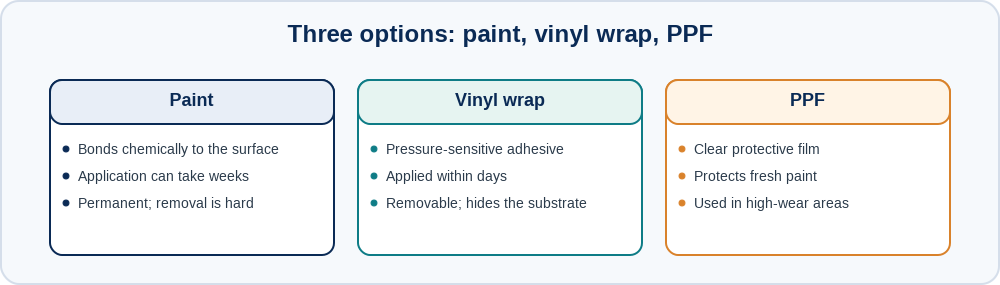
The basic difference is how they hold. Paint bonds chemically to the surface; wrap relies on pressure-sensitive adhesives and needs heat and careful tension during application. This difference determines both application time and removal: paint is permanent and hard to remove; wrap is a removable covering.
A boating magazine says the adhesive layer of the applied film attaches completely to the surface like paint, preventing water from contacting the substrate and helping protect the hull from marine organisms. Another source says the film is installed from the waterline to the rub rail, the edges are sealed and, if needed, bottom paint is applied. These details show that edge sealing and the underwater application are critical.
3. Time and cost#
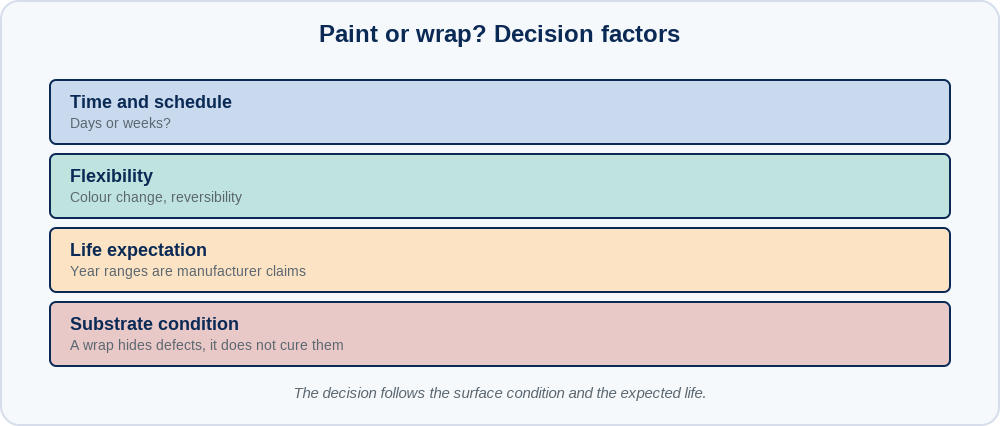
The most cited benefit of wrap is time. A boating magazine says the cost of a wrap is lower because of the shorter job time, that a wrap is not necessarily less expensive than paint but the labour and time are considerably less, and that the job often takes days rather than weeks, meaning less storage and yard cost. A supplier guide says vinyl wrap can cost two-thirds less than a professional spray job. The gap between the two sources shows that cost depends on the surface, the yacht’s size and the region.
The point to note is that “cheap” and “suitable” are not synonyms. One source notes that removal and reapplication are an extra cost and that a wrap not professionally applied can affect warranties.
| Property | Paint | Vinyl wrap | PPF |
|---|---|---|---|
| Adhesion | Chemical bond | Pressure-sensitive adhesive | Clear adhesive film |
| Application time | Usually weeks | Usually days | Days |
| Reversibility | Permanent; removal hard | Removable | Removable |
| Appearance flexibility | Colour options may be limited | Many colours and textures | Protects the existing paint |
| Life (claimed) | 7–10+ years (quality paint) | About 5–10 years (claimed) | Depends on manufacturer and region |
| Effect on substrate | Solves defects by repairing | Hides defects | Depends on paint condition |
4. Life expectations: treat claims with caution#
On life, sources give different ranges. A supplier guide says that with high-grade materials and correct application a yacht wrap typically lasts five to ten years while quality paint can last seven to ten years and more. A yachting magazine says most yacht wrappers use a permanent adhesive that should last seven years, sometimes longer; the same magazine advises taking life claims from manufacturers and wrappers with a healthy pinch of salt. Another source speaks of a four-to-seven-year UV-blocking life in the harsh sun of Florida and the Caribbean.
These ranges show that giving a single number is not right. Life depends on climate, the film, the adhesive, application quality and care. In a purchase decision, ask whether the life claim becomes a written warranty.
5. PPF: the clear protective film#
Paint protection film (PPF) was developed as a clear, hydrophobic, UV-blocking, damage-reducing film to protect a new paint job. One applicator says he has installed PPF on hull sides, transoms, masks and toe rails and also on high-traffic surfaces such as decks and cockpits. In this sense PPF is a complement that “protects new paint”; it is intended not to change colour but to protect the existing surface.
A PPF decision is therefore more a protection-strategy decision than a paint or wrap decision: which areas wear (bow shoulders, stern, around handholds) and which are worth protecting?
6. The substrate: a wrap does not cure defects#
The point most often missed when choosing wrap or PPF is the substrate. The film is applied over the surface; if there are cracks, blisters, moisture or unevenness it can hide them but does not solve them. Preparation steps (inspection, repair, cleaning, drying) are therefore at least as important before a wrap as before paint. One source lists sanding, cleaning and degreasing the surface as preparation steps before wrapping.
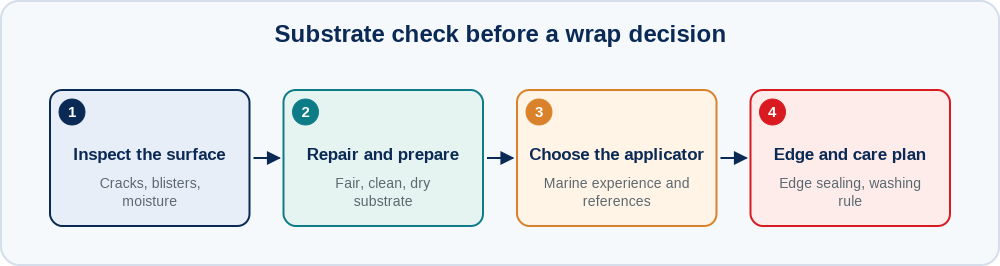
- Inspect the surface: cracks, blisters, moisture and the condition of the old paint.
- Make necessary repairs; bring the surface to a fair, clean and dry state.
- Choose an applicator with marine experience; obtain references and warranty terms in writing.
- Clarify edge sealing, the underwater area and washing rules beforehand.
- Ask about removal terms and their likely cost.
7. Care: no need to polish a wrap, but care is essential#
An industry guide says a vinyl yacht wrap is easy to care for, needs no buffing or polishing and the crew can simply wash it. Even so, a wrap depends on the applicator’s instructions for cleaning methods and products used. Stiff brushes, abrasive products or high-pressure water can lift edges; the care rule should therefore be given to the crew in writing.
8. A short case: three boats, three decisions#
The first boat is a 14-metre motor yacht with sound gelcoat but a faded colour; the owner wants to change colour and to be able to go back after a few years. For this profile a wrap can make sense for speed and reversibility. The second is an old fibreglass yacht with many blisters and a moisture problem in the hull; surface repair is needed first and a wrap would hide the problem rather than solve it. The third is a newly painted superyacht; the owner wants to protect the paint and considers PPF in high-wear areas.
The three boats point to three different answers to the same question. The right decision comes from the condition of the surface, the expected life and the owner’s need for flexibility.
9. Checklist#
10. Common mistakes#
- Thinking wrap is a way to solve surface problems.
- Accepting a life claim without questioning it.
- Looking only at price and not asking about the applicator’s marine experience.
- Skipping edge sealing and the underwater area.
- Not asking about removal terms and cost beforehand.
- Washing a wrap with a stiff brush or high pressure.
11. Conclusion#
Paint, vinyl wrap and PPF are three different answers to the same question. Wrap is fast and reversible; paint is permanent and repairs the surface; PPF is a complement that protects the existing surface. Treat life claims with caution, verify the surface first and take the decision according to expectation.
Frequently asked questions#
Is vinyl wrap cheaper than paint?
Some sources say wrap can be markedly cheaper than a professional spray job; another says wrap is not necessarily cheaper than paint and that the real difference is the shorter job time. Cost depends on the surface and the yacht’s size.
How long does a wrap last?
Sources give ranges of about 5 to 10 years; one magazine says manufacturer and applicator life claims should be taken with caution. The real life depends on climate, the film and the adhesive.
What is the difference between PPF and wrap?
PPF is a clear protective film developed to protect a fresh paint job; wrap is a film covering also used to change colour and appearance.
Does removing a wrap damage the substrate?
A boat owner reports that removal is fairly easy and has no impact on the underlying surface; this depends, however, on surface condition and application. Removal terms should be obtained from the applicator in writing.
Can a wrap go on a damaged or blistered hull?
A wrap hides defects; it does not solve them. If there are blisters, moisture or cracks the surface should first be inspected and repaired.
Was this guide helpful?
Thank you! Your feedback has been saved.
Guide content is for general information; in practice, the current technical data sheet of the product applies.
Keep reading
Related guides
Gelcoat Renewal or Paint? A Technical Comparison
On a GRP boat, should you renew the gelcoat or paint? A technical comparison of durability, adhesion, maintenance and cost.
4 min read Paint and CoatingsColour Stability and UV Resistance in Yacht Paints
A study of the fading caused by sunlight on paint colours, UV resistance and the components that preserve this property.
2 min read Paint and CoatingsAwlgrip in Hot Weather: Fast Drying, Dry Spray and Choosing a Reducer
As temperature rises, solvent leaves quickly, paint pulls fast and the wet edge shortens. This article explains the logic of hot-weather problems, the reducer families the maker separates by temperature band, and their limits.
11 min read