
Refit and Maintenance
Refit Tenting and Climate Control: Temperature, Humidity, Dust
The quality of a coating depends on the air in the room at the moment it is applied. In a refit, the tent is the first technical tool that brings that air under control.
Short answer
Refit tenting and climate control means a closed workspace that holds the temperature, relative humidity and dust level needed for paint, resin and filler to cure correctly. The application windows published by the coating manufacturer set the standard for this environment.
Key points
- Paint and resin cure according to surface temperature and the dew point.
- Paint is not applied unless the surface is at least 3 °C above the dew point.
- Dust leaves permanent defects in a wet film, so dusty work is separated from clean work.
- Environmental readings are recorded before and during every application.
Why a tent is needed#
An outdoor refit means working in an environment where the weather keeps changing. A hull wet with morning dew can overheat by the afternoon, and a thin film of moisture can form on the surface as the evening cools. These changes affect directly how paint or resin cures. A tent does not remove every variable, but it makes the working window predictable.
The second job of the tent is to protect the surface from outside influences. Wind carries dust and loose debris; rain that reaches a freshly opened laminate or a newly brushed primer means the work has to be redone. The third job is safety: solvent vapour accumulates in a closed space, so ventilation has to be designed on purpose.
Reading three variables together#
A single measurement is not enough for paint application. Three values are read together: air temperature, relative humidity and surface temperature. Their relationship decides whether moisture on the surface will condense.
The dew point is the temperature at which water vapour in the air begins to turn into liquid. If the surface temperature falls below this point, a thin layer of water forms on it. When paint is applied over that layer, adhesion weakens and during curing blisters, colour shifts or dull patches appear. A widely accepted working rule is that the surface temperature stays at least 3 °C above the dew point. The exact ranges are given in each product's technical data sheet, and the data sheet always takes precedence.
| Variable | When it is low | When it is high |
|---|---|---|
| Temperature | Curing slows, the film stays soft | Solvent flashes off too fast, dry edges form |
| Relative humidity | Condensation risk, loss of adhesion | Slow drying, flawed film |
| Surface temperature | Dew risk, dull finish | Boiling and blistering, abrupt drying |
| Dust | Permanent defect on the surface | Quick re-contamination after blasting |
Setting up the tent#
The tent frame is set up so that it leaves free air space around the hull. A cover touching the hull creates condensation at that point, so a gap is kept between the cover and the hull for air to circulate. The roof is pitched so that rainwater runs away from the hull. Even when the doors are open, air should move from one side of the tent to the other; otherwise dusty air circulates inside the tent.
The choice of heating is a separate question. Combustion heaters produce moisture and carbon monoxide, and in a closed tent both problems appear together. Electric, controlled heaters used together with a sensor that measures temperature and humidity give more predictable results.
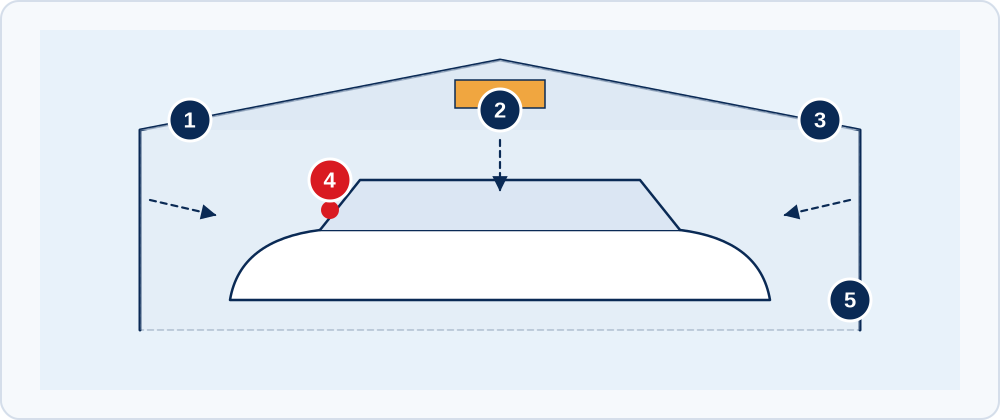
Controlling dust#
Dust is the most deceptive enemy of a refit. It settles on the surface as an almost invisible layer and gets under wet paint and resin. Blasting, sanding and cutting create dust, so dust-producing work is physically separated from primer and topcoat work. Dirty work is done first, dust is removed next, the room is cleaned after that, and only then does clean work begin.
In practice dust control has three steps: vacuuming the surface, wiping it with a damp cloth, and finally, just before application, removing remaining particles with a light air flow. Wiping an oily or silicone-contaminated surface can spread dust rather than remove it, so the cleaning product's data sheet is followed.
Recording measurements#
Environmental measurements are taken before and during every application and recorded. The record contains the date, time, air temperature, relative humidity, surface temperature and the batch number of the product used. If a defect appears later, this record is the only reliable way to find out whether the product, the environment or the application caused it. In a tent without records, nobody can tell which of these is responsible.
Conclusion#
The refit tent is the invisible infrastructure that decides the quality of every coat applied to a surface. Managing temperature, humidity and dust together keeps the conditions defined by the coating manufacturer in place. The environmental conditions described here also apply to the next step, removing old coatings, because the dust and chemicals released during removal must be managed inside the tent as well. The next article explains how old coatings are removed.
Can a refit be done without a tent?
Some small jobs can be done outdoors, but paint and resin work needs a stable environment. Outdoor work has a very narrow and unpredictable application window.
Which instrument is used to measure humidity?
A digital meter that reads air temperature, relative humidity and surface temperature, together with a contact surface thermometer. The calibration date of the instrument is added to the record.
Does the tent need heating overnight?
Heating or humidity control may be needed during hours when the temperature falls to the dew point. The decision is made by reading the measurement records.
Was this guide helpful?
Thank you! Your feedback has been saved.
Guide content is for general information; in practice, the current technical data sheet of the product applies.
Keep reading
Related guides
Tank Inspection, Maintenance and Repair: Holiday Testing, Thickness Measurement and Records
Inspection, thickness measurement, holiday testing, repair approaches and records for steel boat tanks, summarised from source accounts with their limits.
10 min read Refit and MaintenanceGrey Water, Black Water and Shower Tanks: Corrosion, Lining and Design
Why grey, black and shower tanks on steel boats corrode, what an internal lining does and design details, summarised from source accounts.
11 min read Refit and MaintenanceDrinking-Water Tank Epoxy Lining: Selection, Stripe Coat, Cure and Disinfection
Product documents, stripe coat, cure, flushing and disinfection steps in epoxy lining of drinking-water tanks, summarised from source accounts with their limits.
11 min read