
Paint and Coatings
The Fisheye Paint Defect: The Contamination Chain and Prevention
When small round craters appear in fresh paint, the first thought is that the paint is bad. Yet a fisheye is usually the story of the surface or of the surroundings: silicone, oil, wax residue, a dirty cloth or a dirty air line. This article explains the contamination chain and the logic of prevention; it recommends no product, additive, ratio or time. The current data sheet and the maker's technical service remain the authority.
Short answer
A fisheye is where paint pulls back from a contamination point on the surface and leaves a crater-like dimple. It is associated less with the paint or binder system than with silicone, oil, wax, dirty cloths, sanding dust or a contaminated air line reaching the surface or the paint. Silicone holds a special place because very small amounts can cause trouble and it is hard to remove. Prevention means thinking about the source and the route of contamination. This article is general information, not an application instruction; the current data sheet and technical service are the authority.
Key points
- A fisheye is paint pulling back from a contamination point and leaving a crater.
- Silicone, oil, wax, dirty cloths and contaminated air lines are commonly named sources.
- Silicone can cause trouble in very small amounts and is hard to clean away.
- Prevention means considering every link in the contamination chain, not one step.
- This is general information; the current data sheet and technical service are the authority.
1. What is a fisheye and what does it look like?#
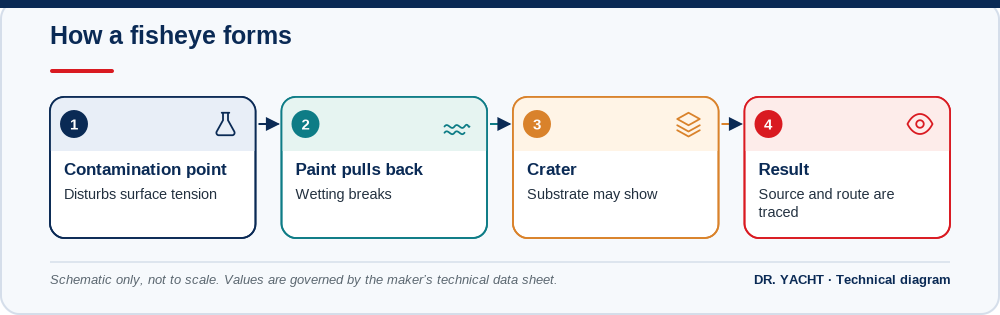
A fisheye is a defect in which fresh paint pulls back to form small round craters in the surface. A technical definition drawn from a coatings dictionary describes the paint crawling into a recognisable pattern of dimples; another account describes a small depression with a mound in the centre. Often the substrate can be seen in the bottom of the crater. These descriptions come from general paint literature and are not a yacht-paint maker's data sheet.
The basic logic of the defect is wetting. Paint wets the surface evenly and flows together. If a contamination point disturbs the surface tension, the paint pulls away from that point and the film cannot be continuous. One technical article explains it with the image of water beading on a waxed car: in organic coatings the film is continuous except in the defect areas. The image is an intuitive aid, not a measurement.
This article is not an application instruction. Its aim is to explain how the defect forms, what links make up the contamination chain and the logic of prevention. No product, additive, ratio, time or grit is suggested, because the right values depend on product version, surface and environment.
2. The contamination chain: source, carrier, surface#
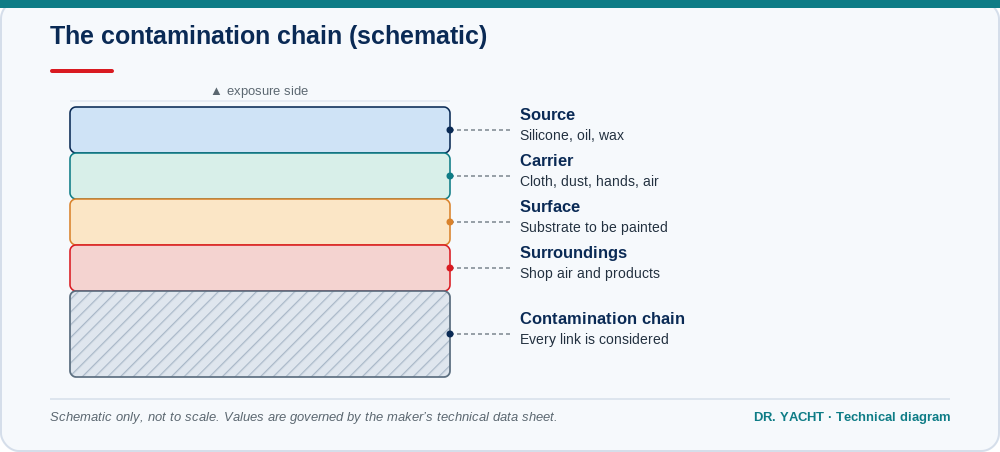
Rather than thinking of a fisheye as a single mistake, it helps to read it as a chain: source, carrier and surface. The source is a substance such as silicone, oil, wax, polish or hand cream. The carrier may be a cloth, a glove, sanding dust, a contaminated air line or vapour in the air. The surface is the substrate on which the paint will be applied. If any link in the chain is broken the defect does not form, but checking every link at once is hard.
Maker guides list the links: spraying over surfaces that contain silicone, contamination of air lines and hoses, and cloths, sanding dust or dirty hands touching the substrate. Another maker's account says small amounts of silicone can come from waxes and polishes, sanding dust, contaminated rags, household cleaning sprays and even cars being polished nearby. These are general paint-industry accounts and, when adapted to a boat, the maker's data sheet should be the basis.
The boat environment has its own sources too: earlier polish and wax layers on the hull, gelcoat repair products, mould release agents and spray products used in the shop. This article blames no particular product; it only reminds the reader that sources can be broad. The route of contamination should be thought of like a leak: where did it enter, what carried it, where did it settle?
3. Why does silicone hold a special place?#
In accounts silicone stands out as the most troublesome cause of fisheyes. One account says silicone contamination can cause trouble even in very small amounts and that removing it takes special care. Another says many modern polishes and waxes contain silicone, that it adheres strongly to the film and that extra effort is needed to remove it. These are general industry accounts; for a boat, product-by-product verification is needed.
The routes by which silicone spreads can be surprising. One forum account tells how silicone from furniture polish used in office cleaning at a plant spread through the air-handling system to the paint area and spoiled many paint jobs. The same account adds that the defect looked very like fisheyes but had a different cause. It is a forum anecdote: not general proof, but a reminder that silicone can arrive by an unexpected route.
Another technical article notes that beauty and care products such as hand cream can also contain silicone and recommends keeping them off the work floor. That too shows the contamination chain is not limited to "paint products". Personal products, shop spray products and neighbouring jobs can all be links in the chain.
| Array | Array | Array | Array |
|---|
4. Prevention logic: not one step but every link#
In makers' guides prevention is usually gathered under these headings: wearing clean gloves when touching the substrate, cleaning the surface thoroughly with suitable cleaners, using clean disposable cloths, and servicing air filters and compressors regularly. One guide also mentions an anti-fisheye additive as a last resort. That is an automotive paint maker's guide; for boat products the data sheet should be the basis.
Another maker guide describes degreasing the surface thoroughly before and after sanding and choosing cleaning materials that will not contaminate. One forum account says the surface should be wiped with remover before work and that certain lubricant spray products should not be used in the shop. These are accounts of experience and may not suit every environment.
Another side of prevention is workflow: separating risky jobs (polishing, using mould release, maintenance with silicone products) from the painting area and time. This article imposes no workflow; it only reminds the reader that the chain must be sought in the shop layout as well as on the surface.
5. Additives and correction: a limited and disputed area#
Some maker guides mention an anti-fisheye additive and describe an extra coat helping paint flow over the dimples, or sanding the affected area after the paint has cured and repainting. These accounts come from automotive guides and are not verified for boat paints. This article recommends no additive, ratio or correction method.
Forum accounts hold differing views about additives: one says a small amount helps prevent the defect, another argues that where the cause is not silicone the preventer can make it worse. These are personal experiences and cannot be generalised. Compatibility of an additive with the product system must be verified on the data sheet and with technical service.
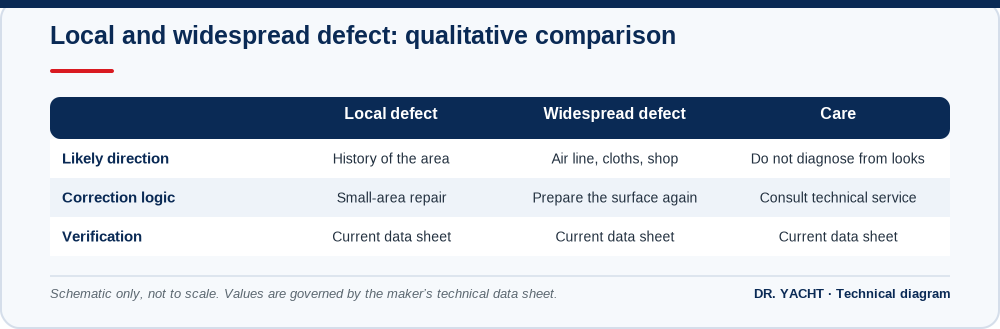
On correction the general logic is this: if the defect is small, some accounts describe filling by brush after cure and sanding; if it is widespread the surface may need to be prepared again. Which is suitable depends on product, area and expectation. This article recommends no method; consulting technical service is general good practice.
A small scenario: how the contamination chain is traced#
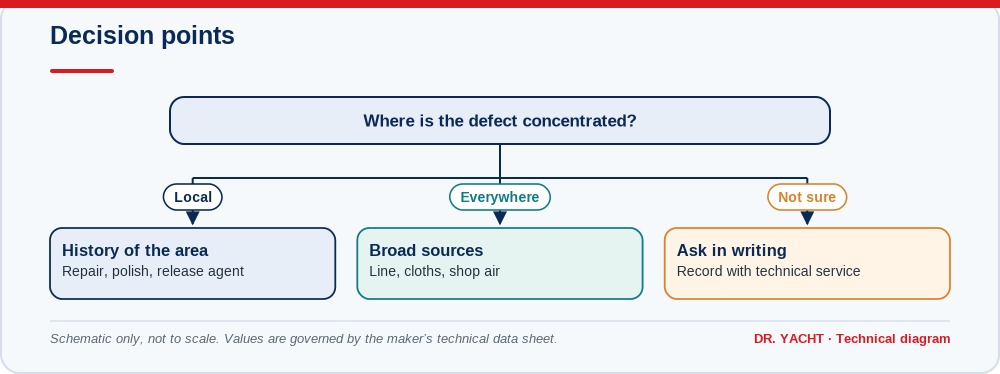
Suppose scattered craters appear in a fresh coat. The first question is where the defect concentrates: only in certain areas or over the whole surface? If it is concentrated in certain areas, the history of those areas (earlier repair, polish, mould release) is examined. If it is everywhere, broad sources such as the air line, cloths or shop air are considered. This is reasoning, not diagnosis.
The second step is to list the possible links in the chain: source, carrier, surface. The third is to test the assumption with a small trial. None of these steps recommends a product or ratio; for every point left uncertain the current data sheet and technical service are the authority. Keeping a record also helps prevent the same defect from recurring.
6. Common misreadings#
The first misreading is to blame a fisheye on poor paint quality; accounts mostly point to contamination of the surface and surroundings. The second is to think an additive is the solution in every case. The third is to clean only the surface and forget the air line and cloths. The fourth is to assume silicone is absent because it cannot be seen.
The fifth is to carry automotive paint guide methods straight over to boat paint. The sixth is to put a forum anecdote in place of a maker's data sheet. The seventh is to neglect safety: breathing protection, gloves and ventilation against cleaning solvents and paint vapour are general good practice.
| Array | Array | Array | Array |
|---|

7. Records and later maintenance#
When a defect appears, keeping a record (which area, which conditions, which product, which equipment) helps both the correction decision and later jobs. Defects that recur in the same shop often point to a shared source. A record makes that pattern easier to see.
Finally, defects that look like fisheyes may have different causes. One forum account says a silicone-related defect looks very like a fisheye but has a different cause. So rather than diagnosing from appearance alone, it is healthier to examine the process and surroundings and, when uncertain, to approach technical service.
Frequently asked questions#
What is a fisheye?
It is where fresh paint pulls back from a contamination point on the surface and leaves small crater-like dimples. It is generally associated with silicone, oil or similar contamination.
What is the most common cause?
In maker and guide accounts surface contamination, especially silicone, appears as the most common cause. Wax, polish, oil, dirty cloths and contaminated air lines are also named.
Why is silicone so troublesome?
According to accounts, very small amounts can cause problems, it adheres strongly to the film and is hard to clean. It can also travel via sanding dust, cloths or products sprayed at a distance.
Are anti-fisheye additives used?
Some maker guides mention such additives; some forum accounts say that in some cases they can make the problem worse. The product data sheet and technical service govern use; this article recommends no additive or ratio.
Is this article an application instruction?
No. It is a general guide to understanding and recommends no product, additive, ratio or time. The current data sheet and technical service are the authority.
Was this guide helpful?
Thank you! Your feedback has been saved.
Guide content is for general information; in practice, the current technical data sheet of the product applies.
Keep reading
Related guides
How to Read the Awlgrip Topcoat Technical Data Sheet: Solids, Dry Film, Cure Time
A data sheet is not a recipe card; it is a reference written for specific conditions. This article explains how to read the solids, dry film, wet film, coverage and cure lines, and where their limits lie.
13 min read Paint and CoatingsWet Edge and Speed in the Roll-and-Tip Method: The Logic Behind a Professional Finish
In roll-and-tip the result is often decided less by the product than by keeping the wet edge. This article explains how the edge line forms, what speed and division of work change, and where sources disagree.
13 min read Paint and CoatingsAwlgrip in Hot Weather: Fast Drying, Dry Spray and Choosing a Reducer
As temperature rises, solvent leaves quickly, paint pulls fast and the wet edge shortens. This article explains the logic of hot-weather problems, the reducer families the maker separates by temperature band, and their limits.
11 min read