
Refit and Maintenance
Cathodic Protection: Zinc Anodes, Current and Control
In seawater, metal needs an electric current to protect itself. Cathodic protection supplies that current in a controlled way, keeping the hull and metal fittings away from corrosion.
Short answer
Cathodic protection is a system that uses an anode, usually zinc or aluminium, connected to the hull and metal parts, providing a controlled current that stops corrosion. The system is confirmed by potential readings taken with a reference electrode and recorded.
Key points
- The zinc anode corrodes first, sacrificing itself to protect the metal hull.
- Current and potential measurement shows whether protection is sufficient.
- Areas where paint has peeled or worn need more protection.
- Regular checking and renewal of anodes determines the life of the system.
Why protection is needed#
Seawater is a liquid with high electrical conductivity. When there is a small potential difference between a metal hull and a metal part, a current flows through the seawater and the more active metal dissolves. This is called galvanic corrosion. The propeller, stern tube, rudder stock and underwater fittings are constantly exposed to this kind of corrosion. Cathodic protection is installed to manage the process.
The sacrificial anode system#
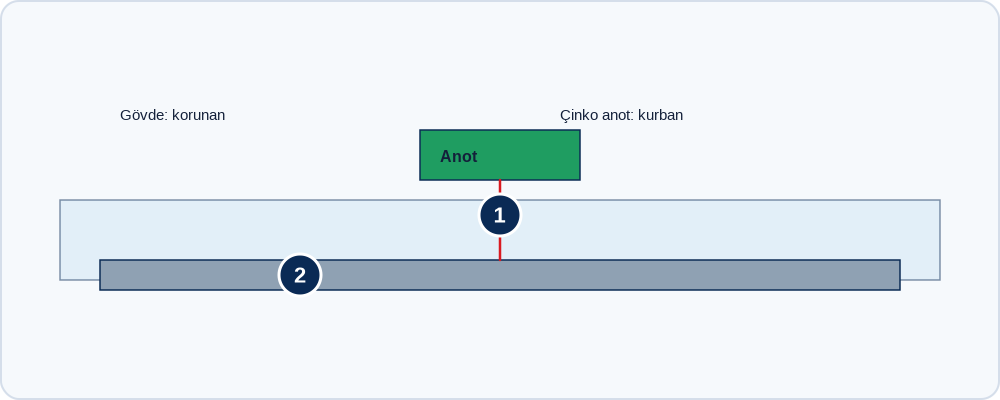
In the sacrificial anode system, a piece of zinc or aluminium attached to the hull corrodes first because it is more active. While it does, the protected metal stays free of corrosion. The anode gradually wears away and is renewed at intervals. The size and number of anodes are chosen according to the boat's size, its underwater surface area and the conductivity of the seawater.
| Component | Function | Check |
|---|---|---|
| Zinc anode | Protects the hull by sacrificing itself | Wear and surface condition |
| Bonding cable | Conductively connects the anode to the hull | Breaks and looseness |
| Reference electrode | Provides potential measurement | Calibration and contact |
| Metal fitting | The protected surface | Paint and insulation condition |
Current and potential measurement#
Whether cathodic protection is adequate is found by measuring potential. A reference electrode is placed in the water and the voltage between it and the hull or protected fitting is read with a meter. The reading is compared with the acceptable range for the material. If it is not negative enough, protection is insufficient; if it is more negative than the range, the hull is over-protected, which can damage paint and, on aluminium, the metal itself. Readings are taken at different points at regular intervals.
Checking and renewal during the refit#
During a refit the existing anodes are removed and their weight is measured. Anodes that have worn away are replaced. Bonding cables are checked for looseness and breaks. Connection points on the hull are cleaned and contact resistance is checked. New anodes are fitted in the same position as the old ones or in a calculated position.
Measurement records#
For each measurement point the date, value and anode condition are recorded. These records help plan when anodes should be replaced. Measurement records are added to the boat's refit file.
Points to watch#
A cathodic protection system solves only the problem of metal corrosion; it does not make up for a lack of paint or insulation. In addition, all metal parts connected to the protection system must be electrically bonded correctly. Otherwise some parts are protected while others are not.
Choosing the anode material#
Sacrificial anodes are made of different materials, and the choice depends on the water the boat lives in. Zinc has long been the standard in seawater. Aluminium alloy anodes work well in seawater and in brackish water and can last longer for the same weight. Magnesium anodes are for fresh water only; in seawater they waste away very quickly and can push the hull into over-protection, damaging paint.
If the boat will spend a season in different waters, such as river and sea, the anode type is chosen for that use. The wrong material either does not work or wears away much faster than expected.
Where anodes go#
Anodes are placed near the metal parts they protect and electrically connected to them. There may be separate anodes on the shaft, the propeller hub, the hull, trim tabs, the bow thruster and, on sailing boats, the saildrive. Each anode has a limited reach and may not protect a distant part, so the number and position of anodes follow the layout of the underwater metals.
The bonding system#
The arrangement that connects the underwater metals to one another and to the anode with cable is called the bonding system. It keeps all the metals at the same potential so the anode protects them all. Bonding cables are terminated with corrosion-resistant terminals and the resistance of each connection is measured. A broken or corroded connection leaves that part unprotected.
When to replace#
Anodes are replaced before they are fully consumed; a common practice is replacing them at about half their original size, after which their protective capacity falls quickly. When fitting a new anode, the contact surface is cleaned to bright metal, because paint, dirt or corrosion between anode and surface breaks the electrical contact. Anodes are never painted; they are masked during antifouling or fitted afterwards.
Signs of stray current#
Anodes wearing away unexpectedly fast within a season usually point to stray current, which can come from a fault in the boat's own system or from elsewhere in the marina. On board, it is traced by switching off consumers one by one while watching hull potential. Marina effects are limited by a galvanic isolator or isolation transformer on the shore connection.
How often are anodes replaced?
They are usually checked at every haul-out and replaced at about half their original size. The rate depends on the boat's environment.
What does it mean if an anode does not wear at all?
The connection may be broken, the anode painted or the material wrong. Protection may not be working and needs checking.
Conclusion#
Cathodic protection is a system that protects the metal parts of a boat quietly and out of sight. When the condition of the zinc anodes and the current and potential readings are monitored together, protection becomes continuous and reliable. The next article turns to the refit of sailing yachts, covering the mast, rigging and sail hardware.
Was this guide helpful?
Thank you! Your feedback has been saved.
Guide content is for general information; in practice, the current technical data sheet of the product applies.
Keep reading
Related guides
Steel Hull Refit: Thickness Gauging, Plate Renewal and Corrosion Protection
How is plate thickness measured on a steel boat, when is plate renewed and how is corrosion prevented? Principles of gauging, welding and coating.
7 min read Refit and MaintenanceAluminium Hull Refit: Galvanic Corrosion and Compatible Coating Systems
Why an aluminium boat corrodes differently, how galvanic corrosion is prevented and which coating system is compatible. Insulation and paint selection.
6 min read Refit and MaintenanceFilling and Fairing: Rebuilding the Hull Form
How is a hull surface corrected with filler and fairing compound? Filler selection, straightedge checks and coat thickness principles.
6 min read