
Refit and Maintenance
Primer Systems: Function and Sequence of Epoxy Primer Coats
The primer is the most important layer beneath the paint. Though invisible, it determines adhesion, the barrier and the long life of the surface.
Short answer
A primer system is a set of layers applied in a defined order that bond to the surface, block the passage of water and chemicals, and link to the upper coats. The type of each coat and its cure time are chosen according to the manufacturer's system.
Key points
- Epoxy primer forms the strongest bond to the surface and acts as a barrier.
- Coats are applied before the previous one fully cures or within the time stated by the manufacturer.
- The primer system must fully cure before the topcoat.
- Dry film thickness is measured separately for each coat.
Why a primer is needed#
A primer is the layer that bridges the surface and the paint. Bare laminate or metal struggles to bond directly with paint; the primer makes that bond possible. It also forms a barrier that stops water and moisture from passing through. Paint applied without a primer will eventually blister and lift from the surface.
The function of epoxy primer#
Epoxy primer forms the strongest bond to the surface. It gives high adhesion to laminate, metal and previously painted surfaces. Its dense structure makes it harder for water to reach the substrate. For this reason it is usually the first primer coat on a hull.
Epoxy primer has a limit: it is not resistant to UV light and becomes brittle if left exposed to the outdoors for long. That is why epoxy primer is protected by an upper coat.
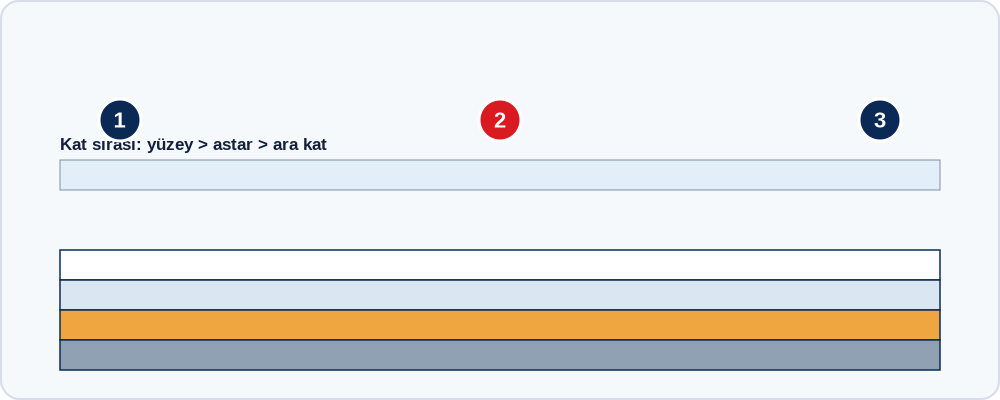
| Order | Layer | Function |
|---|---|---|
| 1 | Epoxy primer | Bond to surface and water barrier |
| 2 | Build primer | Thickness and smoothness |
| 3 | Surfacer | Preparation for final sanding and colour check |
| 4 | Topcoat | Colour, gloss and UV resistance |
Coat sequence and cure time#
Coats are applied one over another within the cure window stated by the manufacturer. If a coat is applied before the previous one has fully cured, the bond between them weakens. A coat applied too late bonds poorly if the previous surface has hardened too much. For this reason the “recoat” or ”sanding” window is taken from the data sheet and recorded for each coat.
Dry film thickness#
The dry film thickness of each coat must be measured. A very thin coat cannot perform its barrier function; a very thick coat cracks or sags as it cures. Measurement is done within the range the manufacturer recommends and recorded. The total thickness must reach the value the system is designed for.
Checks and records#
Before the primer is applied, the surface is checked: it must be clean, dry and free of dust. During application, ambient temperature, humidity and surface temperature are recorded. After each coat the cure time is tracked. At the end of the sequence the dry film thickness is measured and the result recorded.
Types of primer#
There is no single primer in yacht refit; each is developed for a particular task. Epoxy primers are the main layers that form a barrier against corrosion and water, and they are used on both metal and fibreglass. On metal, some systems use a dedicated adhesion primer as the first coat. High-build primers with a high solids content help fill small surface defects and give an even base after sanding. Tie coats link two systems of different chemistry, for example when antifouling goes over an epoxy barrier.
Which primers are used in which order depends on the substrate, the boat's service conditions and the topcoat system. The decision rests on the coating manufacturer's system definition.
The overcoating window#
Every epoxy primer has a window within which the next coat can be applied. A coat applied within that window bonds chemically with the one beneath. Once the window has passed, the lower coat has fully hardened and the new coat can bond only mechanically, so the lower coat must be sanded. The window changes with temperature: it shortens in heat and lengthens in cold.
Primer coats are therefore placed in the schedule with conditions and team planning in mind. Breaks such as weekends or holidays can push a coat past its window. When that happens, the surface is sanded and the event is recorded.
Tracking coats by colour#
When several primer coats are applied, successive coats are chosen in different colours so they are not confused. The applicator can see which area has received which coat. In later sanding, the lower colour showing through also warns that a coat has been sanded too thin.
Common mistakes#
The first mistake is mixing products from different manufacturers in one system. Each manufacturer tests its products for compatibility with each other; mixing systems can cause unexpected adhesion problems and void the warranty.
The second is applying a mix at the end of its pot life. A mix near the end of its pot life thickens, wets the surface poorly and bonds weakly. Mixes are prepared in small batches to suit the pot life.
The third is judging the thinner ratio by eye. Over-thinned primer needs more coats to reach the required film thickness and is more likely to sag.
How many primer coats are needed?
The number is set by the total dry film thickness the system targets and the thickness each coat achieves. The measurement matters more than the count.
How long can a primer coat stay exposed?
Within the maximum overcoating interval stated by the manufacturer. Beyond that, the surface is sanded and cleaned.
Conclusion#
The primer system is the invisible layer that does the most work. When the right epoxy primer, coat sequence and cure time work together, the surface beneath the paint is protected for many years. The next article covers the topcoat that sits on this primer: polyurethane systems and spray application.
Was this guide helpful?
Thank you! Your feedback has been saved.
Guide content is for general information; in practice, the current technical data sheet of the product applies.
Keep reading
Related guides
Tank Inspection, Maintenance and Repair: Holiday Testing, Thickness Measurement and Records
Inspection, thickness measurement, holiday testing, repair approaches and records for steel boat tanks, summarised from source accounts with their limits.
10 min read Refit and MaintenanceGrey Water, Black Water and Shower Tanks: Corrosion, Lining and Design
Why grey, black and shower tanks on steel boats corrode, what an internal lining does and design details, summarised from source accounts.
11 min read Refit and MaintenanceDrinking-Water Tank Epoxy Lining: Selection, Stripe Coat, Cure and Disinfection
Product documents, stripe coat, cure, flushing and disinfection steps in epoxy lining of drinking-water tanks, summarised from source accounts with their limits.
11 min read