
Refit and Maintenance
Topcoat: Polyurethane Systems, Spray Application and Film Thickness
The topcoat is the visible face of the hull. Colour, gloss and UV resistance are decided in this layer, and the soundness of every coat beneath depends on it.
Short answer
A topcoat is the upper layer that gives colour and durability, applied from a polyurethane based system with suitable equipment at the thickness set by the manufacturer. For spray application, pressure, distance and number of coats follow the product data sheet.
Key points
- A polyurethane topcoat gives UV and mechanical resistance and gloss.
- In spray application, pressure and distance decide a uniform film.
- Film thickness is measured for each coat to check the total value.
- Ambient humidity and temperature directly affect the cure of the topcoat.
The job of the topcoat#
The topcoat is the most visible and most exposed layer of the boat. Besides colour and gloss, it protects against sunlight, salt water and mechanical impacts. The primer and filler beneath are protected by the topcoat from outside influences. The quality of the topcoat directly determines how many years the paint will last.
Polyurethane systems#
Polyurethane based topcoats are the common choice for boat paint. They resist UV light strongly, keep their colour and gloss for a long time and resist abrasion. In a two-component system, the paint is mixed with the hardener and applied within a set pot life. After that time the mix cannot be used.
| Property | Effect | Point to watch |
|---|---|---|
| UV resistance | Keeps colour and gloss | Number of coats recommended by the manufacturer |
| Gloss | Visual quality | Surface preparation and ambient humidity |
| Hardness | Abrasion resistance | Cure time |
| Pot life | Working life of the mix | Apply the mix before the time runs out |
Spray application#
Spraying is the common method for the most even finish of the topcoat. Pressure is kept within the range stated in the product data sheet: too high a pressure atomises the paint and creates a dust cloud, while too low a pressure prevents even distribution. Gun distance and travel speed determine the wet appearance of each coat. Each pass overlaps the edge of the previous one slightly.
In spray application, wind and ambient humidity are critical. Wind can deflect the paint and gritty particles can settle on the surface. High humidity slows the cure and reduces gloss. For this reason application is carried out inside a tent under controlled conditions.
Film thickness#
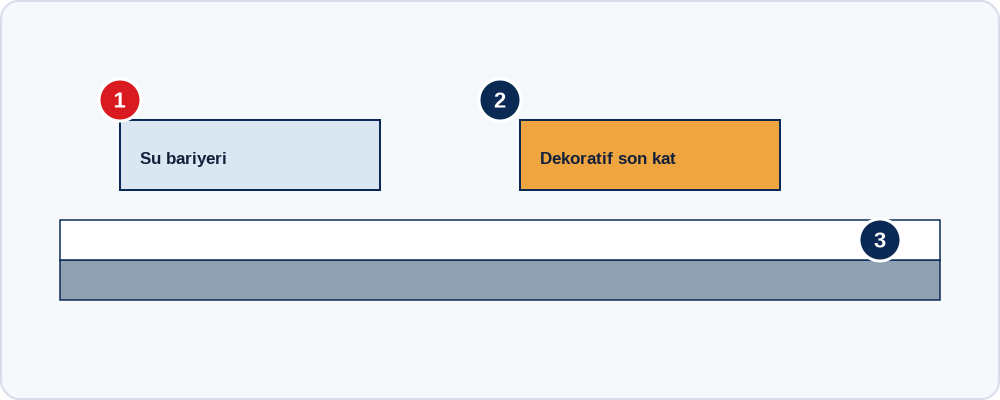
The dry film thickness of the topcoat must fall within the range stated in the product data sheet. A very thin topcoat cannot give UV protection; a very thick coat cracks or sags during cure. Measurement is taken once each coat has dried and the total thickness is recorded. If film thickness varies across different areas of the hull, application is corrected in those areas.
Conditions and records#
During topcoat application, ambient temperature, relative humidity and surface temperature are recorded continuously. The batch number of the mix, the time of mixing and the times of application are also added to the record. These records are the main data for finding which conditions were responsible if a problem appears in the topcoat.
Colour choice and heat#
The colour of a topcoat is not only an aesthetic decision. Dark colours absorb far more sunlight, and the surface becomes markedly hotter than a light colour. That heat makes the laminate and filler layers beneath expand. Cycles of heating and cooling can, over time, cause filled areas to show through the surface and print-through to become visible on dark topsides. When a dark colour is chosen, the heat resistance of the underlying system is assessed as well.
Colour also affects maintenance and repair. Some colours and metallic shades make colour matching difficult in local repairs. When choosing the colour, how future touch-ups will be done is considered and the colour code is recorded.
Application methods#
Spraying is the most common method for an even, glossy surface, but not the only one. Roll and tip, done by a team of two, gives good results: one person rolls on a thin coat, the other immediately tips it off with a brush to level it and remove roller marks. The method is used where spraying is not possible or on small areas.
Whichever method is chosen, the paint is used with the thinning ratio and conditions the manufacturer gives for that method.
Common surface defects#
Orange peel comes from paint not flowing out on the surface. Wrong thinning, unsuitable gun settings or a surface that is too hot can cause it.
Sags appear when a coat is too thick or the paint is over-thinned. On vertical surfaces coats are kept thin and checked with a gauge.
Cratering occurs when oil, silicone or another contaminant on the surface makes the paint pull away from those points. Wiping the surface with a suitable cleaner before application prevents it.
Solvent popping happens when solvent trapped beneath a skinned surface tries to escape. Ignoring overcoating times and applying coats too thick are the main causes.
Safety#
Two-pack polyurethane hardeners contain substances that are harmful if inhaled. The mist formed during spraying must not be breathed without suitable protection. Applicators use air-fed respiratory protection, eye protection and protective clothing, and the area is ventilated and closed to others during application.
How long does a polyurethane topcoat last?
It depends on application quality, colour, sun exposure and care. With regular maintenance a good appearance can be kept for many years.
Can local damage be repaired?
Yes, but colour and gloss matching need care. Repairs are usually taken to a panel edge or natural boundary so the transition is less visible.
Conclusion#
The topcoat is the face of the boat, but its success depends on the accuracy of every coat beneath it. When the right polyurethane system, controlled spray application and measured film thickness work together, colour and gloss are kept for years. The next article looks at the underwater part of the boat: antifouling selection and the coating plan.
Was this guide helpful?
Thank you! Your feedback has been saved.
Guide content is for general information; in practice, the current technical data sheet of the product applies.
Keep reading
Related guides
Varnish and Lacquer Work: Coat Count, Intercoat Sanding and UV Resistance
How are varnish and lacquer applied to wooden surfaces on a boat? The principles of coat count, intercoat sanding and UV resistance.
6 min read Refit and MaintenanceTank Inspection, Maintenance and Repair: Holiday Testing, Thickness Measurement and Records
Inspection, thickness measurement, holiday testing, repair approaches and records for steel boat tanks, summarised from source accounts with their limits.
10 min read Refit and MaintenanceGrey Water, Black Water and Shower Tanks: Corrosion, Lining and Design
Why grey, black and shower tanks on steel boats corrode, what an internal lining does and design details, summarised from source accounts.
11 min read