
Hull Repair
Removal Scope for Damaged Gelcoat and Laminate in Osmosis Repair
This study examines how much damaged gelcoat and laminate should be removed in osmosis repair. It argues that the removal scope should rest on the damage map and the condition of the laminate, and that both excessive and insufficient removal weaken the repair.
Short answer
The removal scope is set by considering together the damage map, the depth of deterioration seen in section, and the margin needed to reach sound laminate. Removal should end on sound laminate, and the margin should be recorded.
Key points
- Removal is planned according to the damage map.
- Removal depth extends to where deterioration ends in section.
- A margin is left to reach sound laminate.
- Both excessive and insufficient removal weaken the repair.
Abstract#
This study examines how the removal scope for damaged gelcoat and laminate in osmosis repair should be determined. It argues that removal depth and margin should rest on the damage map and section observation. Both excessive and insufficient removal reduce the durability of the repair.
Keywords: removal scope, osmosis repair, gelcoat removal, margin, laminate removal.
1. Introduction#
One of the most critical decisions in osmosis repair is what to remove and what to leave. Removing too little leaves deteriorated laminate beneath; removing too much causes unnecessary material loss and structural weakening. The question here is by what criteria the removal scope should be set.
2. Theoretical framework#
Osmotic deterioration does not end sharply at the edge of visible damage; there is a transition zone. The removal boundary must therefore extend somewhat beyond the visible damage. This extension is called the margin.
3. Method#
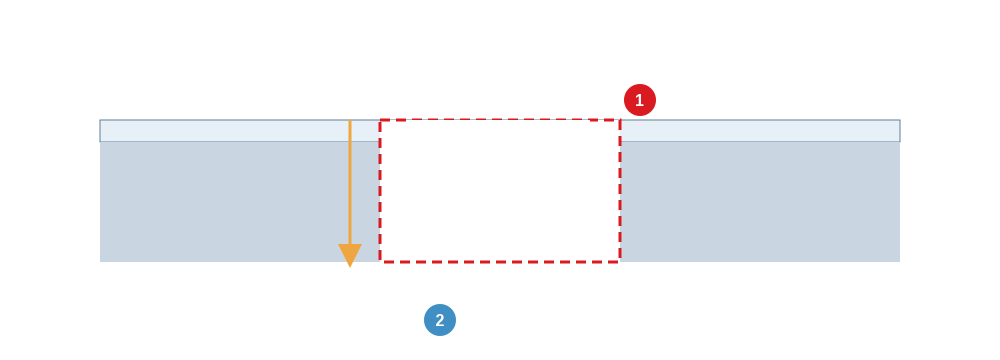
The removal scope was determined by examining the damaged area in section. Figure 1 presents the section representation of removal depth and margin.
4. Findings#
| Removal decision | Determining criterion | Outcome |
|---|---|---|
| Superficial removal | Deterioration limited to gelcoat | Gelcoat removed and recoated |
| Deep removal | Deterioration extends into laminate | Stepwise removal and rebuild of laminate |
| Margin | Covering the transition zone | Clean bond to sound laminate |
| Excessive removal | Removal of sound laminate | Structural weakening and extra work |
5. Discussion#
The findings show that the removal scope should be determined by the boundary of deterioration observed in section, not by visible damage alone. Leaving a margin ensures that the repair material bonds well to the sound laminate.
6. Conclusion#
In osmosis repair, the removal scope is a decision based on the damage map and section observation. The correct depth and margin together determine both the durability of the repair and the avoidance of unnecessary expansion of removal.
Was this guide helpful?
Thank you! Your feedback has been saved.
Guide content is for general information; in practice, the current technical data sheet of the product applies.
Keep reading
Related guides
Salt Residue and Dulling of the Hull: Causes, Cleaning and Prevention
Salt residue holds moisture and minerals against the surface and speeds UV and abrasion damage. We explain what white marks are, how to clean them and how to prevent them.
7 min read Hull RepairBoat Washing Routine: How, How Often and in What Order
Regular, correct washing is the cheapest way to protect gelcoat and paint. Cut scratch and stain risk with a pre-rinse, two buckets, the right soap and drying.
8 min read Hull RepairNano Coating and Boat Protection: What It Promises and How to Judge It
Nano coating products promise hard, water-repellent, long-lasting protection for a boat. Most claims are maker claims; sources say preparation and upkeep decide the result.
8 min read