
Underwater
Underwater Hull Cleaning: Diver, Robot and Shore-Washing Methods
When a hull starts to foul, the first question is "how do I clean it". The real questions are wider: does it damage the coating, do biocide and organisms enter the water, and do local rules allow it? This article explains the logic of diver, robot and shore-washing methods and the benefits and risks that sources describe, in general terms. It recommends no method, time or product; the current data sheet, local rules and technical service remain the authority.
Short answer
Hull cleaning means removing biofilm and fouling by mechanical means (brushes, water jets, hand scraping) and can be done in the water or ashore. Official and academic sources describe in-water cleaning as cheap and practical but able to damage coatings, able to release biocide and organisms into the water and restricted in some harbours. The suitability of a method depends on coating type, fouling level and local rules. This article is general information, not an application instruction.
Key points
- Hulls can be cleaned by hand, by diver, by robot or ashore; each method has different benefits and risks.
- According to sources in-water cleaning can be practical and cheap, but can damage coatings and carries a risk of releasing biocide and organisms.
- Biocidal and biocide-free coatings may call for different cleaning logic.
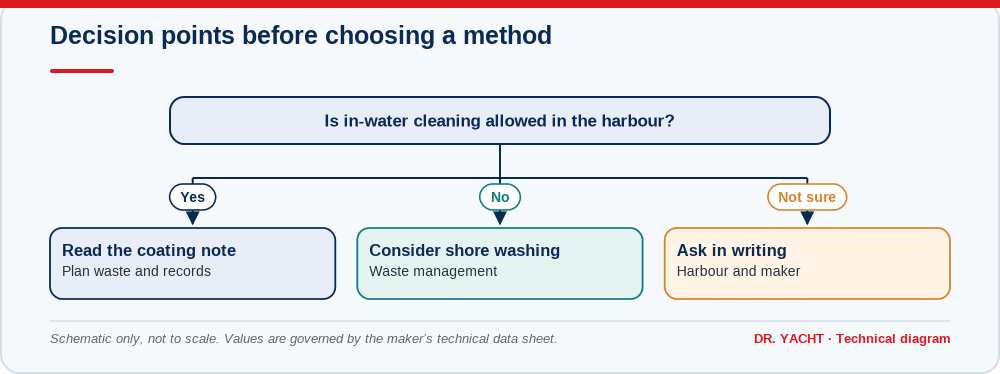
- Some harbours do not allow diver cleaning; local rules are the authority.
- This is general information; the data sheet, local rules and technical service are the authority.
1. Why hull cleaning is not a single question#
At first sight hull cleaning looks like a simple maintenance job: a dirty hull gets cleaned. But cleaning a hull has different consequences. What does cleaning do to the coating, what does the fouling carry into the water, which rules apply and how does protection continue after cleaning? So rather than sorting methods into "good" or "bad", it is healthier to read the logic, benefit and limit of each.
Official and academic sources describe in-water cleaning as removing biofilm and fouling from the hull by mechanical methods such as brushes or water jets. This can be done in advance as part of a biofouling management plan or afterwards to remove existing fouling. These definitions are mostly written for ships; when adapting them to yacht scale, the coating data sheet and local rules should be the basis.
This article is not an application instruction. Its aim is to teach how to read the logic of the method families and the benefits and risks sources describe. No method, time, tool or product is suggested, because the right choice depends on coating, fouling level, region and local rules.
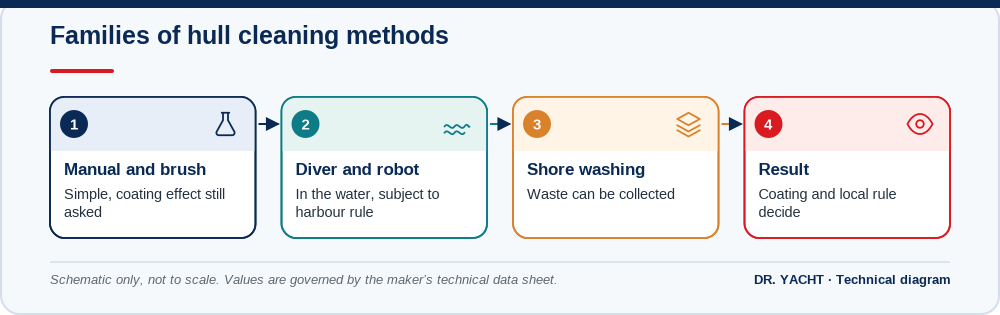
2. Manual and diver cleaning#
A New Zealand government document divides in-water cleaning methods into categories, among them manual technologies: picking off organisms by hand and hand cleaning with non-powered brushes, scrapers and scouring pads. These look simplest but are still assessed for their effect on the coating and for the release of removed particles into the water. The document says all categories of in-water cleaning have the potential to damage antifouling coatings; the degree varies with method and coating.
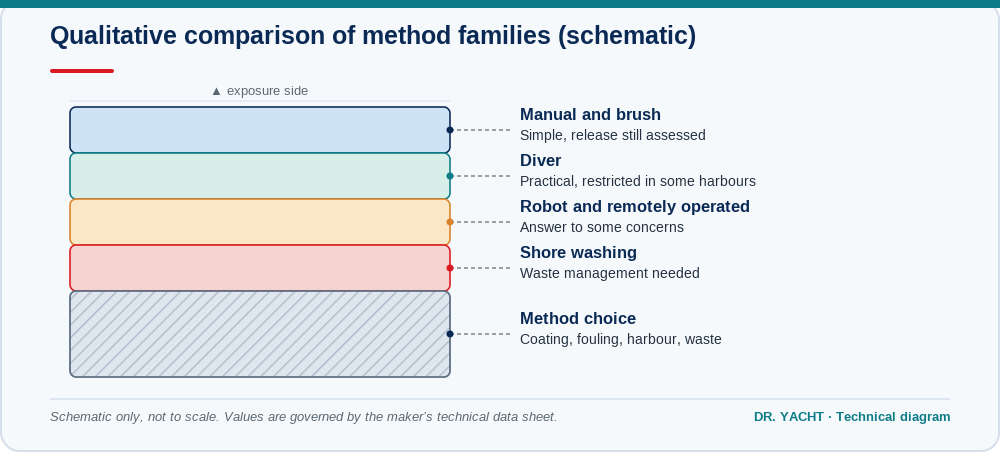
Diver cleaning is described in sources as cleaning the hull in the water by hand or with powered tools. A patent text says some ports do not allow diver cleaning because the removed organisms are released and may become invasive species. That is the background account of a technical document, but it shows why local rules can differ. For a yacht owner the key point is to learn the harbour's rule in advance.
The benefit of diver cleaning is practicality: it can be done without hauling the boat out. An Australian-New Zealand review says in-water cleaning can be much cheaper than hauling out and cleaning, because direct and indirect costs differ. The same review notes that some systems cannot reach recesses and protrusions. These are assessments written for ship scale and should be verified for a yacht.
3. Robots and remotely operated systems#
An academic review says in-water cleaning can be carried out by divers, remotely operated or cart-type systems such as submersible cleaning and maintenance platforms. A patent text says robotic cleaning devices were recently developed for places where diver cleaning is not allowed. That shows robots are described not only as a convenience but also as an answer to some concerns.
An academic study says in-water cleaning earlier did not adequately address water quality and biosecurity risks, but that newer approaches, such as systems that capture the cleaning waste, aim to reduce those risks. The study also separates proactive and reactive cleaning: light cleaning before fouling develops and cleaning established fouling afterwards can have different consequences. That is an academic framework, not a direct rule for yacht scale.
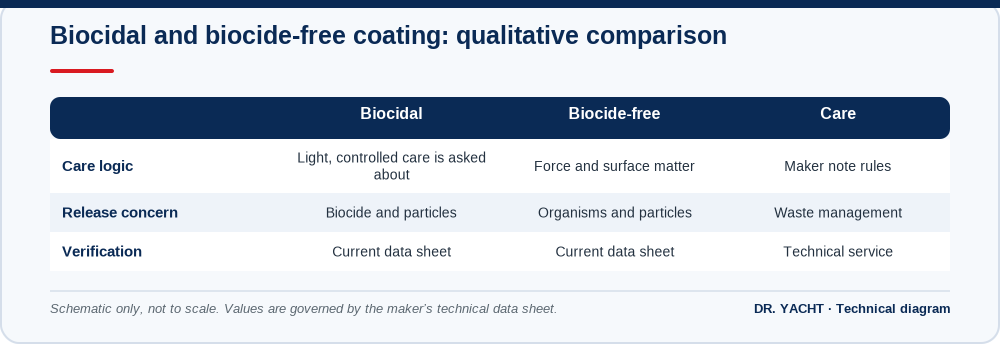
The fit of robots with the coating is a separate question. One publication says biocidal coatings and biocide-free (for example foul-release) coatings call for different care logic, with a light grooming approach suiting one and sufficient force to dislodge fouling mattering for the other. It is a reminder against the assumption that one robot suits everyone.
| Array | Array | Array | Array |
|---|
4. Effect on the coating and biocide release#
An Australian government document says in-water cleaning of hulls carrying biocidal antifouling paint can cause large releases of biocide to the marine environment. The same document has separate sections on assessing contaminants released during in-water cleaning and on the suitability of a coating for cleaning. A US environmental agency document says that underwater hull cleaning with currently available methods can release both toxic chemicals and aquatic invasive species into receiving waters and that copper is the most commonly used biocide.
These accounts show the logic that cleaning can wear the coating and that worn material can enter the water. For coatings renewed every year or two, how suitable light, controlled maintenance is depends on the coating type. Makers' care notes differ for hard-matrix, eroding or biocide-free coatings; those notes must be read from the data sheet.
This article gives no release quantity or safe limit, because such values depend on coating, method and environment. The competent authorities and maker documents are the authority. Regulations and makers may also take different positions on how well a coating withstands cleaning.
5. Shore washing: waste and surface#
When the boat is hauled out, shore washing offers a different context: wash water can be collected and the surface can be seen directly. Sources imply that some concerns of in-water cleaning (organisms and particles entering receiving water) can be addressed by waste management in shore washing. Still, shore washing produces wash water and paint particles; collecting and disposing of them depends on local rules.
Another aspect of shore washing is the cost of hauling out. The Australian-New Zealand review says the indirect costs of hauling out to clean can be substantial. For a yacht owner this means hull care should be thought about together with the schedule (annual haul-out, repainting). This article suggests no schedule.
On shore, the risk of damaging the coating is also assessed separately: high pressure, a hard brush or a wrong method can wear the coating. Which pressure or tool is suitable depends on the coating and the maker's data sheet; this article suggests no limit.
A small scenario: three hulls, three different questions#
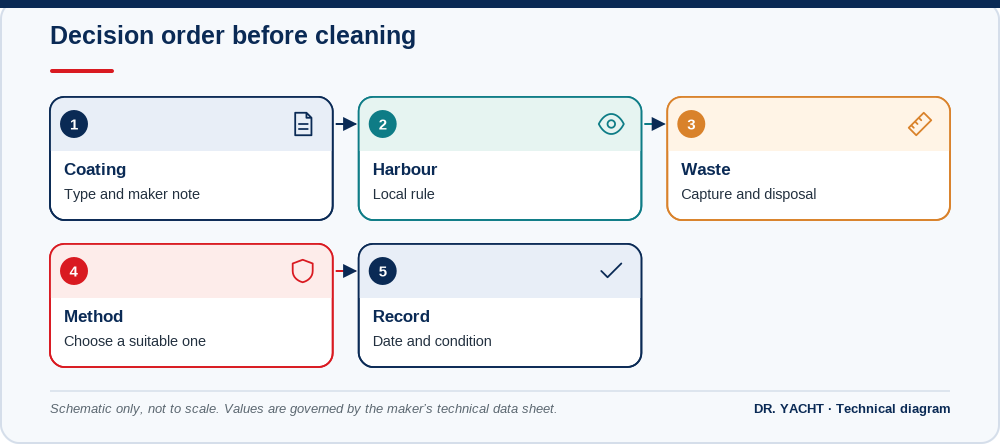
The first hull has light fouling and a hard biocidal coating. The questions here concern whether light, controlled care suits the coating, and the harbour's rule. The second hull has a biocide-free slippery coating. Here the maker's care note is decisive, because the logic of cleaning may differ. The third hull has established fouling. The questions here concern how the fouling will be removed and how the waste will be managed.
None of the three scenarios recommends a method, because the right choice depends on coating, fouling, harbour and local rule. When there is uncertainty, asking the maker and the harbour in writing and keeping the reply is general good practice.
6. Common misreadings#
The first misreading is to call in-water cleaning "harmless" or "always banned"; sources describe a picture that varies by method, coating and region. The second is to assume a method suits every coating. The third is to treat a document written for ship scale as a direct rule for a yacht.
The fourth is to neglect waste management; particles containing biocide can cause problems. The fifth is to think frequent, hard cleaning always protects the coating; excessive mechanical cleaning can wear it. The sixth is to put a retailer or forum account in place of maker and agency documents. The seventh is to neglect safety: gloves, eye protection and breathing protection are general good practice.
| Array | Array | Array | Array |
|---|
7. Records and later maintenance#
A short record after hull cleaning is useful: which date, which method, what fouling level and what coating condition? Such a record helps at the next maintenance and in correspondence with the maker. It is general good practice, not an obligation.
Finally, remember that most sources were written in a ship and public-policy context. For yacht scale it is reasonable to start from them and then verify with the maker's data sheet, the local harbour rule and the competent authority. This article does not replace that verification.
Frequently asked questions#
By which methods is a hull cleaned?
According to sources: by hand and brush, by water jet, by diver or remotely operated systems, and by shore washing. Each method has a different effect on the coating and different environmental consequences.
Does in-water cleaning damage antifouling coatings?
Sources say all in-water cleaning methods have the potential to damage coatings, but the effect varies by method and coating. The data sheet for your coating and technical service are the authority.
Why do some harbours not allow diver cleaning?
Organisms removed in cleaning and particles containing biocide can enter the water. This is linked to concerns about invasive species and water quality. Local harbour rules are the authority.
Is shore washing safer?
Shore washing can reduce some concerns because the wash water can be collected, but it requires waste management. For details the local rules and the coating data sheet are the authority.
Is this article an application instruction?
No. It recommends no method, time or product. The current data sheet, local rules and technical service are the authority.
Was this guide helpful?
Thank you! Your feedback has been saved.
Guide content is for general information; in practice, the current technical data sheet of the product applies.
Keep reading
Related guides
How to Read the Awlgrip Topcoat Technical Data Sheet: Solids, Dry Film, Cure Time
A data sheet is not a recipe card; it is a reference written for specific conditions. This article explains how to read the solids, dry film, wet film, coverage and cure lines, and where their limits lie.
13 min read Paint and CoatingsWet Edge and Speed in the Roll-and-Tip Method: The Logic Behind a Professional Finish
In roll-and-tip the result is often decided less by the product than by keeping the wet edge. This article explains how the edge line forms, what speed and division of work change, and where sources disagree.
13 min read Paint and CoatingsAwlgrip in Hot Weather: Fast Drying, Dry Spray and Choosing a Reducer
As temperature rises, solvent leaves quickly, paint pulls fast and the wet edge shortens. This article explains the logic of hot-weather problems, the reducer families the maker separates by temperature band, and their limits.
11 min read