
Refit and Maintenance
Haul-Out, Blocking and Hull Support
Afloat, a yacht is a structure that the water carries evenly at every point; ashore she rests on a few points. The first technical task of a refit is to make that transition without harming the hull.
Short answer
Haul-out is the removal of a yacht from the water by slings or cradle and her support ashore in an arrangement in which the keel blocks carry the weight and the side stands provide only stability. Slings and stands are positioned on structural members of the hull, and ground, load and duration ashore are considered together.
Key points
- Ashore the keel carries the weight; stands are stability elements, not load-bearing ones.
- Slings are placed on structural areas, clear of shafts, propellers, sensors and stabilisers.
- Stands are set at bulkheads and frames and chained together in pairs.
- During a long stay the supports are checked regularly; any change in hull shape is a warning sign.
From a floating structure to a seated one#
Afloat, a vessel is carried by buoyancy distributed over her whole wetted surface, and the hull is designed for that distributed load. When she is hauled out, the same weight is transferred to a few narrow points of contact. The change from distributed to point loading is one of the most unusual load cases a hull meets in its service life.
Methods of haul-out#
Three methods are common for yachts, and each loads the hull differently.
| Method | How it works | Point to watch |
|---|---|---|
| Travel lift | The yacht is suspended in two or more slings | Sling position and spacing |
| Slipway and rail | The yacht sits in a cradle drawn up on rails | Fit of the cradle to the hull form |
| Mobile crane | Single-point lift with a spreader beam | Length of spreader; slings must not squeeze the hull |
| Hydraulic trailer | The yacht is supported from below on adjustable arms | Pads must bear on structural areas |
Position of the slings#
Most builders indicate with small marks on the gunwale where the slings should lie. Where the marks are missing or worn away, the position is determined from the general arrangement plan and the underwater form. The basic rule is that slings should bear on structurally strong areas free of appendages.
The following should never lie under a sling: propeller shaft and bracket, propeller, rudder blade, stabiliser fins, speed and depth transducers, intake grilles and through-hull fittings. A sling bearing on any of these may bend the part or crack its seating in the hull. On motor yachts the aft sling is usually placed just forward of the shaft exit and the forward sling at the forward bulkhead; on sailing yachts the slings are placed ahead of and behind the fin keel.
The second concern is slipping. On hulls that rise markedly towards the bow, the forward sling tends to slide forwards. To prevent this the slings are tied together. The trim of the yacht is watched during the lift; if she hangs noticeably bow- or stern-down she is lowered and the slings are repositioned.
Who carries the load: blocks and stands#
The basic principle of support ashore is easily misunderstood: the weight of the yacht is carried by the blocks beneath the keel; side stands or cradle arms exist not to carry weight but to prevent her from toppling. Loading the stands forces the hull shell inwards.
Keel blocks are placed beneath the strongest parts of the keel so that the load is distributed evenly along it. On long-keeled vessels several rows of blocks are used along the keel. On fin-keeled sailing yachts most of the weight rests beneath the fin, and the condition of the hull-to-keel joint then takes on particular importance. On flat-bottomed motor yachts, or those without a pronounced keel, blocks are placed at the points recommended by the builder, generally beneath longitudinal girders and bulkheads.
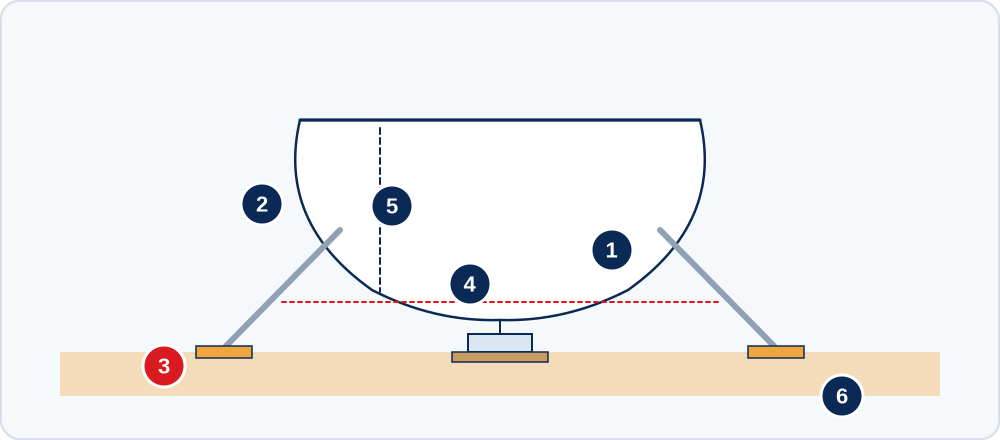
- Keel blocks: carry the weight of the yacht
- Side stands: provide stability only
- Stand pad: a timber pad that follows the hull form and spreads the load
- Cross chain: prevents the stands from spreading outwards
- Bulkhead position: the structural area against which the stand bears
- Compacted, load-bearing ground and base plates
Placing the stands#
Stands should bear on the hull as nearly perpendicular as possible and in line with structural members. The point where a bulkhead, frame or longitudinal lies on the inside is where the shell is stiffest. A stand placed on an unsupported panel between two structural members flexes the shell inwards, particularly on sandwich hulls, and can crush the core.
Ground and footing#
The least regarded component of the support arrangement is the ground. The ground beneath blocks and stands must carry the load without settling. Uncompacted fill, soil softened by rain and asphalt softened by heat all settle within weeks. Where settlement is uneven, the yacht leans and load shifts onto the stands.
Mast, wind and tent loads#
A yacht ashore has a far higher centre of gravity than afloat and lacks the damping the sea provides. On sailing yachts left with the mast stepped, wind loading increases markedly. In a long refit, unstepping the mast both relieves the support arrangement and simplifies rigging work.
A refit tent and staging also add to wind loading. The tent should be carried by independent staging, not by the yacht; a cover tied to the yacht works like a sail in the wind and can pull her off her stands. This subject is treated in the article on tenting and climate control.
Immediately after haul-out#
The moment the yacht leaves the water is the moment when most can be learned about the condition of the underwater hull. Marine growth is still soft and is easily removed with a pressure washer; once dry it becomes difficult to dislodge.
- Washing
The underwater hull is washed with fresh water under pressure before it dries.
- First observation
Blisters, the wear pattern of the antifouling, anode consumption and the condition of the propeller are photographed.
- Support check
Once the yacht has settled on her blocks, the stands are tightened and the chains tensioned.
- Shape check
Interior doors, drawers and hatches are checked for free opening and closing.
- Draining
Bilges, tanks and water circuits are drained according to the planned work.
- Record
Sling and stand positions are recorded with measurements and photographs.
The appearance of blisters in the first hours is particularly important; osmotic blisters may shrink and disappear as the hull dries. This observation forms part of the condition survey.
Monitoring hull shape#
A correctly supported yacht keeps ashore the shape she has afloat. The signs that the shape has altered are simple: an interior door that used to close freely begins to bind, a drawer will not open, a crack appears in the joint between deck and superstructure, or stiffness is felt when the shaft is turned by hand. When any of these signs is seen, the support arrangement should be reviewed and, if necessary, the load on blocks and stands redistributed.
The shaft line calls for particular attention in this respect. Engine-to-shaft alignment is set with the yacht afloat; because hull shape changes slightly ashore, an alignment carried out ashore may not hold afloat. Final alignment is therefore carried out after launching, once the yacht has been afloat for some time. Details are given in the article on engine room refits.
Conclusion#
Haul-out and support form the first step of a refit, invisible yet the one on which everything else is built. Taking the weight through the keel and stability through the stands, placing points of contact at structural positions and monitoring the ground and the shape of the hull ensure that all subsequent work is done on a true geometry.
How long can a yacht remain ashore?
Correctly supported fibreglass, steel and aluminium yachts can remain ashore for long periods. On wooden yachts a long stay dries out the planking and opens the seams, so it should be planned.
How are stands moved during painting?
One at a time. A stand is first placed and tightened in the new position, and only then is the old one removed. The stand is moved again once the area beneath it has received all coats of the system and has cured sufficiently.
Can shaft alignment be set ashore?
A preliminary setting can be made, but final alignment should be carried out after launching, once the hull has taken up its own shape afloat.
Was this guide helpful?
Thank you! Your feedback has been saved.
Guide content is for general information; in practice, the current technical data sheet of the product applies.
Keep reading
Related guides
Tank Inspection, Maintenance and Repair: Holiday Testing, Thickness Measurement and Records
Inspection, thickness measurement, holiday testing, repair approaches and records for steel boat tanks, summarised from source accounts with their limits.
10 min read Refit and MaintenanceGrey Water, Black Water and Shower Tanks: Corrosion, Lining and Design
Why grey, black and shower tanks on steel boats corrode, what an internal lining does and design details, summarised from source accounts.
11 min read Refit and MaintenanceDrinking-Water Tank Epoxy Lining: Selection, Stripe Coat, Cure and Disinfection
Product documents, stripe coat, cure, flushing and disinfection steps in epoxy lining of drinking-water tanks, summarised from source accounts with their limits.
11 min read