
Refit and Maintenance
Building a Refit Budget: Cost Items and Contingency
A refit budget is not a price but a model: it expresses in figures what will be done, how much of it, to what quality and with what uncertainty. A budget without a model loses its meaning at the first surprise.
Short answer
A refit budget consists of labour, materials, yard and site costs, equipment and spare parts, subcontracted services and a contingency. A sound budget is built from the bottom up by assigning a quantity and unit cost to every work package in a breakdown based on the condition survey, and it includes a separate allowance for work that only becomes visible on opening up.
Key points
- The budget is built from the bottom up by pricing every package in the work breakdown by quantity and unit cost.
- Labour is the largest item in most refits, and preparation labour is decisive.
- The contingency is not a precaution but a predictable item arising from the nature of the work.
- Quotations should be compared by scope, product system and acceptance criteria, not by total price.
The function of the budget#
A refit budget is often reduced to a single question: “How much will it cost?” Yet its real function is not to answer that question but to make decisions possible throughout the project. A well-built budget shows what an additional job will cost, which item can be removed if the scope must be reduced and where spending stands in relation to the plan.
Bottom-up budgeting#
A refit budget can be built in two ways. In the top-down method a total is estimated by reference to work on similar vessels; it is quick but does not reflect the condition of the particular yacht. In the bottom-up method every package in the work breakdown is priced separately and the total emerges as their sum. The second method is more laborious, but its result is a budget that can be defended and tracked.
Cost items#
A refit budget is grouped under six main headings.
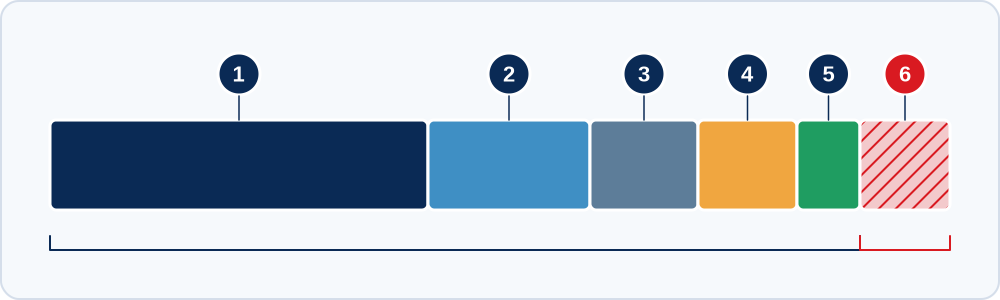
- Labour: preparation, application, removal and refitting
- Materials: resin, filler, primer, paint, consumables
- Yard and site: haul-out, hardstanding, staging, tent, power
- Equipment and spares: machinery parts, fittings, electronics
- Subcontract and specialist services: measurement, engineering, custom fabrication
- Contingency: work revealed after dismantling
Labour#
In almost every refit the largest item is labour. The reason is that a good result depends largely on preparation, and preparation is manual work. In a polyurethane paint job most of the labour goes not into applying the topcoat but into removal, masking, filling and sanding between coats. Savings obtained by reducing labour are therefore almost always taken from preparation, and they shorten the life of the result.
Materials#
Material cost depends on the choice of product system and on surface area. The point to watch in the calculation is the difference between the theoretical coverage in the data sheet and actual consumption on site. Overspray, product left in the can, material discarded when its pot life expires and surface roughness all increase real consumption. Consumables should also appear as a separate line: abrasives, masking tape, sheeting, filters, gloves and coveralls together make up a far from negligible sum.
Yard and site costs#
Haul-out and launch, time on the hardstanding, erection of staging and tent, electricity, water and waste disposal fall under this heading. Some of these costs are proportional to time, so every delay in the schedule is also reflected in the budget. This relationship shows why schedule and budget must be considered together.
Equipment and spare parts#
Machinery parts, pumps, valves, electrical materials, deck hardware and electronic equipment belong here. Their prices are often sensitive to exchange rates and lead times, which is why a quotation should state its period of validity.
Subcontract and specialist services#
These are services bought in by the main contractor, such as ultrasonic gauging, engineering calculations, custom casting and machining, upholstery and glazing. Their scope and responsibility should be defined explicitly in the contract.
The contingency#
The most distinctive item in a refit budget is the contingency. In new construction what is to be done is known from drawings; in a refit, what lies beneath a coating, behind joinery or inside a tank is seen only when it is opened. This uncertainty is not a fault but a structural feature of the work.
The size of the contingency depends on three factors: the depth of the condition survey, the age and maintenance history of the yacht and the amount of dismantling the work involves. On a vessel that has been measured in detail and whose maintenance records are complete, the allowance can be kept small; on one of unknown history that has long been neglected, it grows markedly. Common practice in project management is to show this allowance on a separate line as a percentage of the total budget, the figure being agreed between contractor and owner in the light of the findings.
Fixed price or time and materials?#
Refit work is carried out under two basic pricing models, each suited to a different situation.
| Criterion | Fixed price | Time and materials |
|---|---|---|
| Suitable for | Work with a clear, measured scope | Work whose scope emerges after dismantling |
| Who bears the risk | Mainly the contractor | Mainly the owner |
| Transparency | Focused on the result | Focused on expenditure; requires records |
| Typical example | Topside paint, antifouling | Structural repair, removal of old plumbing |
| Point to watch | Exclusions | A ceiling figure and weekly reporting |
Comparing quotations#
Placing the totals of two quotations side by side is the least informative way of comparing them. The difference between two quotations for the same yacht usually stems not from price but from scope: one includes removal of hardware, the other settles for masking; one allows for three topcoats, the other for two.
Payment plan and progress#
The payment plan is the instrument that ties the budget to the schedule. With calendar-based payments, sums fall due on fixed dates; with progress-based payments, completed and accepted stages are the basis. The second method is more balanced for both parties: the contractor is paid for work completed, and the owner sees on the yacht what the payment has bought. The acceptance criteria of the stages should be defined in the contract.
Tracking the budget during the project#
A budget is not a document completed when the contract is signed but a tool that is updated throughout the project. Tracking rests on keeping three values side by side for each work package: the planned sum, the expenditure incurred to date and the estimated sum still needed to complete the job. Comparing planned with actual alone is misleading; a work package may have spent half its budget while completing only a third of the work.
Economic assessment#
Once the budget is known, the final question is whether the expenditure makes sense. The answer rests on comparing three values: the total cost of the refit, the market value of the yacht afterwards and the period of use the refit will provide. Refit cost is not always reflected in resale value; structural and protective work makes a yacht saleable without raising her value in proportion. The assessment should therefore be made not only in terms of return on investment but also in terms of years of safe and trouble-free use.
Conclusion#
A refit budget is the financial expression of the work breakdown and should be just as detailed. Seeing the six items separately, defining the contingency openly and comparing quotations by scope turn the budget from an estimate into a management tool.
Can an average price per metre be given for a refit?
Not reliably. Two yachts of the same length may differ greatly in condition, material and required scope. A realistic figure can only be calculated after the condition survey and work breakdown.
What happens if the contingency is not used?
The allowance belongs to the owner; any unused part is not invoiced. Every use of it should be supported by a written finding and approval.
Why can choosing the lowest quotation be risky?
A low price often means a narrower scope, less preparation or fewer coats. Quotations should be compared by scope, product system and acceptance criteria rather than by total.
Was this guide helpful?
Thank you! Your feedback has been saved.
Guide content is for general information; in practice, the current technical data sheet of the product applies.
Keep reading
Related guides
Tank Inspection, Maintenance and Repair: Holiday Testing, Thickness Measurement and Records
Inspection, thickness measurement, holiday testing, repair approaches and records for steel boat tanks, summarised from source accounts with their limits.
10 min read Refit and MaintenanceGrey Water, Black Water and Shower Tanks: Corrosion, Lining and Design
Why grey, black and shower tanks on steel boats corrode, what an internal lining does and design details, summarised from source accounts.
11 min read Refit and MaintenanceDrinking-Water Tank Epoxy Lining: Selection, Stripe Coat, Cure and Disinfection
Product documents, stripe coat, cure, flushing and disinfection steps in epoxy lining of drinking-water tanks, summarised from source accounts with their limits.
11 min read