
Refit and Maintenance
Work Breakdown and Scheduling in a Refit Project
Most delays in a refit arise not because work is done slowly but because jobs wait on one another. A good schedule shows in advance which job is waiting for which.
Short answer
In a refit project the work breakdown divides the total job into measurable items by zone and discipline; the schedule then orders those items according to their dependencies, their curing and drying times and the working conditions they need. The sequence runs from structure to surface and from dirty work to clean work.
Key points
- The work breakdown turns scope into items that can be measured and priced.
- Dependencies are of three kinds: technical, spatial and environmental.
- Curing, drying and procurement times are invisible but decisive lines in the schedule.
- Every delay to a job on the critical path passes straight through to the delivery date.
The place of planning in a refit#
A yacht consists of a large number of systems compressed into a limited volume. Behind a single lining panel, plumbing, cables, insulation and structure lie together. This density is what distinguishes a refit from the renovation of a building: for one tradesman to work, another must usually have finished or not yet begun. Planning is the task of making that mutual dependence visible and managing it.
Building the work breakdown#
Starting from the findings of the condition survey report, the work breakdown divides the total job into a hierarchy. At the top is the vessel; below her the zones; beneath the zones the disciplines; and at the lowest level the work packages that one team can complete in one period.
| Zone | Discipline | Work package |
|---|---|---|
| Underwater hull | Coating removal | Removal of antifouling and old primer |
| Underwater hull | Laminate | Opening of blisters, monitoring of drying |
| Underwater hull | Coating | Epoxy barrier, tie coat, antifouling |
| Topsides | Fairing | Filler, long-board sanding |
| Topsides | Paint | Primer, intercoat sanding, topcoat |
| Deck | Joinery | Teak removal, substrate repair, new decking |
| Engine room | Mechanical | Shaft removal, bearing renewal, alignment |
Types of dependency#
Three kinds of dependency are considered when sequencing work.
Technical dependency#
One job cannot physically begin until another is finished. Filler is not applied to an unprimed surface; topcoat is not applied before the primer has cured; a shaft is not aligned before its bearing is fitted. These dependencies derive from product data sheets and engineering logic and cannot be relaxed.
Spatial dependency#
Two jobs may be technically independent yet impossible to carry out in the same space at the same time. Cables are not pulled in a compartment where welding is in progress; a paint team does not work beneath a team sanding on the staging above. Spatial dependencies are the kind most often overlooked in planning.
Environmental dependency#
The conditions created by one job spoil another. Blasting and grinding produce dust, and dust is the principal enemy of a wet paint film. The heat of welding burns the coating on the reverse face of the plate. Dirty jobs are therefore grouped, completed and cleaned up before clean work begins.
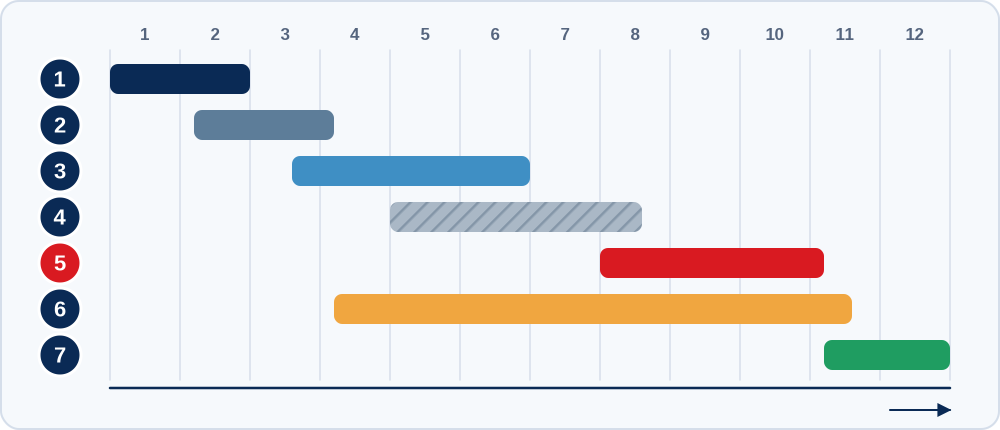
- Condition survey, scope and procurement orders
- Haul-out, removal and protection
- Structural work: laminate, plating, timber
- Drying and waiting times
- Fairing, primer and topcoat
- Machinery, electrics and plumbing
- Reassembly, launch and trials
The invisible lines of the schedule#
An inexperienced plan lists only the jobs that require labour. Yet a considerable part of a refit schedule consists of periods in which nobody is working but the job is progressing.
Drying and curing times come first. In an osmosis treatment the drying of the laminate takes weeks, sometimes months, and can be accelerated only to a limited degree. The overcoating intervals of epoxy fillers and primers depend on temperature; at low temperatures they lengthen markedly. There is also a difference measured in days between the moment a polyurethane topcoat can be taped and the moment it is fully cured.
The second invisible line is procurement. Custom glazing, imported machinery parts, propellers cast to order and specially mixed paint colours can take weeks to arrive. These items should enter the plan not on the date the work will be done but on the date the order must be placed.
The third is weather. For paint work in the open, surface temperature, relative humidity and dew point define the application window. This risk is reduced by tenting and climate control but never eliminated; the schedule should include a weather allowance.
The concept of the critical path#
In project management the critical path is the longest chain of dependent jobs from start to finish, and it determines the total duration. A delay of one day to a job on that chain moves the delivery date by one day; jobs outside the chain have a certain amount of float.
Basic rules of sequencing#
Details vary between vessels, but the following logic holds for almost every refit.
- Removal first
Hardware, fittings and parts that cannot be protected are removed, labelled and stored. Parts left in place are masked.
- Dirty work first
Jobs that generate dust and sparks, such as blasting, grinding, welding and cutting laminate, are completed together.
- Structure first
Laminate, plating and timber repairs are finished and verified before coating.
- Then fairing and primer
The surface form is established and sealed with primer coats.
- Then systems
Plumbing and wiring are completed and tested before linings are closed up.
- Surfaces last
Topcoat, varnish and interior finishes are applied after heavy work is finished.
- Reassembly and trials
Hardware is refitted on fresh sealant and systems are tested.
Resource planning and balancing the teams#
A schedule shows not only the order of the jobs but also the load on the people and equipment that will carry them out. In a refit, trades are not interchangeable: a laminator does not spray paint, and a painter does not weld. Planning therefore examines the weekly load of each discipline separately. If paint work coincides in three zones in one week and the paint team stands idle for the following two, the plan is correct on paper and unworkable in the yard.
Managing change#
No refit plan reaches completion in its original form. Findings after dismantling, new requests from the owner and procurement delays all alter it. What matters is not that change occurs but how it is managed. In a sound procedure every additional job is defined in writing, its effect on time and budget is stated and it is not started without approval. A shift in the delivery date thus becomes a consequence whose origin is known.
A short weekly status report is enough to monitor the plan: work packages completed, in progress and waiting, with the reason for waiting. Supported by photographs and measurement records, such a report allows the owner to follow the project remotely.
At DR. YACHT a zone-based work plan is prepared for every refit and shared with the owner; stages are tracked with photographs and measurement records. The general outline of how we work is given on our process page.
Conclusion#
The work breakdown and the schedule convert the technical knowledge of a refit into organisational discipline. Dividing the work into measurable packages, defining dependencies of all three kinds and writing waiting times explicitly into the plan make both time and cost predictable. The financial expression of the plan, namely how the budget is built, is the subject of the next article.
What most lengthens a refit schedule?
In most projects, additional work revealed after dismantling, long procurement lead times and the drying time of the laminate. All three can be managed by allowing for them in the plan from the start.
Does adding more labour speed up the work?
Only on jobs that lie on the critical path and that several teams can work on at once. Curing and drying times are independent of the number of people.
Why is painting left until last?
A wet or freshly cured paint film is vulnerable to dust, impact and chemicals. A topcoat applied before heavy work is finished will be damaged by later trades and will have to be redone.
Was this guide helpful?
Thank you! Your feedback has been saved.
Guide content is for general information; in practice, the current technical data sheet of the product applies.
Keep reading
Related guides
Tank Inspection, Maintenance and Repair: Holiday Testing, Thickness Measurement and Records
Inspection, thickness measurement, holiday testing, repair approaches and records for steel boat tanks, summarised from source accounts with their limits.
10 min read Refit and MaintenanceGrey Water, Black Water and Shower Tanks: Corrosion, Lining and Design
Why grey, black and shower tanks on steel boats corrode, what an internal lining does and design details, summarised from source accounts.
11 min read Refit and MaintenanceDrinking-Water Tank Epoxy Lining: Selection, Stripe Coat, Cure and Disinfection
Product documents, stripe coat, cure, flushing and disinfection steps in epoxy lining of drinking-water tanks, summarised from source accounts with their limits.
11 min read